
Read page 1 text
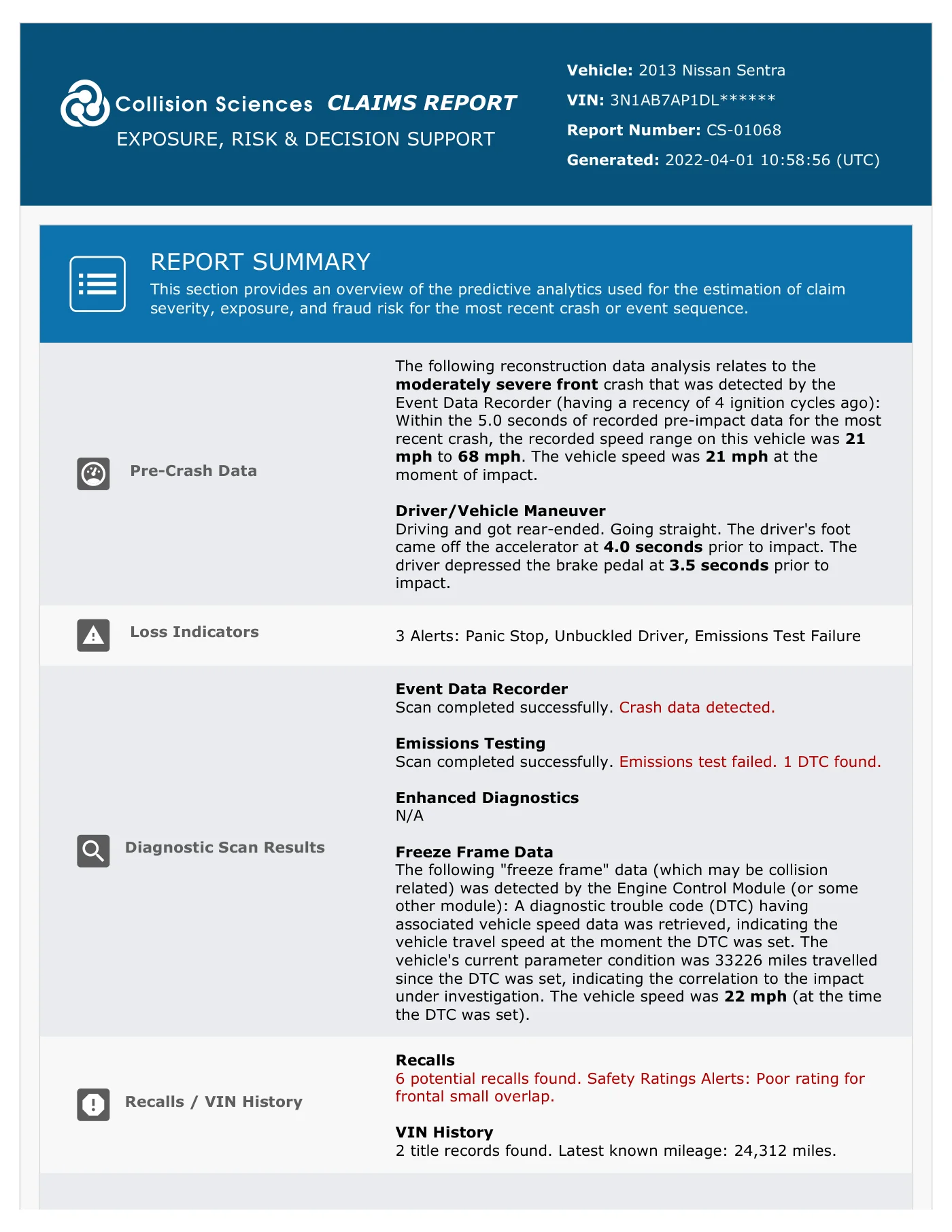
REPORT SUMMARY This section provides an overview of the predictive analytics used for the estimation of claim severity, exposure, and fraud risk for the most recent crash or event sequence. Pre-Crash Data The following reconstruction data analysis relates to the moderately severe front crash that was detected by the Event Data Recorder (having a recency of 4 ignition cycles ago): Within the 5.0 seconds of recorded pre-impact data for the most recent crash, the recorded speed range on this vehicle was 21 mph to 68 mph. The vehicle speed was 21 mph at the moment of impact. Driver/Vehicle Maneuver Driving and got rear-ended. Going straight. The driver's foot came off the accelerator at 4.0 seconds prior to impact. The driver depressed the brake pedal at 3.5 seconds prior to impact. Loss Indicators 3 Alerts: Panic Stop, Unbuckled Driver, Emissions Test Failure Diagnostic Scan Results Event Data Recorder Scan completed successfully. Crash data detected. Emissions Testing Scan completed successfully. Emissions test failed. 1 DTC found. Enhanced Diagnostics N/A Freeze Frame Data The following "freeze frame" data (which may be collision related) was detected by the Engine Control Module (or some other module): A diagnostic trouble code (DTC) having associated vehicle speed data was retrieved, indicating the vehicle travel speed at the moment the DTC was set. The vehicle's current parameter condition was 33226 miles travelled since the DTC was set, indicating the correlation to the impact under investigation. The vehicle speed was 22 mph (at the time the DTC was set). Recalls / VIN History Recalls 6 potential recalls found. Safety Ratings Alerts: Poor rating for frontal small overlap. VIN History 2 title records found. Latest known mileage: 24,312 miles. CLAIMS REPORT EXPOSURE, RISK & DECISION SUPPORT Vehicle: 2013 Nissan Sentra VIN: 3N1AB7AP1DL****** Report Number: CS-01068 Generated: 2022-04-01 10:58:56 (UTC)
Read page 2 text
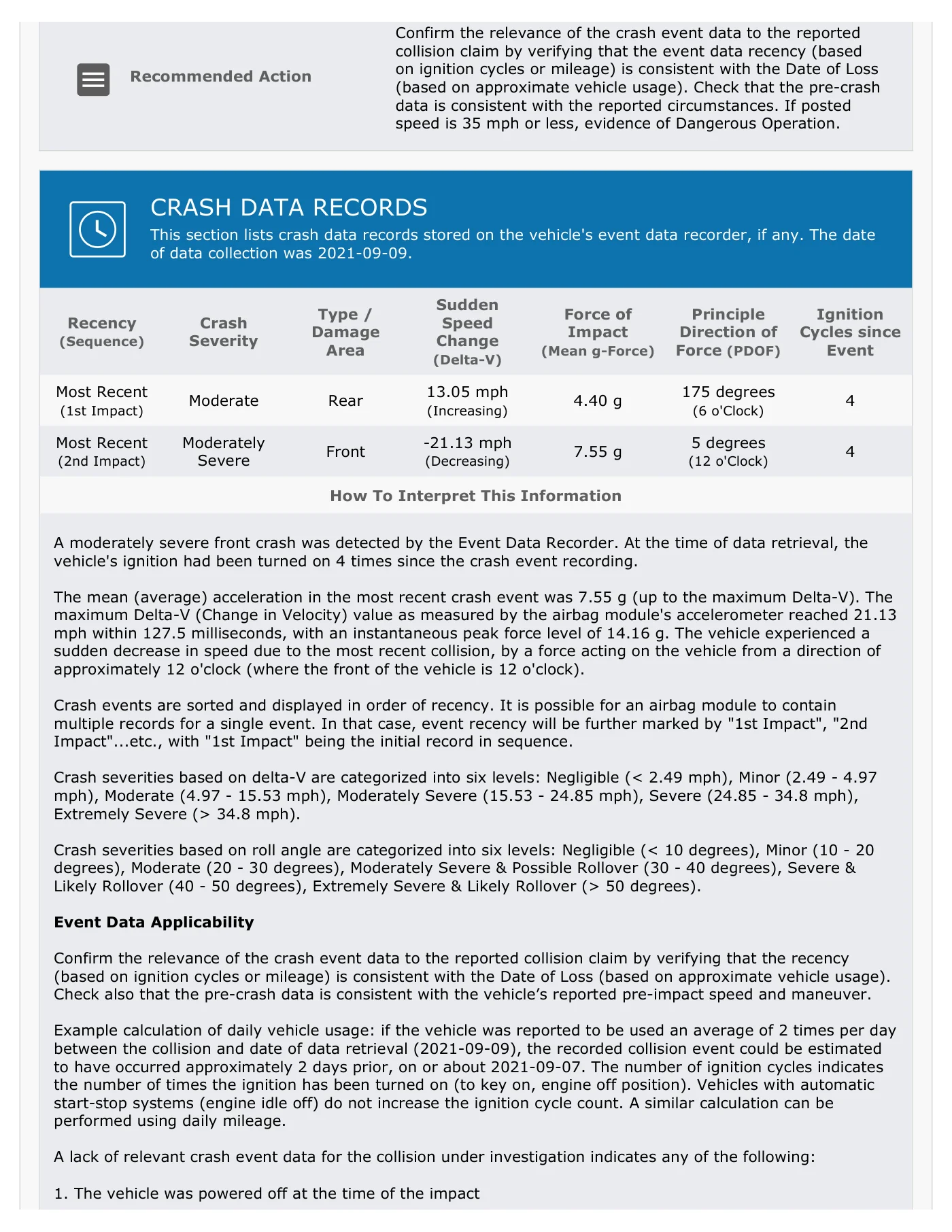
Recommended Action Confirm the relevance of the crash event data to the reported collision claim by verifying that the event data recency (based on ignition cycles or mileage) is consistent with the Date of Loss (based on approximate vehicle usage). Check that the pre-crash data is consistent with the reported circumstances. If posted speed is 35 mph or less, evidence of Dangerous Operation. CRASH DATA RECORDS This section lists crash data records stored on the vehicle's event data recorder, if any. The date of data collection was 2021-09-09. Recency (Sequence) Crash Severity Type / Damage Area Sudden Speed Change (Delta-V) Force of Impact (Mean g-Force) Principle Direction of Force (PDOF) Ignition Cycles since Event Most Recent (1st Impact) Moderate Rear 13.05 mph (Increasing) 4.40 g 175 degrees (6 o'Clock) 4 Most Recent (2nd Impact) Moderately Severe Front -21.13 mph (Decreasing) 7.55 g 5 degrees (12 o'Clock) 4 How To Interpret This Information A moderately severe front crash was detected by the Event Data Recorder. At the time of data retrieval, the vehicle's ignition had been turned on 4 times since the crash event recording. The mean (average) acceleration in the most recent crash event was 7.55 g (up to the maximum Delta-V). The maximum Delta-V (Change in Velocity) value as measured by the airbag module's accelerometer reached 21.13 mph within 127.5 milliseconds, with an instantaneous peak force level of 14.16 g. The vehicle experienced a sudden decrease in speed due to the most recent collision, by a force acting on the vehicle from a direction of approximately 12 o'clock (where the front of the vehicle is 12 o'clock). Crash events are sorted and displayed in order of recency. It is possible for an airbag module to contain multiple records for a single event. In that case, event recency will be further marked by "1st Impact", "2nd Impact"...etc., with "1st Impact" being the initial record in sequence. Crash severities based on delta-V are categorized into six levels: Negligible (< 2.49 mph), Minor (2.49 - 4.97 mph), Moderate (4.97 - 15.53 mph), Moderately Severe (15.53 - 24.85 mph), Severe (24.85 - 34.8 mph), Extremely Severe (> 34.8 mph). Crash severities based on roll angle are categorized into six levels: Negligible (< 10 degrees), Minor (10 - 20 degrees), Moderate (20 - 30 degrees), Moderately Severe & Possible Rollover (30 - 40 degrees), Severe & Likely Rollover (40 - 50 degrees), Extremely Severe & Likely Rollover (> 50 degrees). Event Data Applicability Confirm the relevance of the crash event data to the reported collision claim by verifying that the recency (based on ignition cycles or mileage) is consistent with the Date of Loss (based on approximate vehicle usage). Check also that the pre-crash data is consistent with the vehicle’s reported pre-impact speed and maneuver. Example calculation of daily vehicle usage: if the vehicle was reported to be used an average of 2 times per day between the collision and date of data retrieval (2021-09-09), the recorded collision event could be estimated to have occurred approximately 2 days prior, on or about 2021-09-07. The number of ignition cycles indicates the number of times the ignition has been turned on (to key on, engine off position). Vehicles with automatic start-stop systems (engine idle off) do not increase the ignition cycle count. A similar calculation can be performed using daily mileage. A lack of relevant crash event data for the collision under investigation indicates any of the following: 1. The vehicle was powered off at the time of the impact
Read page 3 text
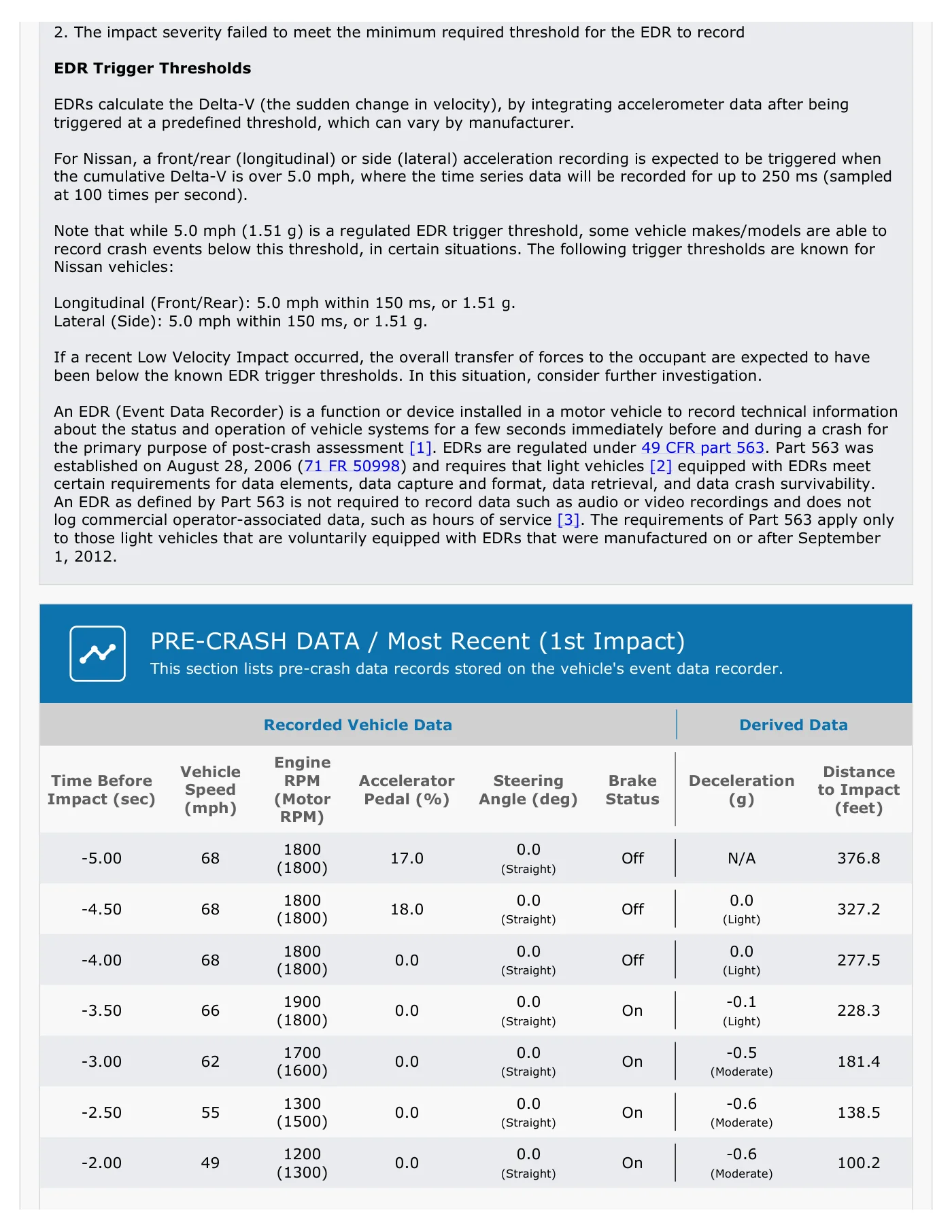
2. The impact severity failed to meet the minimum required threshold for the EDR to record EDR Trigger Thresholds EDRs calculate the Delta-V (the sudden change in velocity), by integrating accelerometer data after being triggered at a predefined threshold, which can vary by manufacturer. For Nissan, a front/rear (longitudinal) or side (lateral) acceleration recording is expected to be triggered when the cumulative Delta-V is over 5.0 mph, where the time series data will be recorded for up to 250 ms (sampled at 100 times per second). Note that while 5.0 mph (1.51 g) is a regulated EDR trigger threshold, some vehicle makes/models are able to record crash events below this threshold, in certain situations. The following trigger thresholds are known for Nissan vehicles: Longitudinal (Front/Rear): 5.0 mph within 150 ms, or 1.51 g. Lateral (Side): 5.0 mph within 150 ms, or 1.51 g. If a recent Low Velocity Impact occurred, the overall transfer of forces to the occupant are expected to have been below the known EDR trigger thresholds. In this situation, consider further investigation. An EDR (Event Data Recorder) is a function or device installed in a motor vehicle to record technical information about the status and operation of vehicle systems for a few seconds immediately before and during a crash for the primary purpose of post-crash assessment [1]. EDRs are regulated under 49 CFR part 563. Part 563 was established on August 28, 2006 (71 FR 50998) and requires that light vehicles [2] equipped with EDRs meet certain requirements for data elements, data capture and format, data retrieval, and data crash survivability. An EDR as defined by Part 563 is not required to record data such as audio or video recordings and does not log commercial operator-associated data, such as hours of service [3]. The requirements of Part 563 apply only to those light vehicles that are voluntarily equipped with EDRs that were manufactured on or after September 1, 2012. PRE-CRASH DATA / Most Recent (1st Impact) This section lists pre-crash data records stored on the vehicle's event data recorder. Recorded Vehicle Data Derived Data Time Before Impact (sec) Vehicle Speed (mph) Engine RPM (Motor RPM) Accelerator Pedal (%) Steering Angle (deg) Brake Status Deceleration (g) Distance to Impact (feet) -5.00 68 1800 (1800) 17.0 0.0 (Straight) Off N/A 376.8 -4.50 68 1800 (1800) 18.0 0.0 (Straight) Off 0.0 (Light) 327.2 -4.00 68 1800 (1800) 0.0 0.0 (Straight) Off 0.0 (Light) 277.5 -3.50 66 1900 (1800) 0.0 0.0 (Straight) On -0.1 (Light) 228.3 -3.00 62 1700 (1600) 0.0 0.0 (Straight) On -0.5 (Moderate) 181.4 -2.50 55 1300 (1500) 0.0 0.0 (Straight) On -0.6 (Moderate) 138.5 -2.00 49 1200 (1300) 0.0 0.0 (Straight) On -0.6 (Moderate) 100.2
Read page 4 text
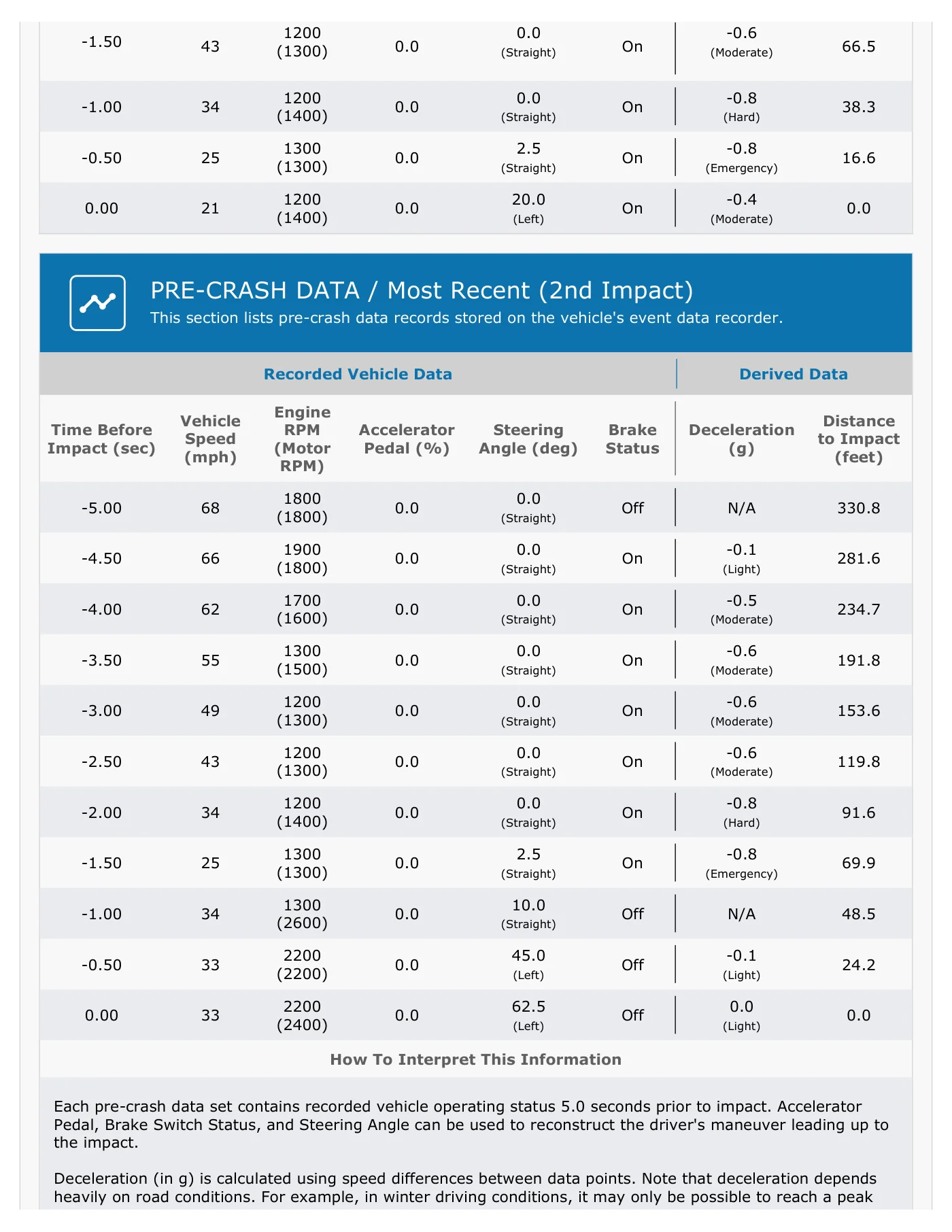
-1.50 43 1200 (1300) 0.0 0.0 (Straight) On -0.6 (Moderate) 66.5 -1.00 34 1200 (1400) 0.0 0.0 (Straight) On -0.8 (Hard) 38.3 -0.50 25 1300 (1300) 0.0 2.5 (Straight) On -0.8 (Emergency) 16.6 0.00 21 1200 (1400) 0.0 20.0 (Left) On -0.4 (Moderate) 0.0 PRE-CRASH DATA / Most Recent (2nd Impact) This section lists pre-crash data records stored on the vehicle's event data recorder. Recorded Vehicle Data Derived Data Time Before Impact (sec) Vehicle Speed (mph) Engine RPM (Motor RPM) Accelerator Pedal (%) Steering Angle (deg) Brake Status Deceleration (g) Distance to Impact (feet) -5.00 68 1800 (1800) 0.0 0.0 (Straight) Off N/A 330.8 -4.50 66 1900 (1800) 0.0 0.0 (Straight) On -0.1 (Light) 281.6 -4.00 62 1700 (1600) 0.0 0.0 (Straight) On -0.5 (Moderate) 234.7 -3.50 55 1300 (1500) 0.0 0.0 (Straight) On -0.6 (Moderate) 191.8 -3.00 49 1200 (1300) 0.0 0.0 (Straight) On -0.6 (Moderate) 153.6 -2.50 43 1200 (1300) 0.0 0.0 (Straight) On -0.6 (Moderate) 119.8 -2.00 34 1200 (1400) 0.0 0.0 (Straight) On -0.8 (Hard) 91.6 -1.50 25 1300 (1300) 0.0 2.5 (Straight) On -0.8 (Emergency) 69.9 -1.00 34 1300 (2600) 0.0 10.0 (Straight) Off N/A 48.5 -0.50 33 2200 (2200) 0.0 45.0 (Left) Off -0.1 (Light) 24.2 0.00 33 2200 (2400) 0.0 62.5 (Left) Off 0.0 (Light) 0.0 How To Interpret This Information Each pre-crash data set contains recorded vehicle operating status 5.0 seconds prior to impact. Accelerator Pedal, Brake Switch Status, and Steering Angle can be used to reconstruct the driver's maneuver leading up to the impact. Deceleration (in g) is calculated using speed differences between data points. Note that deceleration depends heavily on road conditions. For example, in winter driving conditions, it may only be possible to reach a peak
Read page 5 text
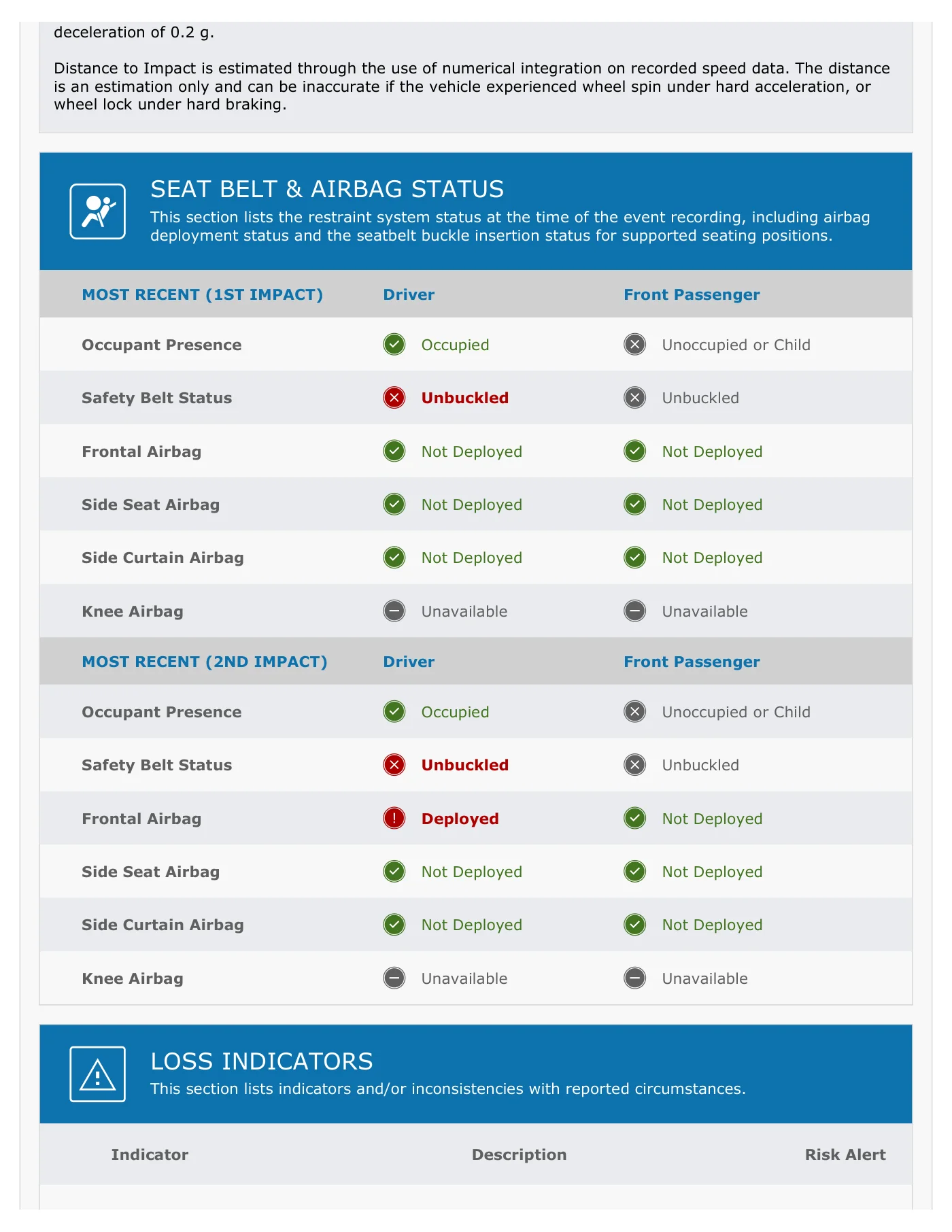
deceleration of 0.2 g. Distance to Impact is estimated through the use of numerical integration on recorded speed data. The distance is an estimation only and can be inaccurate if the vehicle experienced wheel spin under hard acceleration, or wheel lock under hard braking. SEAT BELT & AIRBAG STATUS This section lists the restraint system status at the time of the event recording, including airbag deployment status and the seatbelt buckle insertion status for supported seating positions. MOST RECENT (1ST IMPACT) Driver Front Passenger Occupant Presence Occupied Unoccupied or Child Safety Belt Status Unbuckled Unbuckled Frontal Airbag Not Deployed Not Deployed Side Seat Airbag Not Deployed Not Deployed Side Curtain Airbag Not Deployed Not Deployed Knee Airbag Unavailable Unavailable MOST RECENT (2ND IMPACT) Driver Front Passenger Occupant Presence Occupied Unoccupied or Child Safety Belt Status Unbuckled Unbuckled Frontal Airbag Deployed Not Deployed Side Seat Airbag Not Deployed Not Deployed Side Curtain Airbag Not Deployed Not Deployed Knee Airbag Unavailable Unavailable LOSS INDICATORS This section lists indicators and/or inconsistencies with reported circumstances. Indicator Description Risk Alert
Read page 6 text
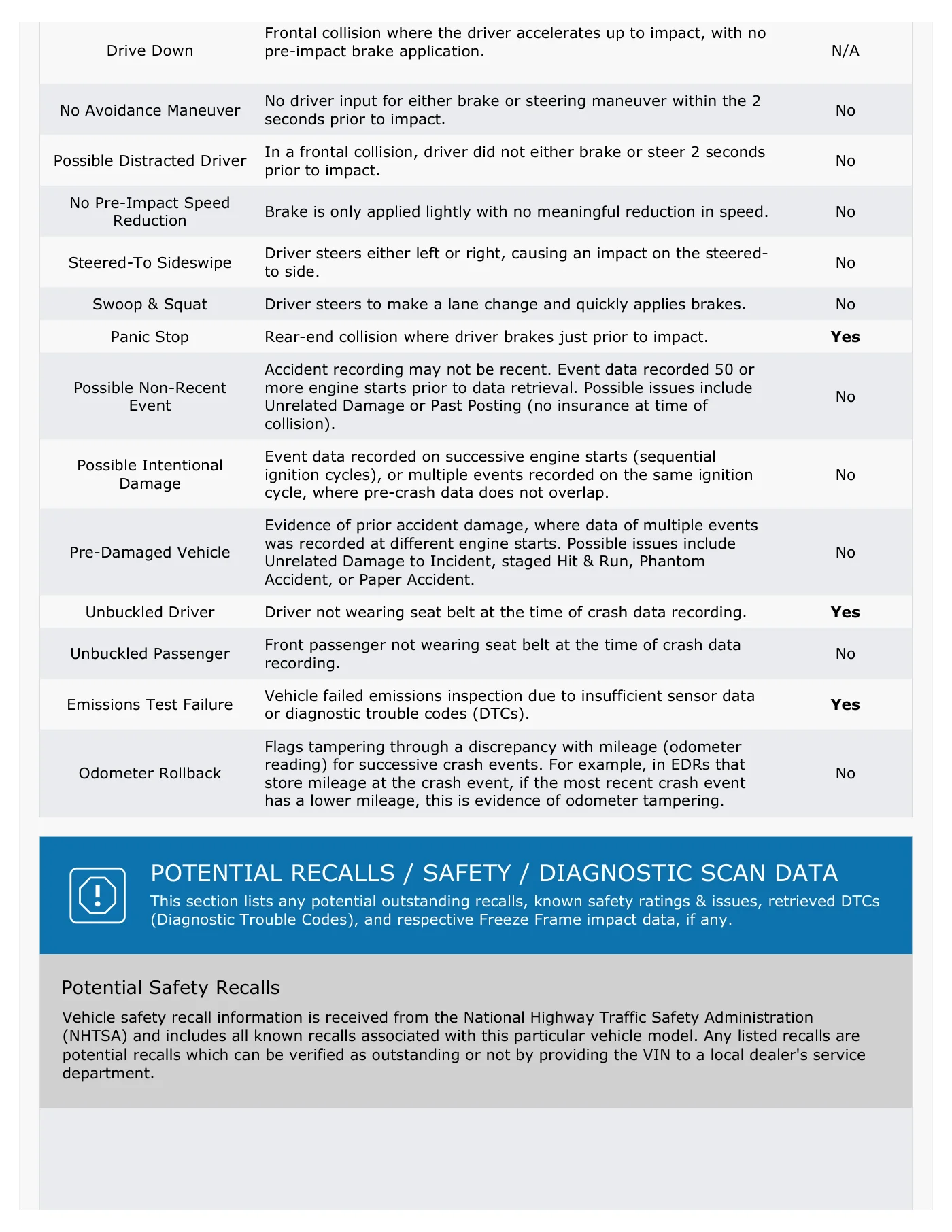
Drive Down Frontal collision where the driver accelerates up to impact, with no pre-impact brake application. N/A No Avoidance Maneuver No driver input for either brake or steering maneuver within the 2 seconds prior to impact. No Possible Distracted Driver In a frontal collision, driver did not either brake or steer 2 seconds prior to impact. No No Pre-Impact Speed Reduction Brake is only applied lightly with no meaningful reduction in speed. No Steered-To Sideswipe Driver steers either left or right, causing an impact on the steered- to side. No Swoop & Squat Driver steers to make a lane change and quickly applies brakes. No Panic Stop Rear-end collision where driver brakes just prior to impact. Yes Possible Non-Recent Event Accident recording may not be recent. Event data recorded 50 or more engine starts prior to data retrieval. Possible issues include Unrelated Damage or Past Posting (no insurance at time of collision). No Possible Intentional Damage Event data recorded on successive engine starts (sequential ignition cycles), or multiple events recorded on the same ignition cycle, where pre-crash data does not overlap. No Pre-Damaged Vehicle Evidence of prior accident damage, where data of multiple events was recorded at different engine starts. Possible issues include Unrelated Damage to Incident, staged Hit & Run, Phantom Accident, or Paper Accident. No Unbuckled Driver Driver not wearing seat belt at the time of crash data recording. Yes Unbuckled Passenger Front passenger not wearing seat belt at the time of crash data recording. No Emissions Test Failure Vehicle failed emissions inspection due to insufficient sensor data or diagnostic trouble codes (DTCs). Yes Odometer Rollback Flags tampering through a discrepancy with mileage (odometer reading) for successive crash events. For example, in EDRs that store mileage at the crash event, if the most recent crash event has a lower mileage, this is evidence of odometer tampering. No POTENTIAL RECALLS / SAFETY / DIAGNOSTIC SCAN DATA This section lists any potential outstanding recalls, known safety ratings & issues, retrieved DTCs (Diagnostic Trouble Codes), and respective Freeze Frame impact data, if any. Potential Safety Recalls Vehicle safety recall information is received from the National Highway Traffic Safety Administration (NHTSA) and includes all known recalls associated with this particular vehicle model. Any listed recalls are potential recalls which can be verified as outstanding or not by providing the VIN to a local dealer's service department.
Read page 7 text
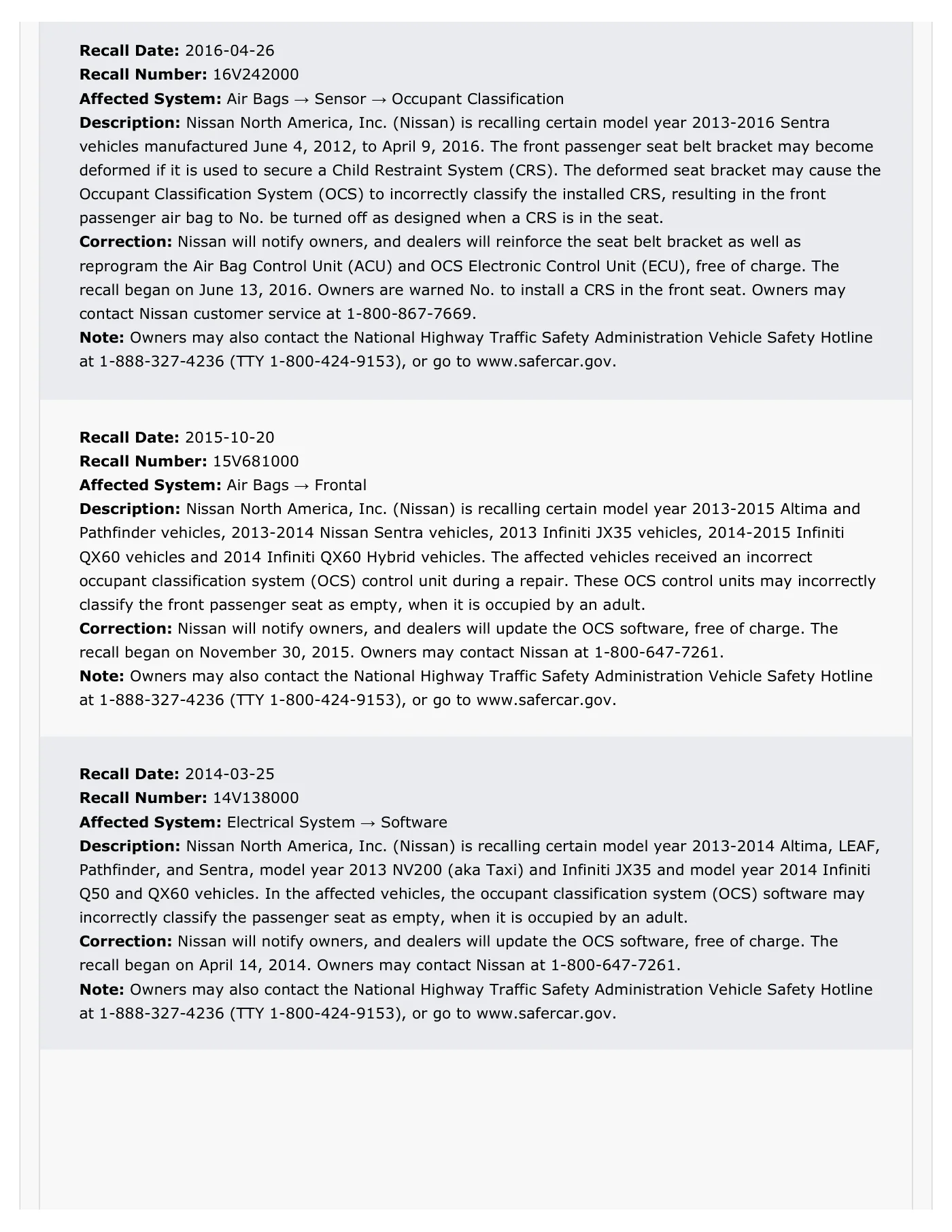
Recall Date: 2016-04-26 Recall Number: 16V242000 Affected System: Air Bags → Sensor → Occupant Classification Description: Nissan North America, Inc. (Nissan) is recalling certain model year 2013-2016 Sentra vehicles manufactured June 4, 2012, to April 9, 2016. The front passenger seat belt bracket may become deformed if it is used to secure a Child Restraint System (CRS). The deformed seat bracket may cause the Occupant Classification System (OCS) to incorrectly classify the installed CRS, resulting in the front passenger air bag to No. be turned off as designed when a CRS is in the seat. Correction: Nissan will notify owners, and dealers will reinforce the seat belt bracket as well as reprogram the Air Bag Control Unit (ACU) and OCS Electronic Control Unit (ECU), free of charge. The recall began on June 13, 2016. Owners are warned No. to install a CRS in the front seat. Owners may contact Nissan customer service at 1-800-867-7669. Note: Owners may also contact the National Highway Traffic Safety Administration Vehicle Safety Hotline at 1-888-327-4236 (TTY 1-800-424-9153), or go to www.safercar.gov. Recall Date: 2015-10-20 Recall Number: 15V681000 Affected System: Air Bags → Frontal Description: Nissan North America, Inc. (Nissan) is recalling certain model year 2013-2015 Altima and Pathfinder vehicles, 2013-2014 Nissan Sentra vehicles, 2013 Infiniti JX35 vehicles, 2014-2015 Infiniti QX60 vehicles and 2014 Infiniti QX60 Hybrid vehicles. The affected vehicles received an incorrect occupant classification system (OCS) control unit during a repair. These OCS control units may incorrectly classify the front passenger seat as empty, when it is occupied by an adult. Correction: Nissan will notify owners, and dealers will update the OCS software, free of charge. The recall began on November 30, 2015. Owners may contact Nissan at 1-800-647-7261. Note: Owners may also contact the National Highway Traffic Safety Administration Vehicle Safety Hotline at 1-888-327-4236 (TTY 1-800-424-9153), or go to www.safercar.gov. Recall Date: 2014-03-25 Recall Number: 14V138000 Affected System: Electrical System → Software Description: Nissan North America, Inc. (Nissan) is recalling certain model year 2013-2014 Altima, LEAF, Pathfinder, and Sentra, model year 2013 NV200 (aka Taxi) and Infiniti JX35 and model year 2014 Infiniti Q50 and QX60 vehicles. In the affected vehicles, the occupant classification system (OCS) software may incorrectly classify the passenger seat as empty, when it is occupied by an adult. Correction: Nissan will notify owners, and dealers will update the OCS software, free of charge. The recall began on April 14, 2014. Owners may contact Nissan at 1-800-647-7261. Note: Owners may also contact the National Highway Traffic Safety Administration Vehicle Safety Hotline at 1-888-327-4236 (TTY 1-800-424-9153), or go to www.safercar.gov.
Read page 8 text
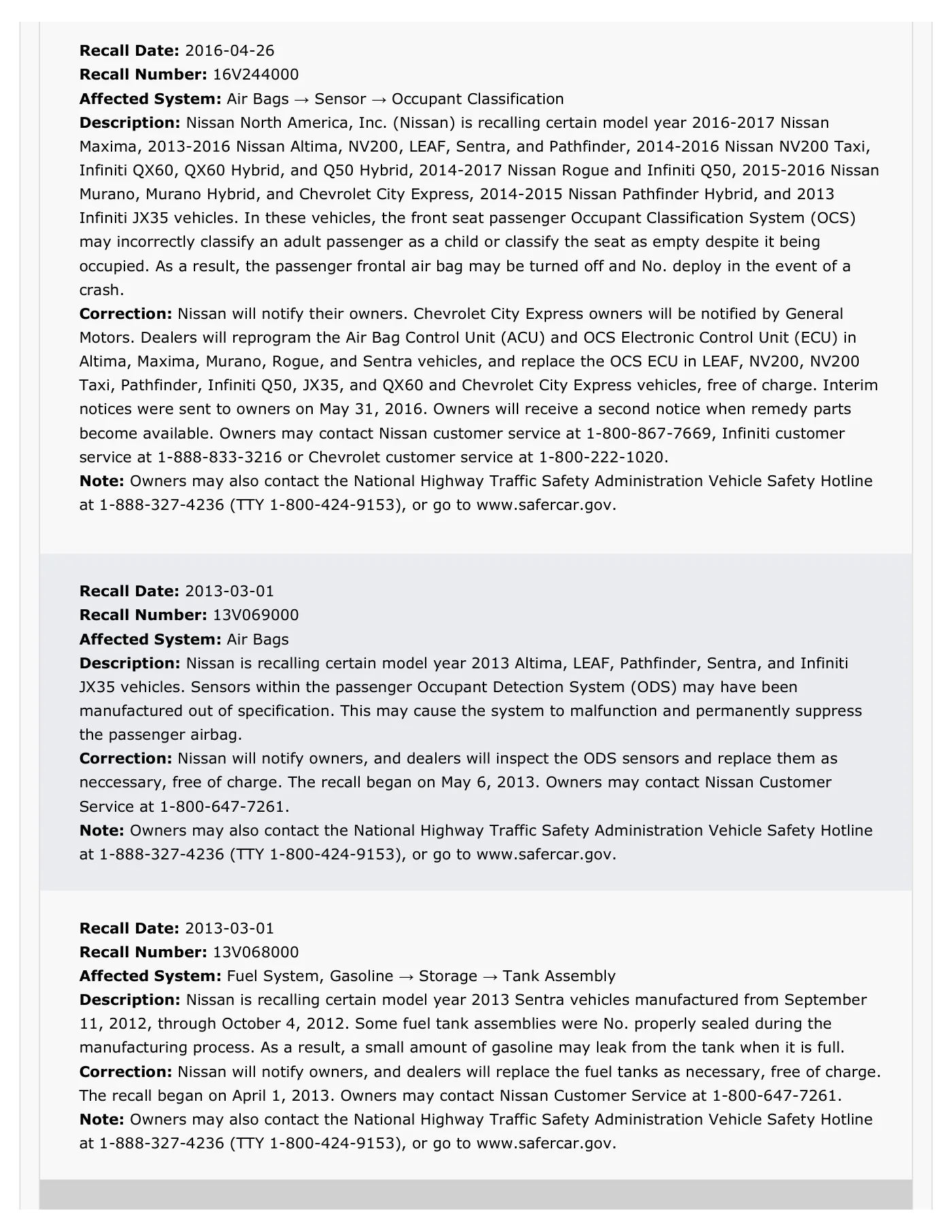
Recall Date: 2016-04-26 Recall Number: 16V244000 Affected System: Air Bags → Sensor → Occupant Classification Description: Nissan North America, Inc. (Nissan) is recalling certain model year 2016-2017 Nissan Maxima, 2013-2016 Nissan Altima, NV200, LEAF, Sentra, and Pathfinder, 2014-2016 Nissan NV200 Taxi, Infiniti QX60, QX60 Hybrid, and Q50 Hybrid, 2014-2017 Nissan Rogue and Infiniti Q50, 2015-2016 Nissan Murano, Murano Hybrid, and Chevrolet City Express, 2014-2015 Nissan Pathfinder Hybrid, and 2013 Infiniti JX35 vehicles. In these vehicles, the front seat passenger Occupant Classification System (OCS) may incorrectly classify an adult passenger as a child or classify the seat as empty despite it being occupied. As a result, the passenger frontal air bag may be turned off and No. deploy in the event of a crash. Correction: Nissan will notify their owners. Chevrolet City Express owners will be notified by General Motors. Dealers will reprogram the Air Bag Control Unit (ACU) and OCS Electronic Control Unit (ECU) in Altima, Maxima, Murano, Rogue, and Sentra vehicles, and replace the OCS ECU in LEAF, NV200, NV200 Taxi, Pathfinder, Infiniti Q50, JX35, and QX60 and Chevrolet City Express vehicles, free of charge. Interim notices were sent to owners on May 31, 2016. Owners will receive a second notice when remedy parts become available. Owners may contact Nissan customer service at 1-800-867-7669, Infiniti customer service at 1-888-833-3216 or Chevrolet customer service at 1-800-222-1020. Note: Owners may also contact the National Highway Traffic Safety Administration Vehicle Safety Hotline at 1-888-327-4236 (TTY 1-800-424-9153), or go to www.safercar.gov. Recall Date: 2013-03-01 Recall Number: 13V069000 Affected System: Air Bags Description: Nissan is recalling certain model year 2013 Altima, LEAF, Pathfinder, Sentra, and Infiniti JX35 vehicles. Sensors within the passenger Occupant Detection System (ODS) may have been manufactured out of specification. This may cause the system to malfunction and permanently suppress the passenger airbag. Correction: Nissan will notify owners, and dealers will inspect the ODS sensors and replace them as neccessary, free of charge. The recall began on May 6, 2013. Owners may contact Nissan Customer Service at 1-800-647-7261. Note: Owners may also contact the National Highway Traffic Safety Administration Vehicle Safety Hotline at 1-888-327-4236 (TTY 1-800-424-9153), or go to www.safercar.gov. Recall Date: 2013-03-01 Recall Number: 13V068000 Affected System: Fuel System, Gasoline → Storage → Tank Assembly Description: Nissan is recalling certain model year 2013 Sentra vehicles manufactured from September 11, 2012, through October 4, 2012. Some fuel tank assemblies were No. properly sealed during the manufacturing process. As a result, a small amount of gasoline may leak from the tank when it is full. Correction: Nissan will notify owners, and dealers will replace the fuel tanks as necessary, free of charge. The recall began on April 1, 2013. Owners may contact Nissan Customer Service at 1-800-647-7261. Note: Owners may also contact the National Highway Traffic Safety Administration Vehicle Safety Hotline at 1-888-327-4236 (TTY 1-800-424-9153), or go to www.safercar.gov.
Read page 9 text
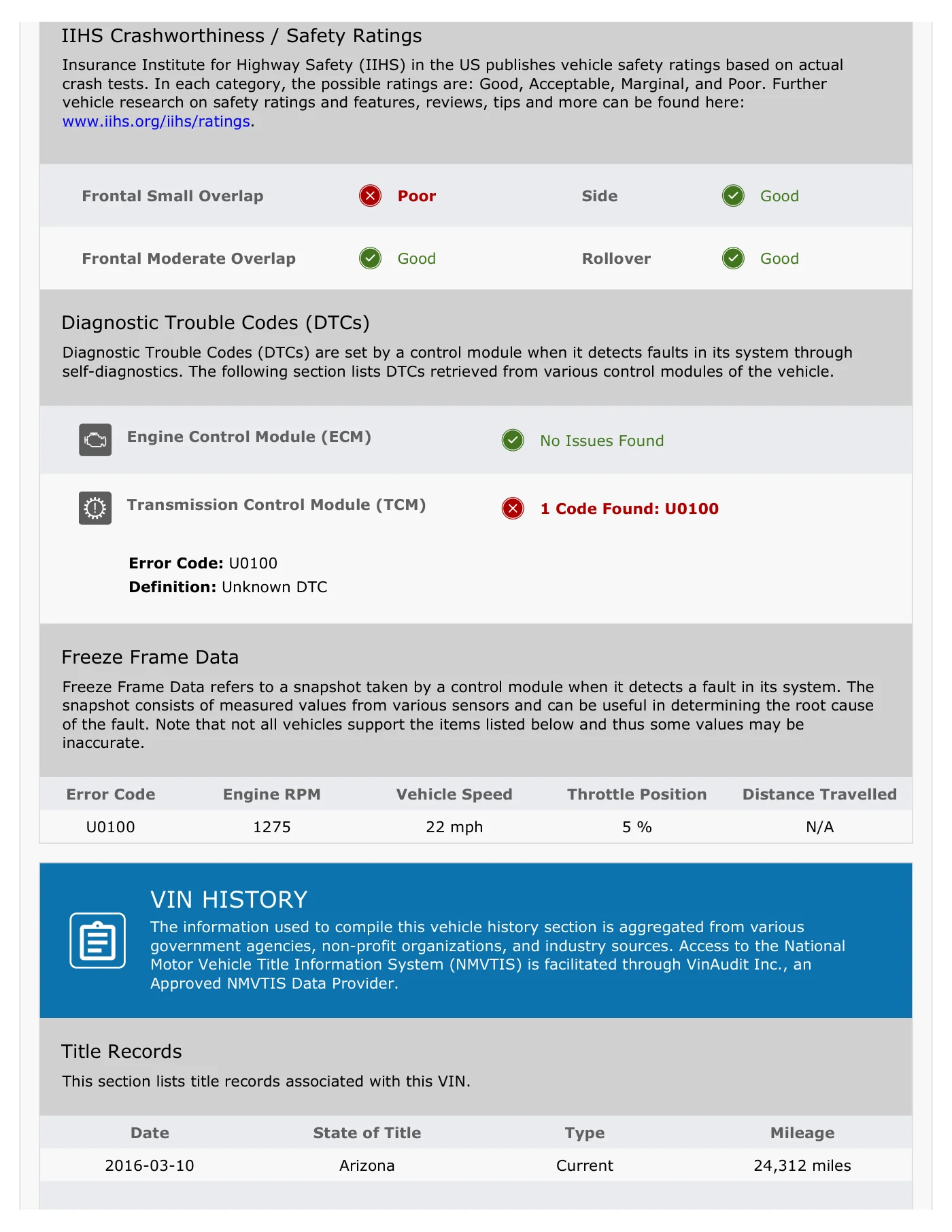
IIHS Crashworthiness / Safety Ratings Insurance Institute for Highway Safety (IIHS) in the US publishes vehicle safety ratings based on actual crash tests. In each category, the possible ratings are: Good, Acceptable, Marginal, and Poor. Further vehicle research on safety ratings and features, reviews, tips and more can be found here: www.iihs.org/iihs/ratings. Frontal Small Overlap Poor Side Good Frontal Moderate Overlap Good Rollover Good Diagnostic Trouble Codes (DTCs) Diagnostic Trouble Codes (DTCs) are set by a control module when it detects faults in its system through self-diagnostics. The following section lists DTCs retrieved from various control modules of the vehicle. Engine Control Module (ECM) No Issues Found Transmission Control Module (TCM) 1 Code Found: U0100 Error Code: U0100 Definition: Unknown DTC Freeze Frame Data Freeze Frame Data refers to a snapshot taken by a control module when it detects a fault in its system. The snapshot consists of measured values from various sensors and can be useful in determining the root cause of the fault. Note that not all vehicles support the items listed below and thus some values may be inaccurate. Error Code Engine RPM Vehicle Speed Throttle Position Distance Travelled U0100 1275 22 mph 5 % N/A VIN HISTORY The information used to compile this vehicle history section is aggregated from various government agencies, non-profit organizations, and industry sources. Access to the National Motor Vehicle Title Information System (NMVTIS) is facilitated through VinAudit Inc., an Approved NMVTIS Data Provider. Title Records This section lists title records associated with this VIN. Date State of Title Type Mileage 2016-03-10 Arizona Current 24,312 miles
Read page 10 text
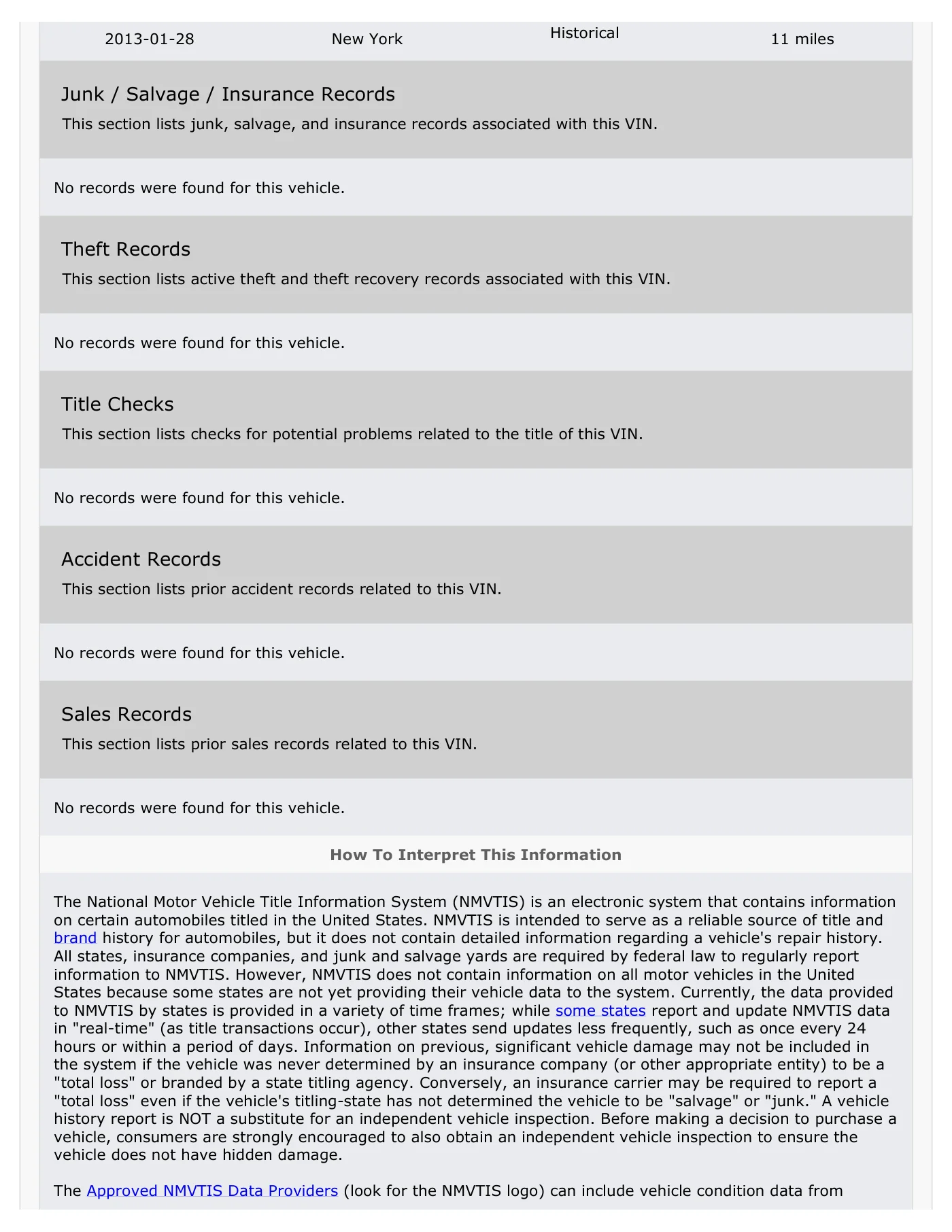
2013-01-28 New York Historical 11 miles Junk / Salvage / Insurance Records This section lists junk, salvage, and insurance records associated with this VIN. No records were found for this vehicle. Theft Records This section lists active theft and theft recovery records associated with this VIN. No records were found for this vehicle. Title Checks This section lists checks for potential problems related to the title of this VIN. No records were found for this vehicle. Accident Records This section lists prior accident records related to this VIN. No records were found for this vehicle. Sales Records This section lists prior sales records related to this VIN. No records were found for this vehicle. How To Interpret This Information The National Motor Vehicle Title Information System (NMVTIS) is an electronic system that contains information on certain automobiles titled in the United States. NMVTIS is intended to serve as a reliable source of title and brand history for automobiles, but it does not contain detailed information regarding a vehicle's repair history. All states, insurance companies, and junk and salvage yards are required by federal law to regularly report information to NMVTIS. However, NMVTIS does not contain information on all motor vehicles in the United States because some states are not yet providing their vehicle data to the system. Currently, the data provided to NMVTIS by states is provided in a variety of time frames; while some states report and update NMVTIS data in "real-time" (as title transactions occur), other states send updates less frequently, such as once every 24 hours or within a period of days. Information on previous, significant vehicle damage may not be included in the system if the vehicle was never determined by an insurance company (or other appropriate entity) to be a "total loss" or branded by a state titling agency. Conversely, an insurance carrier may be required to report a "total loss" even if the vehicle's titling-state has not determined the vehicle to be "salvage" or "junk." A vehicle history report is NOT a substitute for an independent vehicle inspection. Before making a decision to purchase a vehicle, consumers are strongly encouraged to also obtain an independent vehicle inspection to ensure the vehicle does not have hidden damage. The Approved NMVTIS Data Providers (look for the NMVTIS logo) can include vehicle condition data from
Read page 11 text
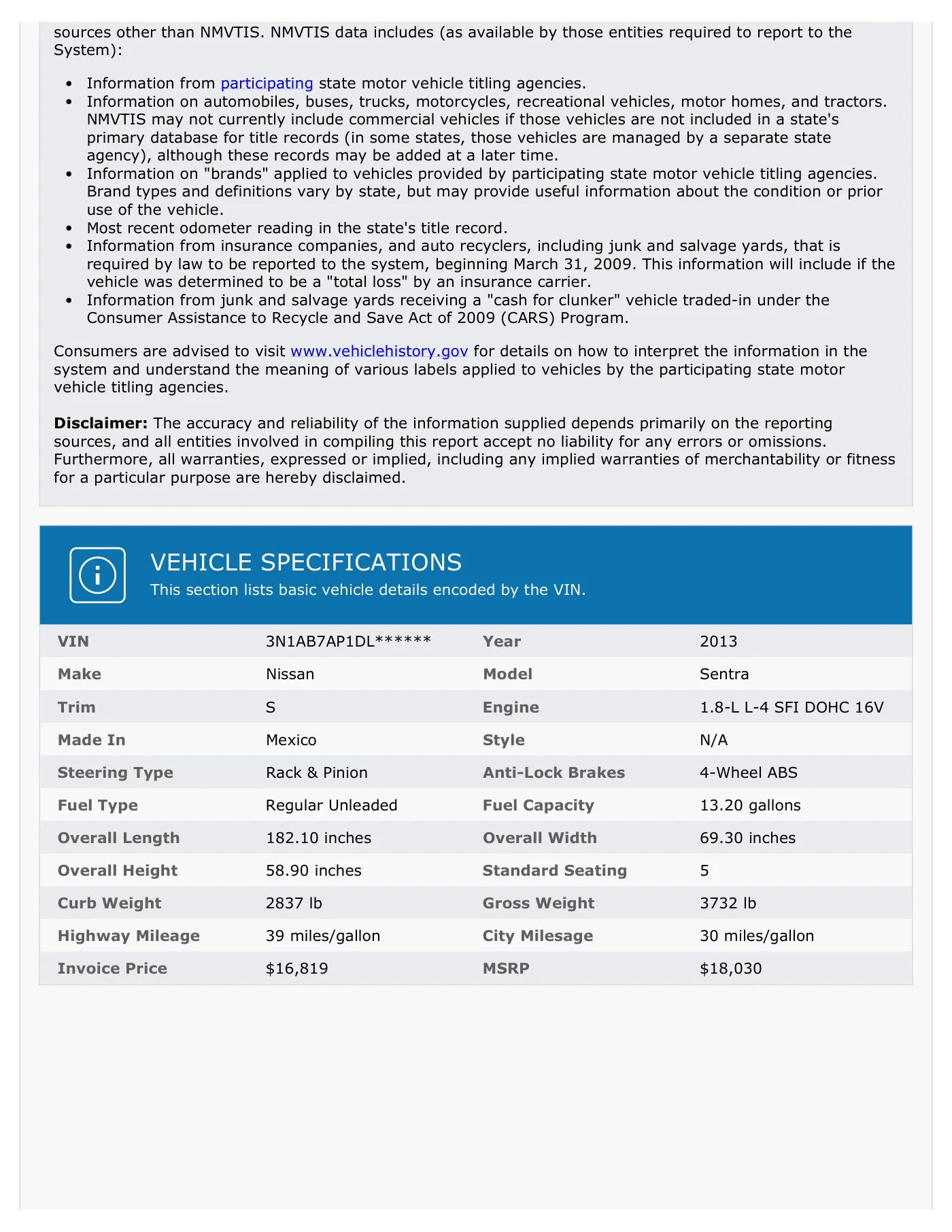
sources other than NMVTIS. NMVTIS data includes (as available by those entities required to report to the System): Consumers are advised to visit www.vehiclehistory.gov for details on how to interpret the information in the system and understand the meaning of various labels applied to vehicles by the participating state motor vehicle titling agencies. Disclaimer: The accuracy and reliability of the information supplied depends primarily on the reporting sources, and all entities involved in compiling this report accept no liability for any errors or omissions. Furthermore, all warranties, expressed or implied, including any implied warranties of merchantability or fitness for a particular purpose are hereby disclaimed. VEHICLE SPECIFICATIONS This section lists basic vehicle details encoded by the VIN. VIN 3N1AB7AP1DL****** Year 2013 Make Nissan Model Sentra Trim S Engine 1.8-L L-4 SFI DOHC 16V Made In Mexico Style N/A Steering Type Rack & Pinion Anti-Lock Brakes 4-Wheel ABS Fuel Type Regular Unleaded Fuel Capacity 13.20 gallons Overall Length 182.10 inches Overall Width 69.30 inches Overall Height 58.90 inches Standard Seating 5 Curb Weight 2837 lb Gross Weight 3732 lb Highway Mileage 39 miles/gallon City Milesage 30 miles/gallon Invoice Price $16,819 MSRP $18,030 Information from participating state motor vehicle titling agencies. Information on automobiles, buses, trucks, motorcycles, recreational vehicles, motor homes, and tractors. NMVTIS may not currently include commercial vehicles if those vehicles are not included in a state's primary database for title records (in some states, those vehicles are managed by a separate state agency), although these records may be added at a later time. Information on "brands" applied to vehicles provided by participating state motor vehicle titling agencies. Brand types and definitions vary by state, but may provide useful information about the condition or prior use of the vehicle. Most recent odometer reading in the state's title record. Information from insurance companies, and auto recyclers, including junk and salvage yards, that is required by law to be reported to the system, beginning March 31, 2009. This information will include if the vehicle was determined to be a "total loss" by an insurance carrier. Information from junk and salvage yards receiving a "cash for clunker" vehicle traded-in under the Consumer Assistance to Recycle and Save Act of 2009 (CARS) Program.

Read page 12 text
Generated by Collision Sciences Event Data Disclaimer Airbag ECU data should be used in conjunction with other physical evidence obtained from the vehicle and the surrounding circumstances. It is important to note is that if a vehicle was spinning or rolling surrounding the collision, then the report's speed measurements would not accurately reflect the actual speed of the vehicle during/after it lost control; the speed measurement is typically based on the wheel speed sensor. Signs of this type of anomaly would be rapid changes in speed between the brief timing intervals. The reported speed may be an average of the four wheels; thus could also be skewed by spinning wheels. In combination with scene evidence, an expert could assess vehicle speed by analyzing the data via accident reconstruction and engineering analysis. Users of the Collision Sciences service and reviewers of the reports and exported data shall ensure that data and information supplied is applicable to the vehicle, vehicle's system(s) and the vehicle ECU. Collision Sciences Inc. and all its directors, officers, employees and members shall not be liable for damages arising out of or related to incorrect, incomplete or misinterpreted software and/or data. Collision Sciences Inc. expressly excludes all liability for incidental, consequential, special or punitive damages arising from or related to the online services, evidence logistics, EDR data, EDR software or use thereof.