
Source page 1
Read page 1 extracted text
Extracted text may not preserve table columns. Refer to the page image or original PDF for data relationships.
P a g e | 1 Compatible Event Data Recorder Analysis: Comparative Evaluation of CrashScan to OEM Platforms Xentry, and Bosch CDR, for Forensic Use Ing. Peter Vertaľ, Ph.D. Abstract: This article presents a comprehensive comparison of Event Data Recorder (EDR) tools used in forensic vehicle crash analysis. It focuses on the Bosch CDR system, OEM diagnostic platforms such as Mercedes-Benz XENTRY and Hyundai/Kia GIT tool, and the mobile CrashScan EDR Kit by Collision Sciences. Through case studies involving (among others) Lexus, Mercedes-Benz, Land Rover, and Hyundai vehicles, the report evaluates each system’s compatibility, data accessibility, forensic usability, and legal defensibility. Particular emphasis is placed on CrashScan’s broader brand support, contextual reporting, and suitability for independent experts. The results highlight the practical value of field-ready tools like CrashScan in scenarios where traditional OEM or Bosch systems are restricted or unsupported. EDR Data and Legal Background Bosch CDR: The Traditional Standard Event Data Recorder (EDR) systems, also known as vehicle "black The Bosch Crash Data Retrieval system was developed in boxes", are devices installed in vehicles that automatically record collaboration with Vetronix (later acquired by Bosch) and has technical driving data and incident details in the event of a crash. been established since the early 2000s as the reference tool for Their primary function is to store key information about vehicle retrieving data from airbag control modules (ACMs). It provides and driver behavior before, during, and after a collision. This data access to raw hexadecimal data, which is software-decoded into may include vehicle speed, brake and accelerator pedal status, technical outputs—typically in tabular formats and pre-crash steering wheel angle, engine RPM, seatbelt usage, airbag behavior summaries. deployment, and other values essential for traffic accident The system consists of a CDR Interface Module (CAN Plus, CDRreconstruction. 900), licensed software, and a wide range of cables designed for Legislation concerning EDR varies by region. In the United States, direct-to-module or OBD-II connection. Bosch CDR supports since 2012, new vehicles equipped with EDRs must comply with over 40 OEM brands - American models, though support for specifications outlined in 49 CFR Part 563. This regulation defines European and Asian brands is expanding. Due to its structured minimum requirements for data types, retention time, and access approach and validated precision, Bosch CDR outputs are widely methods. In the European Union, the EDR function is being accepted as evidence in legal proceedings. introduced under Regulation (EU) 2019/2144 on vehicle general safety, becoming mandatory for new M1 and N1 type-approved CrashScan EDR Kit: A Modern and Mobile Solution vehicles from July 2024. Unlike the robust and costly Bosch CDR system, Collision Sciences developed CrashScan—a modern EDR tool based on a EDR data is frequently used in forensic practice, court mobile application paired with a Bluetooth OBDLink MX+ device proceedings, insurance claims, and traffic safety research. Its use and an optional Direct-to-Module (DTM) lab kit. The system is subject to data protection laws and vehicle owner rights. In emphasizes ease of use, affordability, and extended vehicle support many jurisdictions, access to the data requires the vehicle owner’s for brands not compatible with Bosch CDR—including Kia, consent or a legal warrant. Therefore, when handling EDR data, it Hyundai, Jaguar-Land Rover, Mullen Automotive (globally), and is crucial to respect proper evidence handling procedures, outside of America - Ford, Mazda, Mercedes-Benz, BYD.. maintain chain of custody, and rely on professional interpretation of results.
Source page 2
Read page 2 extracted text
Extracted text may not preserve table columns. Refer to the page image or original PDF for data relationships.
P a g e | 2 One of CrashScan’s main advantages is the contextualization of The availability of two independent data acquisition systems output data. Reports include not only raw values but also pre- provides a valuable opportunity to compare the structure, content, processed analyses—such as impact direction, type of braking and interpretative features of each platform. The retrieved EDR behavior (gentle vs. emergency), biomechanical injury risk, datasets from Bosch CDR and CrashScan will be evaluated side by estimated distance to impact, and indicators of potential fraud. side, focusing on accuracy, contextual presentation, and the ease After scanning, the user receives a free preview and can later order of use for forensic analysis. The following sections provide a a full report with engineering team support. comparative assessment based on data from this real-world incident. Comparative Table Function / CrashScan EDR Kit (Collision Bosch CDR Parameter Sciences) Release Year ~2000 ~2017 Professional Mobile and universal EDR tool for System Focus forensic accident experts and field use analysis CDR Interface OBDLink MX+ Bluetooth + Hardware Module + cables optional DTM kit Hardware cost 4000 eur 200 USD one cable approx. Hardware direct EDR LAB kit for all vehicles 1000 200 eur per to module cost eur Figure 1Traffic accident scene - Lexus specific ACM unit. CDR software Software Mobile app (iOS/Android) The EDR data from the Lexus RC 2016 was retrieved via the (Windows) vehicle's OBD-II port. Using the Bosch system, the extraction was Mainly US brand Vehicle Brand International support (incl. Kia, performed with the CDR 900 interface module. For the CrashScan and specific EU Support Hyundai, FORD, JLR, Mazda,..) brands platform, data was collected using the standard EDR Field Kit Raw data + decoded summary + equipped with an OBDLink MX+ device. At the time of Raw data + Output Type Contextual report + analysis + acquisition, the vehicle was in standby mode with ignition decoded summary calculations + risk factors switched on but the engine off. Both systems successfully Paid licenses + Low initial cost, pay-per-report established communication with the airbag control module and Licensing cable costs model completed the download without errors. Licensing cost 1400 eur / year 300 USD per report Both the Bosch CDR and CrashScan reports display virtually Forensic High (court use, Growing, free training & Acceptance certified experts) certification available identical crash data values, with differences only in formatting and Engineering support by presentation structure. For instance, both tools captured the crash Technical Rare from Bosch email/phone + community as a frontal/rear collision, with a prior side crash recorded. The Support resources trigger occurred 11 milliseconds before impact in both datasets. Expensive HW, big transfer box, Small hardware that can always be Ignition cycle values are fully consistent: the event occurred at Usability not possible to kept in the car ignition cycle 13195, and the download was performed at cycle have it all the time with you 13204, confirming a 9-cycle delay—clearly matching across systems. Deployment times for the driver’s front airbag (18 ms for Case studies: Traffic accident Lexus 1st stage, 48 ms for 2nd stage), pretensioners (18 ms), and side A traffic accident involving a Lexus occurred during daylight curtain airbags (18 ms) are identically recorded. Passenger airbag hours in an urban environment. The circumstances suggest typical deployment was correctly noted as absent in both systems. city driving conditions at the time of the crash. The Lexus model involved is compatible with both the Bosch Crash Data Retrieval Although the Bosch CDR export provides raw data in a highly (CDR) system and the CrashScan EDR Kit developed by Collision structured technical format, the CrashScan report offers more Sciences. This compatibility allows for comprehensive access to user-friendly labeling such as “No Deployment” versus “No” and the vehicle’s Event Data Recorder (EDR), enabling retrieval of pre- appends units (e.g., “ms”) directly. Overall, the data equivalence crash and crash-phase information using both tools. validates both tools' reliability, with only visual and terminological formatting being distinct.
Source page 3
Read page 3 extracted text
Extracted text may not preserve table columns. Refer to the page image or original PDF for data relationships.
P a g e | 3 Figure 4 Bosch CDR data from Lexus The crash pulse data retrieved from both the Bosch CDR system and CrashScan are nearly identical in magnitude and trend, differing primarily in formatting. Bosch provides a structured export including longitudinal delta-V in both mph and km/h and lateral acceleration, along with power supply status for each timestamp. CrashScan presents similar values, but without graphical visualization or power status indication. For example, at 100 ms, Bosch reports a longitudinal delta-V of approximately -17.9 km/h and lateral acceleration of 0.0 m/s²— precisely mirrored in the CrashScan output. Peak lateral acceleration at 20 ms is recorded as -47.9 m/s² (Bosch) and -47.88 m/s² (CrashScan), confirming technical consistency. The Bosch output includes additional metadata such as “Power Figure 2 CrashScan data from Lexus Supply Status,” which is consistently marked “ON,” offering traceability. CrashScan, on the other hand, displays a simplified format without power data, but with clearly labeled time-velocity pairs. While both systems present comparable crash metrics, Bosch’s output is more detailed and suited for regulatory environments, whereas CrashScan emphasizes usability and rapid interpretation in the field. Figure 3 Bosch CDR data from Lexus The Bosch CDR report includes detailed system metadata such as the ECU Part Number and EDR Generation (13EDR), which are not displayed in the CrashScan output. However, this type of technical metadata is generally not critical for forensic analysts, as it does not directly influence the interpretation of crash dynamics or driver behavior. Additionally, in this particular case, the Bosch CDR report indicates the time from the previous pre-crash trigger (694 ms), while the CrashScan report does not present this parameter for this vehicle. Although this value can be useful in complex multi- event scenarios, its absence does not affect the core crash reconstruction for a single-event analysis like this one.
Source page 4
Read page 4 extracted text
Extracted text may not preserve table columns. Refer to the page image or original PDF for data relationships.
P a g e | 4 Figure 5 Bosch CDR Figure 8 CrashScan data from Lexus Key Observations: 1. Vehicle Speed and Engine RPM The vehicle speed values are identical across both tools, ranging from 64 km/h at -4.65 s to 55 km/h at 0 s. Engine speed (RPM) is also consistent, decreasing from 2700 to 1200 RPM. This confirms accurate synchronization between both Figure 6 CrashScan data from Lexus recording systems. 2. Accelerator Pedal Position Both Bosch CDR and CrashScan offer comprehensive snapshots Both tools record a steady release of the accelerator: from of the vehicle’s behavior during the five seconds leading up to the 32.5% down to 0% over the last 2 seconds before impact. This crash. The recorded parameters—such as vehicle speed, engine reflects the driver lifting off the throttle as the event RPM, accelerator position, brake status, yaw rate, and steering approached. input—are largely consistent between the two systems, with 3. Brake Status minor differences in formatting and additional variables provided The brake was off until -0.65 seconds, at which point both by Bosch. tools indicate that it was applied. Bosch additionally provides brake oil pressure readings (12.14 → 11.42 MPa), which is not included in CrashScan in standard, but provides extra insight into braking intensity. 4. Yaw Rate and Steering Angle Yaw rate and steering input match across both tools, showing a transition from straight-line driving to a rapid maneuver. At -0.15 s, steering input reaches -30.0° (right), followed by +60.0° (left) at the next timestep, indicating a potential avoidance attempt. Yaw rate also increases dramatically during this phase, peaking at 49.29 deg/s. 5. Additional Bosch-Only Data Bosch includes unique parameters like: Figure 7 Bosch CDR data from Lexus o Engine throttle % (not in CrashScan), useful for identifying ECU-requested torque. o Motor RPM, which is marked as "Invalid" throughout.
Source page 5
Read page 5 extracted text
Extracted text may not preserve table columns. Refer to the page image or original PDF for data relationships.
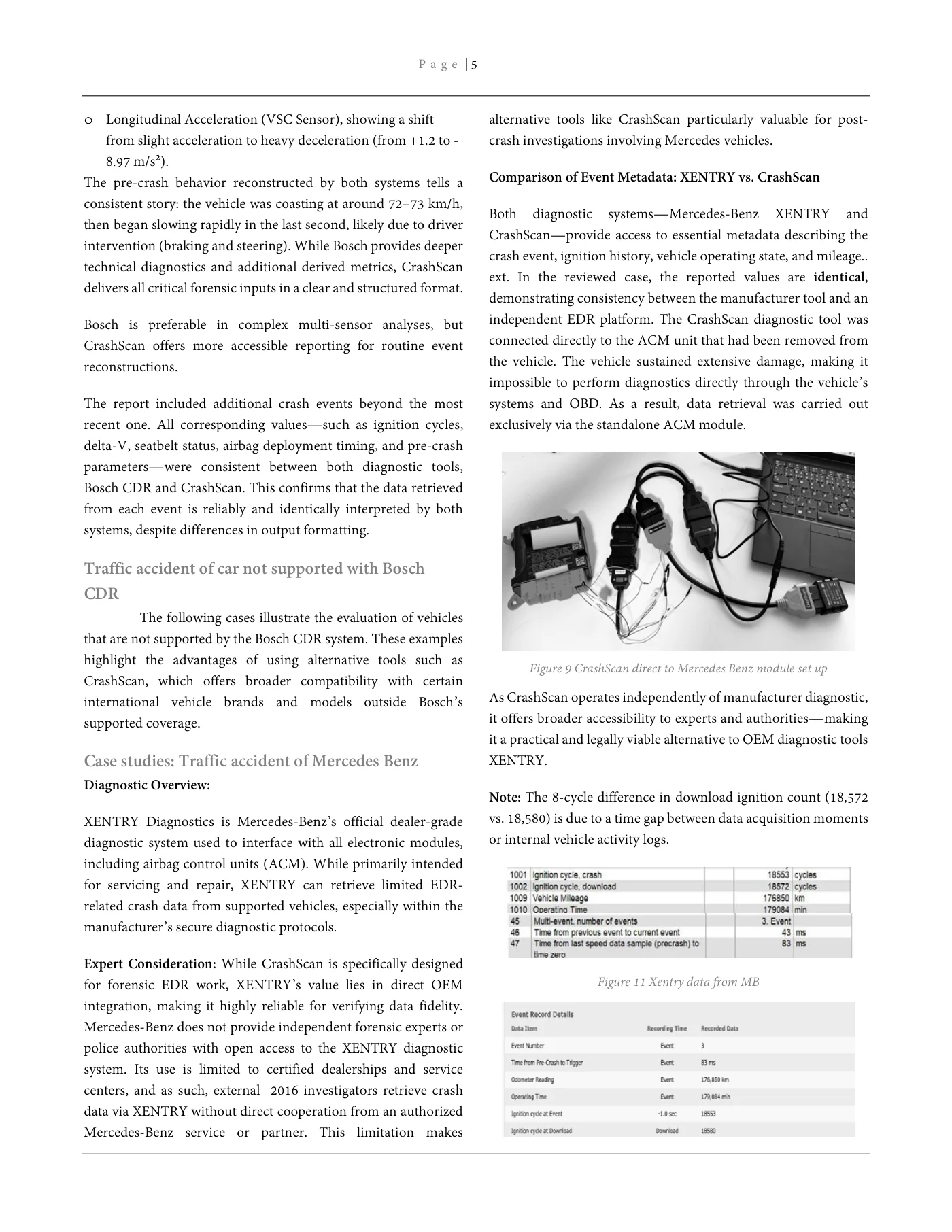
P a g e | 5 o Longitudinal Acceleration (VSC Sensor), showing a shift alternative tools like CrashScan particularly valuable for post- from slight acceleration to heavy deceleration (from +1.2 to - crash investigations involving Mercedes vehicles. 8.97 m/s²). Comparison of Event Metadata: XENTRY vs. CrashScanThe pre-crash behavior reconstructed by both systems tells a consistent story: the vehicle was coasting at around 72–73 km/h, Both diagnostic systems—Mercedes-Benz XENTRY and then began slowing rapidly in the last second, likely due to driver CrashScan—provide access to essential metadata describing the intervention (braking and steering). While Bosch provides deeper crash event, ignition history, vehicle operating state, and mileage.. technical diagnostics and additional derived metrics, CrashScan ext. In the reviewed case, the reported values are identical, delivers all critical forensic inputs in a clear and structured format. demonstrating consistency between the manufacturer tool and an independent EDR platform. The CrashScan diagnostic tool wasBosch is preferable in complex multi-sensor analyses, but connected directly to the ACM unit that had been removed fromCrashScan offers more accessible reporting for routine event the vehicle. The vehicle sustained extensive damage, making itreconstructions. impossible to perform diagnostics directly through the vehicle’s The report included additional crash events beyond the most systems and OBD. As a result, data retrieval was carried out recent one. All corresponding values—such as ignition cycles, exclusively via the standalone ACM module. delta-V, seatbelt status, airbag deployment timing, and pre-crash parameters—were consistent between both diagnostic tools, Bosch CDR and CrashScan. This confirms that the data retrieved from each event is reliably and identically interpreted by both systems, despite differences in output formatting. Traffic accident of car not supported with Bosch CDR The following cases illustrate the evaluation of vehicles that are not supported by the Bosch CDR system. These examples highlight the advantages of using alternative tools such as Figure 9 CrashScan direct to Mercedes Benz module set up CrashScan, which offers broader compatibility with certain international vehicle brands and models outside Bosch’s As CrashScan operates independently of manufacturer diagnostic, supported coverage. it offers broader accessibility to experts and authorities—making it a practical and legally viable alternative to OEM diagnostic tools Case studies: Traffic accident of Mercedes Benz XENTRY. Diagnostic Overview: Note: The 8-cycle difference in download ignition count (18,572 XENTRY Diagnostics is Mercedes-Benz’s official dealer-grade vs. 18,580) is due to a time gap between data acquisition moments diagnostic system used to interface with all electronic modules, or internal vehicle activity logs. including airbag control units (ACM). While primarily intended for servicing and repair, XENTRY can retrieve limited EDR- related crash data from supported vehicles, especially within the manufacturer’s secure diagnostic protocols. Expert Consideration: While CrashScan is specifically designed for forensic EDR work, XENTRY’s value lies in direct OEM Figure 11 Xentry data from MB integration, making it highly reliable for verifying data fidelity. Mercedes-Benz does not provide independent forensic experts or police authorities with open access to the XENTRY diagnostic system. Its use is limited to certified dealerships and service centers, and as such, external 2016 investigators retrieve crash data via XENTRY without direct cooperation from an authorized Mercedes-Benz service or partner. This limitation makes
Source page 6
Read page 6 extracted text
Extracted text may not preserve table columns. Refer to the page image or original PDF for data relationships.
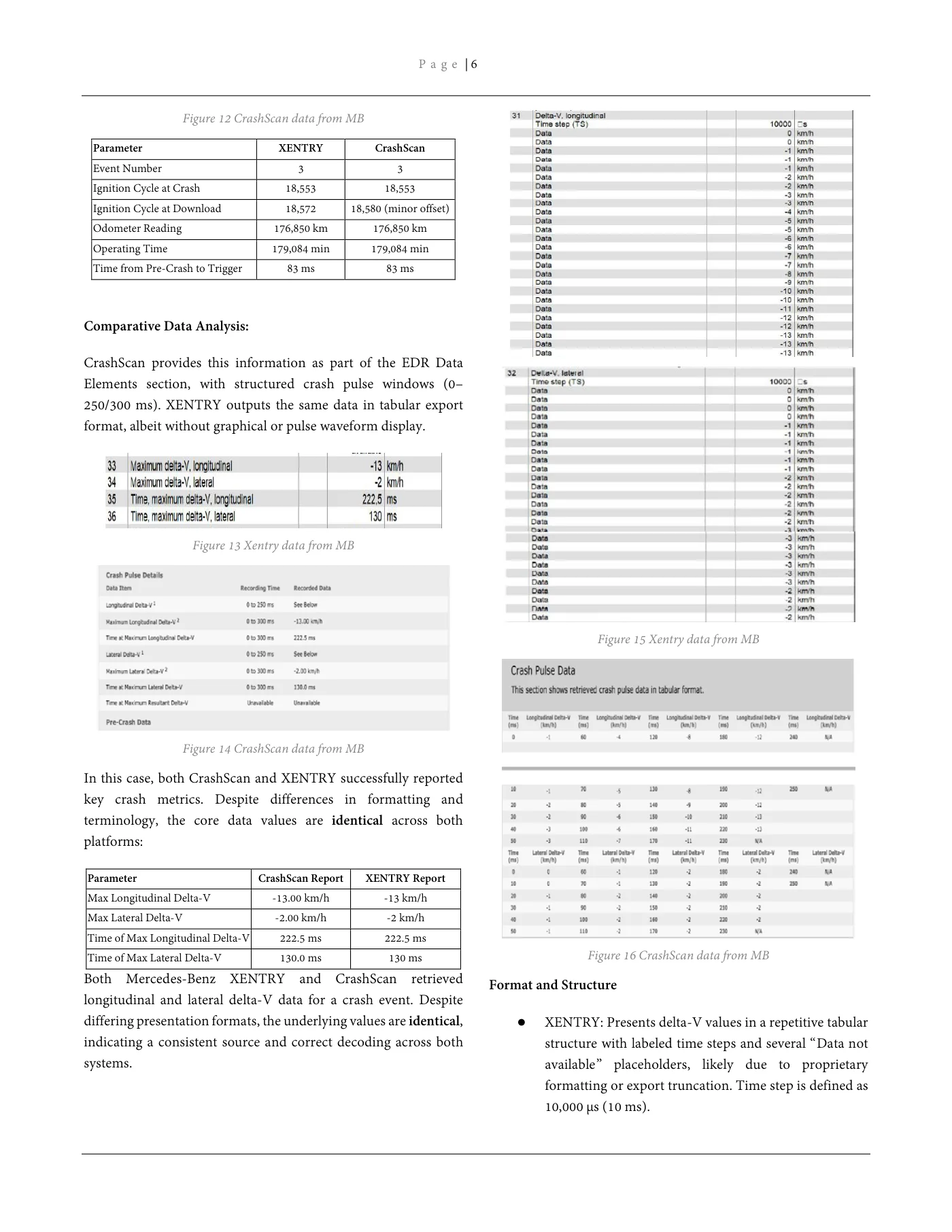
P a g e | 6 Figure 12 CrashScan data from MB Parameter XENTRY CrashScan Event Number 3 3 Ignition Cycle at Crash 18,553 18,553 Ignition Cycle at Download 18,572 18,580 (minor offset) Odometer Reading 176,850 km 176,850 km Operating Time 179,084 min 179,084 min Time from Pre-Crash to Trigger 83 ms 83 ms Comparative Data Analysis: CrashScan provides this information as part of the EDR Data Elements section, with structured crash pulse windows (0– 250/300 ms). XENTRY outputs the same data in tabular export format, albeit without graphical or pulse waveform display. Figure 13 Xentry data from MB Figure 15 Xentry data from MB Figure 14 CrashScan data from MB In this case, both CrashScan and XENTRY successfully reported key crash metrics. Despite differences in formatting and terminology, the core data values are identical across both platforms: Parameter CrashScan Report XENTRY Report Max Longitudinal Delta-V -13.00 km/h -13 km/h Max Lateral Delta-V -2.00 km/h -2 km/h Time of Max Longitudinal Delta-V 222.5 ms 222.5 ms Time of Max Lateral Delta-V 130.0 ms 130 ms Figure 16 CrashScan data from MB Both Mercedes-Benz XENTRY and CrashScan retrieved Format and Structure longitudinal and lateral delta-V data for a crash event. Despite differing presentation formats, the underlying values are identical, ● XENTRY: Presents delta-V values in a repetitive tabular indicating a consistent source and correct decoding across both structure with labeled time steps and several “Data not systems. available” placeholders, likely due to proprietary formatting or export truncation. Time step is defined as 10,000 µs (10 ms).
Source page 7
Read page 7 extracted text
Extracted text may not preserve table columns. Refer to the page image or original PDF for data relationships.
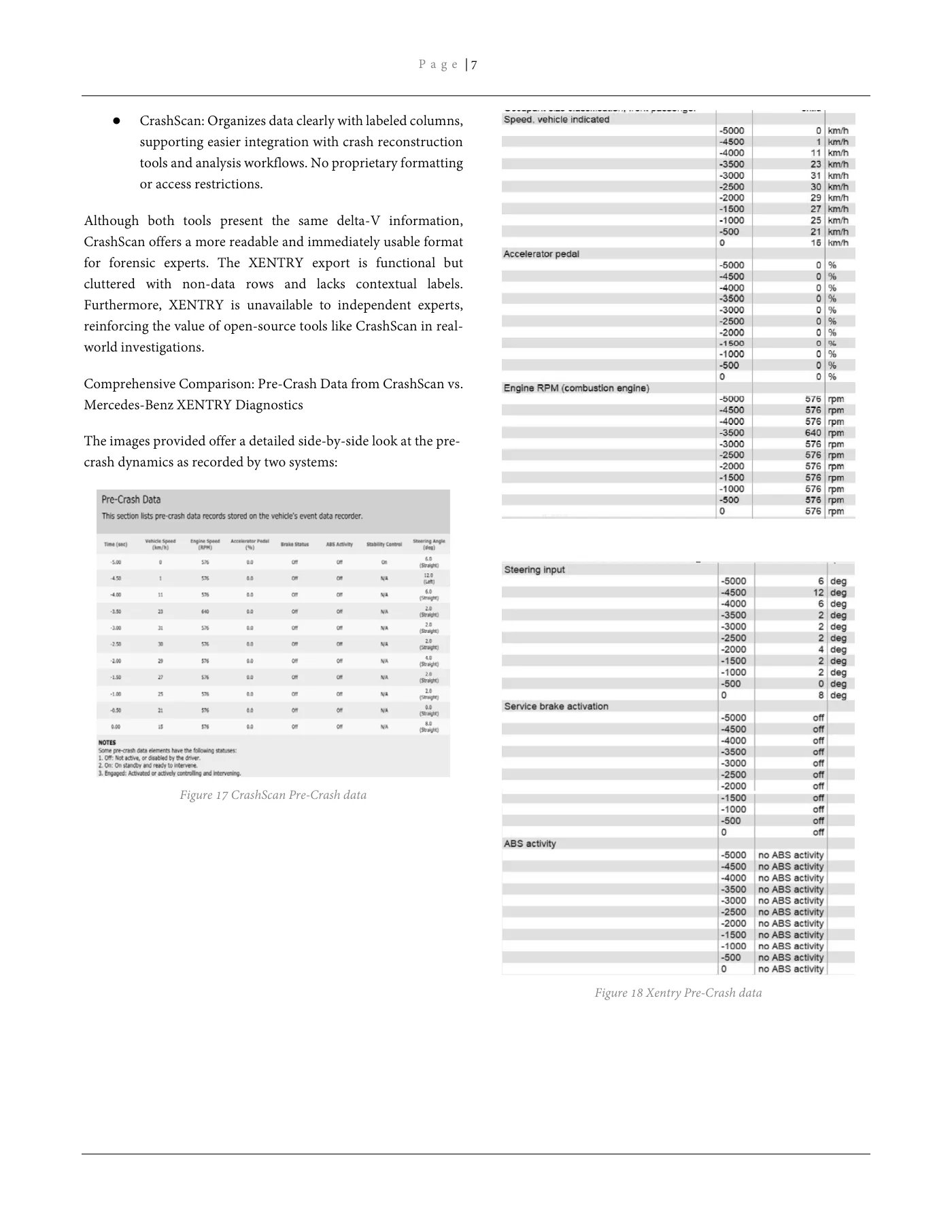
P a g e | 7 ● CrashScan: Organizes data clearly with labeled columns, supporting easier integration with crash reconstruction tools and analysis workflows. No proprietary formatting or access restrictions. Although both tools present the same delta-V information, CrashScan offers a more readable and immediately usable format for forensic experts. The XENTRY export is functional but cluttered with non-data rows and lacks contextual labels. Furthermore, XENTRY is unavailable to independent experts, reinforcing the value of open-source tools like CrashScan in real- world investigations. Comprehensive Comparison: Pre-Crash Data from CrashScan vs. Mercedes-Benz XENTRY Diagnostics The images provided offer a detailed side-by-side look at the pre- crash dynamics as recorded by two systems: Figure 17 CrashScan Pre-Crash data Figure 18 Xentry Pre-Crash data
Source page 8
Read page 8 extracted text
Extracted text may not preserve table columns. Refer to the page image or original PDF for data relationships.
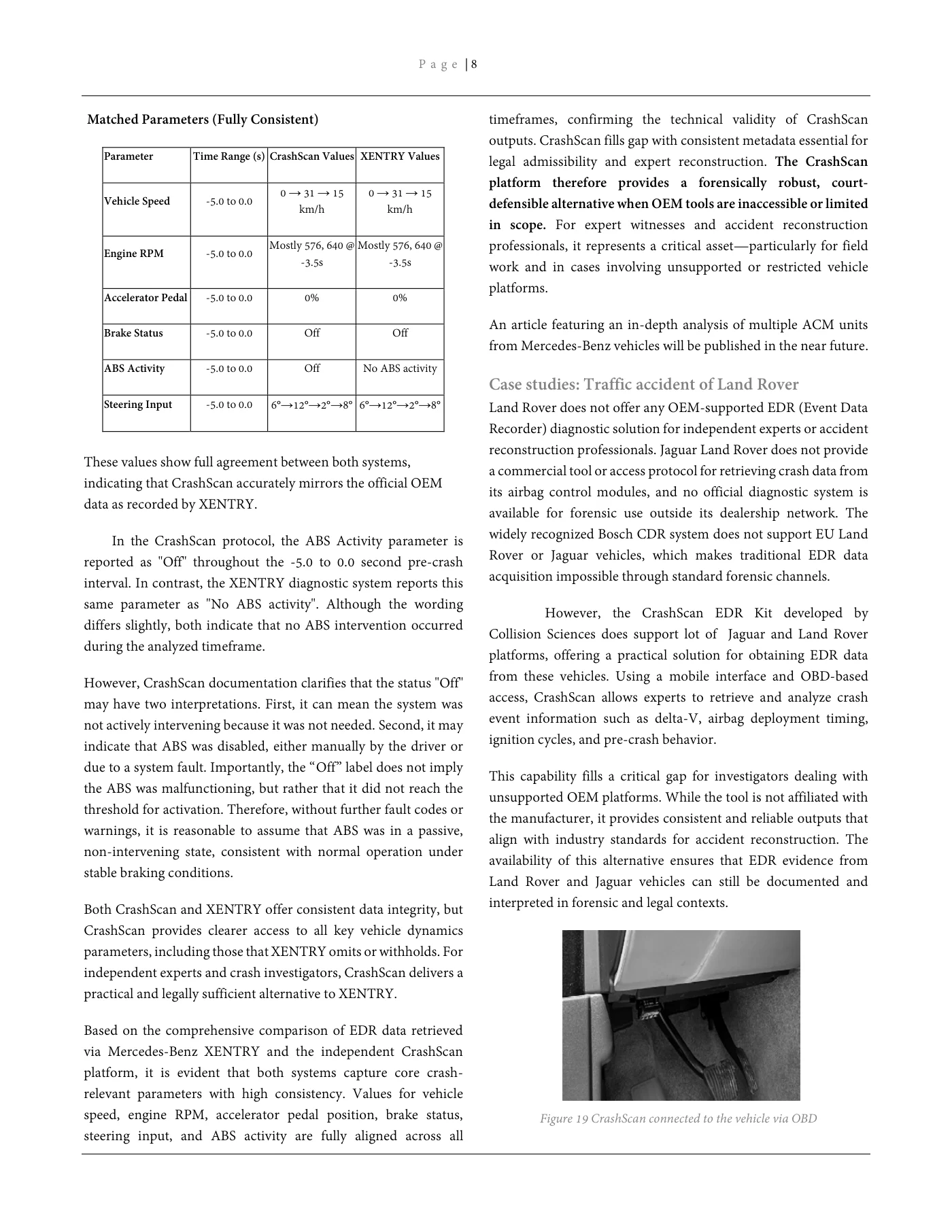
P a g e | 8 Matched Parameters (Fully Consistent) timeframes, confirming the technical validity of CrashScan outputs. CrashScan fills gap with consistent metadata essential for Parameter Time Range (s) CrashScan Values XENTRY Values legal admissibility and expert reconstruction. The CrashScan platform therefore provides a forensically robust, court- 0 → 31 → 15 0 → 31 → 15 Vehicle Speed -5.0 to 0.0 km/h km/h defensible alternative when OEM tools are inaccessible or limited in scope. For expert witnesses and accident reconstruction Mostly 576, 640 @ Mostly 576, 640 @ professionals, it represents a critical asset—particularly for field Engine RPM -5.0 to 0.0 -3.5s -3.5s work and in cases involving unsupported or restricted vehicle platforms. Accelerator Pedal -5.0 to 0.0 0% 0% An article featuring an in-depth analysis of multiple ACM units Brake Status -5.0 to 0.0 Off Off from Mercedes-Benz vehicles will be published in the near future. ABS Activity -5.0 to 0.0 Off No ABS activity Case studies: Traffic accident of Land Rover Steering Input -5.0 to 0.0 6°→12°→2°→8° 6°→12°→2°→8° Land Rover does not offer any OEM-supported EDR (Event Data Recorder) diagnostic solution for independent experts or accident reconstruction professionals. Jaguar Land Rover does not provide These values show full agreement between both systems, a commercial tool or access protocol for retrieving crash data from indicating that CrashScan accurately mirrors the official OEM its airbag control modules, and no official diagnostic system is data as recorded by XENTRY. available for forensic use outside its dealership network. The widely recognized Bosch CDR system does not support EU Land In the CrashScan protocol, the ABS Activity parameter is Rover or Jaguar vehicles, which makes traditional EDR datareported as "Off" throughout the -5.0 to 0.0 second pre-crash acquisition impossible through standard forensic channels.interval. In contrast, the XENTRY diagnostic system reports this same parameter as "No ABS activity". Although the wording However, the CrashScan EDR Kit developed by differs slightly, both indicate that no ABS intervention occurred Collision Sciences does support lot of Jaguar and Land Rover during the analyzed timeframe. platforms, offering a practical solution for obtaining EDR data from these vehicles. Using a mobile interface and OBD-basedHowever, CrashScan documentation clarifies that the status "Off" access, CrashScan allows experts to retrieve and analyze crashmay have two interpretations. First, it can mean the system was event information such as delta-V, airbag deployment timing,not actively intervening because it was not needed. Second, it may ignition cycles, and pre-crash behavior.indicate that ABS was disabled, either manually by the driver or due to a system fault. Importantly, the “Off” label does not imply This capability fills a critical gap for investigators dealing with the ABS was malfunctioning, but rather that it did not reach the unsupported OEM platforms. While the tool is not affiliated with threshold for activation. Therefore, without further fault codes or the manufacturer, it provides consistent and reliable outputs that warnings, it is reasonable to assume that ABS was in a passive, align with industry standards for accident reconstruction. The non-intervening state, consistent with normal operation under availability of this alternative ensures that EDR evidence from stable braking conditions. Land Rover and Jaguar vehicles can still be documented and interpreted in forensic and legal contexts.Both CrashScan and XENTRY offer consistent data integrity, but CrashScan provides clearer access to all key vehicle dynamics parameters, including those that XENTRY omits or withholds. For independent experts and crash investigators, CrashScan delivers a practical and legally sufficient alternative to XENTRY. Based on the comprehensive comparison of EDR data retrieved via Mercedes-Benz XENTRY and the independent CrashScan platform, it is evident that both systems capture core crash- relevant parameters with high consistency. Values for vehicle speed, engine RPM, accelerator pedal position, brake status, Figure 19 CrashScan connected to the vehicle via OBD steering input, and ABS activity are fully aligned across all
Source page 9
Read page 9 extracted text
Extracted text may not preserve table columns. Refer to the page image or original PDF for data relationships.
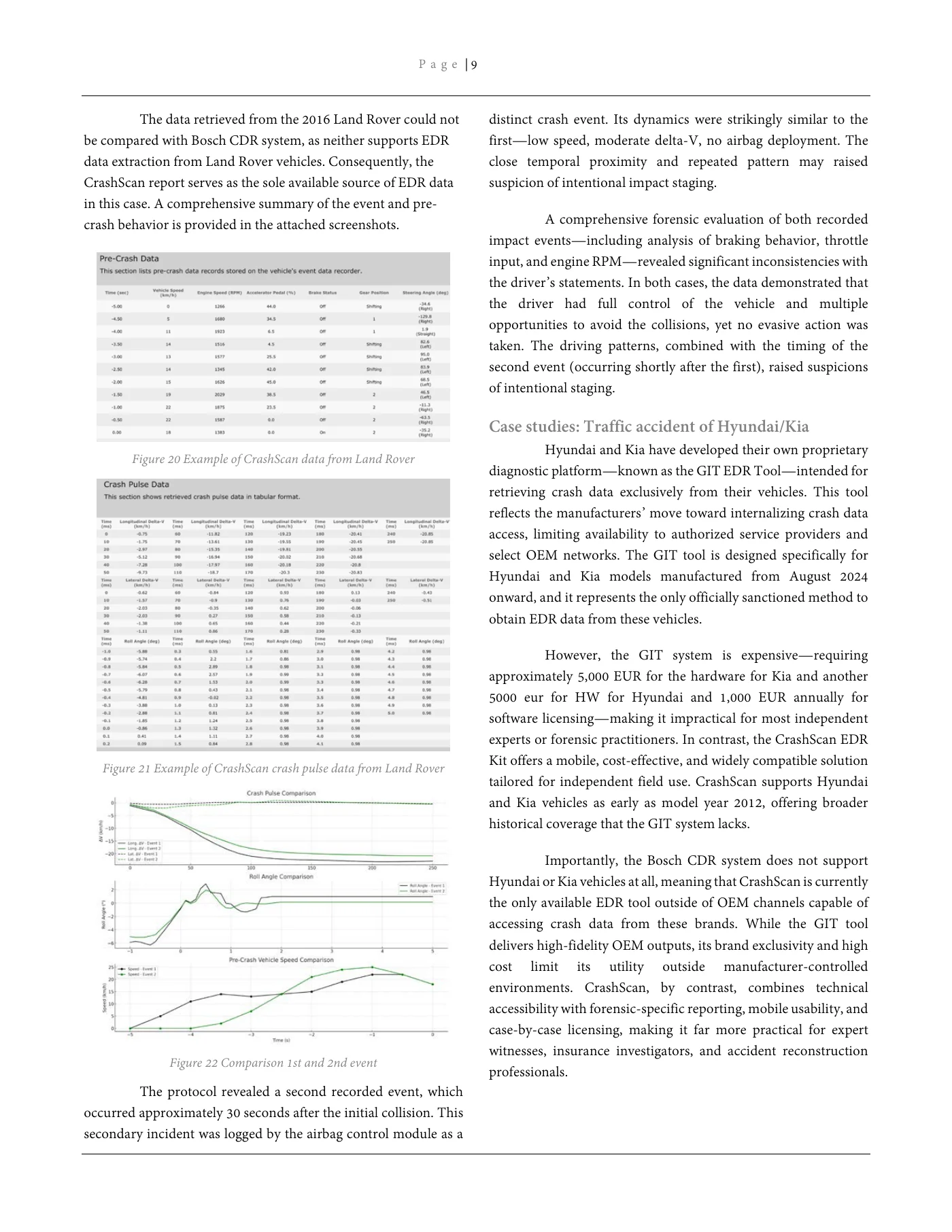
P a g e | 9 The data retrieved from the 2016 Land Rover could not distinct crash event. Its dynamics were strikingly similar to the be compared with Bosch CDR system, as neither supports EDR first—low speed, moderate delta-V, no airbag deployment. The data extraction from Land Rover vehicles. Consequently, the close temporal proximity and repeated pattern may raised CrashScan report serves as the sole available source of EDR data suspicion of intentional impact staging. in this case. A comprehensive summary of the event and pre- A comprehensive forensic evaluation of both recordedcrash behavior is provided in the attached screenshots. impact events—including analysis of braking behavior, throttle input, and engine RPM—revealed significant inconsistencies with the driver’s statements. In both cases, the data demonstrated that the driver had full control of the vehicle and multiple opportunities to avoid the collisions, yet no evasive action was taken. The driving patterns, combined with the timing of the second event (occurring shortly after the first), raised suspicions of intentional staging. Case studies: Traffic accident of Hyundai/Kia Hyundai and Kia have developed their own proprietary Figure 20 Example of CrashScan data from Land Rover diagnostic platform—known as the GIT EDR Tool—intended for retrieving crash data exclusively from their vehicles. This tool reflects the manufacturers’ move toward internalizing crash data access, limiting availability to authorized service providers and select OEM networks. The GIT tool is designed specifically for Hyundai and Kia models manufactured from August 2024 onward, and it represents the only officially sanctioned method to obtain EDR data from these vehicles. However, the GIT system is expensive—requiring approximately 5,000 EUR for the hardware for Kia and another 5000 eur for HW for Hyundai and 1,000 EUR annually for software licensing—making it impractical for most independent experts or forensic practitioners. In contrast, the CrashScan EDR Kit offers a mobile, cost-effective, and widely compatible solution Figure 21 Example of CrashScan crash pulse data from Land Rover tailored for independent field use. CrashScan supports Hyundai and Kia vehicles as early as model year 2012, offering broader historical coverage that the GIT system lacks. Importantly, the Bosch CDR system does not support Hyundai or Kia vehicles at all, meaning that CrashScan is currently the only available EDR tool outside of OEM channels capable of accessing crash data from these brands. While the GIT tool delivers high-fidelity OEM outputs, its brand exclusivity and high cost limit its utility outside manufacturer-controlled environments. CrashScan, by contrast, combines technical accessibility with forensic-specific reporting, mobile usability, and case-by-case licensing, making it far more practical for expert witnesses, insurance investigators, and accident reconstruction Figure 22 Comparison 1st and 2nd event professionals. The protocol revealed a second recorded event, which occurred approximately 30 seconds after the initial collision. This secondary incident was logged by the airbag control module as a
Source page 10
Read page 10 extracted text
Extracted text may not preserve table columns. Refer to the page image or original PDF for data relationships.
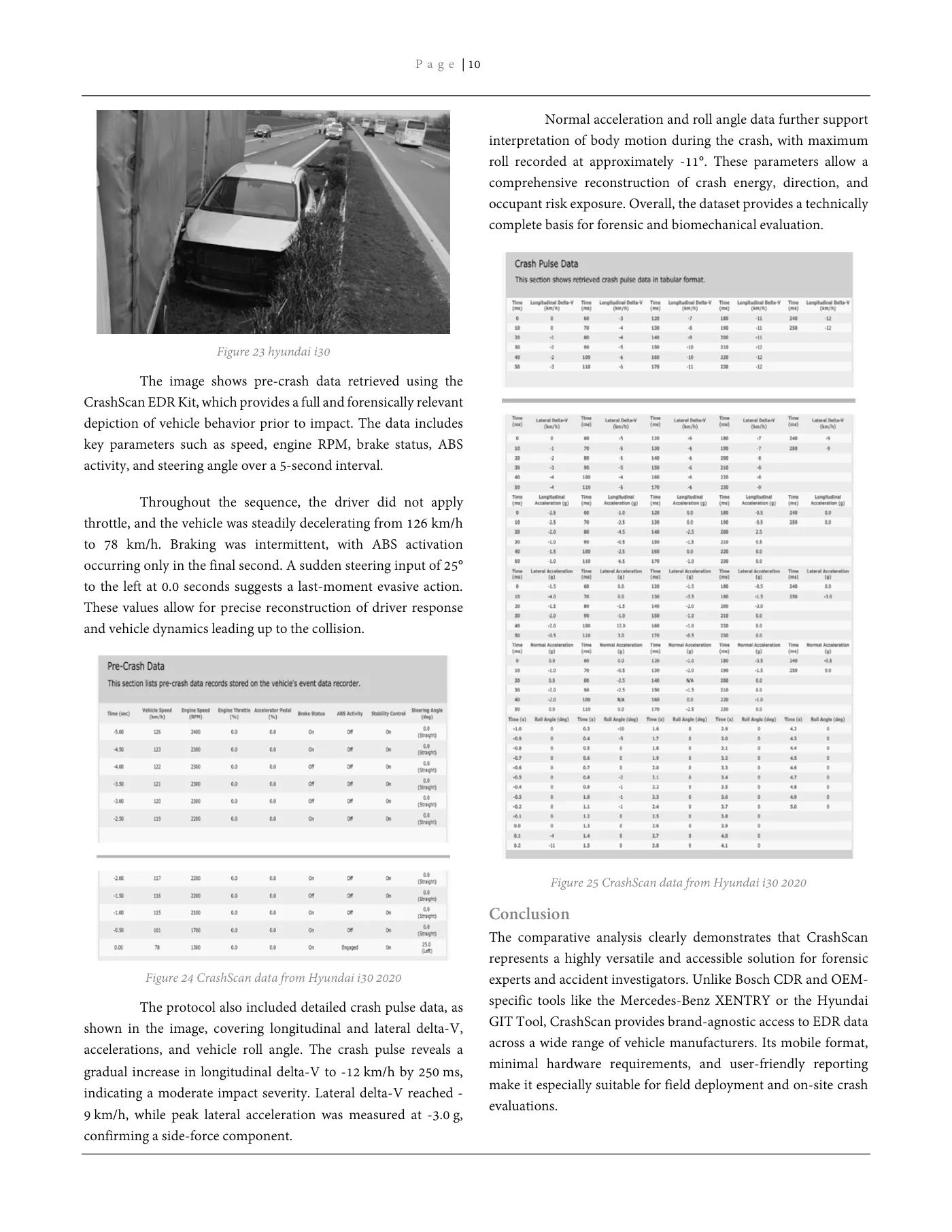
P a g e | 10 Normal acceleration and roll angle data further support interpretation of body motion during the crash, with maximum roll recorded at approximately -11°. These parameters allow a comprehensive reconstruction of crash energy, direction, and occupant risk exposure. Overall, the dataset provides a technically complete basis for forensic and biomechanical evaluation. Figure 23 hyundai i30 The image shows pre-crash data retrieved using the CrashScan EDR Kit, which provides a full and forensically relevant depiction of vehicle behavior prior to impact. The data includes key parameters such as speed, engine RPM, brake status, ABS activity, and steering angle over a 5-second interval. Throughout the sequence, the driver did not apply throttle, and the vehicle was steadily decelerating from 126 km/h to 78 km/h. Braking was intermittent, with ABS activation occurring only in the final second. A sudden steering input of 25° to the left at 0.0 seconds suggests a last-moment evasive action. These values allow for precise reconstruction of driver response and vehicle dynamics leading up to the collision. Figure 25 CrashScan data from Hyundai i30 2020 Conclusion The comparative analysis clearly demonstrates that CrashScan represents a highly versatile and accessible solution for forensic Figure 24 CrashScan data from Hyundai i30 2020 experts and accident investigators. Unlike Bosch CDR and OEM- specific tools like the Mercedes-Benz XENTRY or the Hyundai The protocol also included detailed crash pulse data, as GIT Tool, CrashScan provides brand-agnostic access to EDR datashown in the image, covering longitudinal and lateral delta-V, across a wide range of vehicle manufacturers. Its mobile format,accelerations, and vehicle roll angle. The crash pulse reveals a minimal hardware requirements, and user-friendly reportinggradual increase in longitudinal delta-V to -12 km/h by 250 ms, make it especially suitable for field deployment and on-site crashindicating a moderate impact severity. Lateral delta-V reached - evaluations.9 km/h, while peak lateral acceleration was measured at -3.0 g, confirming a side-force component.
Source page 11
Read page 11 extracted text
Extracted text may not preserve table columns. Refer to the page image or original PDF for data relationships.
P a g e | 11 While Bosch CDR remains a robust option for supported brands, its high cost, bulkiness, and more limited vehicle coverage constrain its practical use in many investigative scenarios. OEM tools like XENTRY are inaccessible to non-dealer professionals, severely limiting their forensic utility. GIT Tool is very expensive, 5000 euros for Kia and another 5000 euros for Hyundai, plus an annual license of 1000 euros per brand. Further, it only supports vehicles from 8/2024. In contrast, CrashScan delivers all critical EDR data—including pre-crash dynamics, delta-V curves, and ignition history—in a format tailored for forensic interpretation and court presentation. Its support for otherwise unsupported brands (e.g., Mercedes Benz, Ford, Land Rover, Hyundai, Kia and others) further enhances its value. For users who occasionally need to retrieve data, this tool is also financially very attractive. At the same time, it is a very compact piece of hardware that can be easily carried at all times. For independent experts and police forces, the ability to retrieve reliable crash data without OEM authorization is a decisive advantage. Given its consistent performance, technical accuracy, and comprehensive reporting, CrashScan fills critical gaps left by traditional systems and provides a legally defensible, cost- effective, and fully mobile platform for modern accident reconstruction. Authors: Ing. Peter Vertal, Ph.D. Institute of Forensic Engineering, University of Zilina, Slovakia peter.vertal@usi.sk / info@vertal.sk