Welcome to the first edition. Every month we extract and analyse forensic data from vehicles across Australia for insurers, law enforcement and legal teams. This bulletin shares what that data is telling us: de-identified fraud and collision trends from our national casework, developments in the law that shapes the discipline, and what vehicle data can prove.
70%
ADVERSE FINDINGS IN ONE REFERRED FRAUD COHORT (JULY)
~2x
GROWTH IN THE "STATIONARY AT IMPACT" SIGNATURE SINCE APRIL
$720m
EST. ANNUAL COST OF MOTOR INSURANCE FRAUD IN AUSTRALIA
5 Sec
PRE-IMPACT WINDOW RECORDED BY A MODERN EDR
T r e n d wat c h
01 / In this resource
The "stationary at impact" signature is escalating
The clearest pattern in our 2026 casework is the growth of one EDR staging signature: a vehicle recorded stationary — often in Park or
Neutral, brake applied for five seconds or more — at the moment of a claimed dynamic collision. In one insurer referral program this profile appeared in roughly a quarter of reviewed claims in April. By July it was present in almost half. A stationary, braked vehicle directly contradicts the "I was struck driving through the intersection" account — converting a he-said/she-said liability dispute into a data question with a definitive answer.
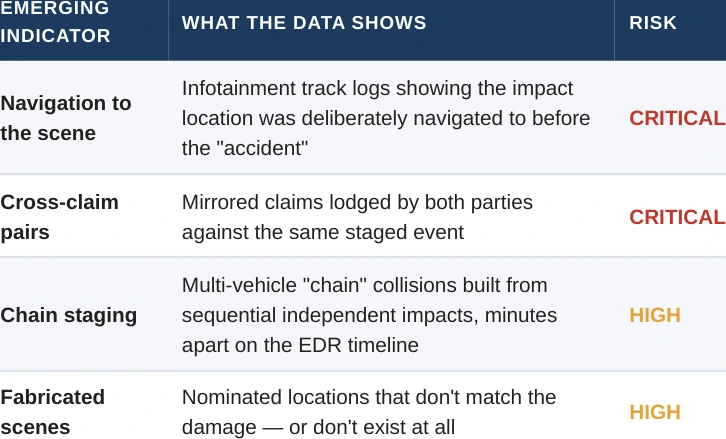
Alongside it, newer typologies are emerging in the same cohorts:
Read table as text
| EMERGING | ||
| INDICATOR | WHATTHEDATASHOWS | RISK |
| Navigationto thescene | Infotainmenttracklogsshowingtheimpact locationwasdeliberatelynavigatedtobefore the"accident" | CRITICAL |
| Cross-claim pairs | Mirroredclaimslodgedbybothparties againstthesamestagedevent | CRITICAL |
| Multi -vehicle "chain" collisions built from | ||
| Chainstaging | sequentialindependentimpacts minutes , | HIGH |
| apartontheEDRtimeline | ||
| Fabricated | Nominatedlocationsthatdon'tmatchthe | |
| scenes | damage — or don't exist at all | HIGH |
Takeaway for claims teams: intersection and roundabout claims where an EDR shows the insured vehicle stationary at impact warrant forensic review before settlement. Scene verification remains cheap, fast and frequently decisive.
02 / In this resource
Scene verification pays
Two claims in a recent referred cohort featured fabricated or unverifiable scenes — including one nominated intersection that does not exist. Physical scene attendance remains one of the cheapest, most decisive checks available and is recommended for single-vehicle loss-of-control claims wherever fraud indicators are present.
Industry note
03 / In this resource
AI-written claims are here
Analysts report a sharp rise in AI-generated claim documentation — fabricated repair estimates and manipulated imagery now feature in a growing share of flagged motor claims. Objective, physics-based vehicle data becomes more valuable as a result: an EDR record can't be prompted into existence.
Did you know
04 / In this resource
Most new cars are already witnesses
Australia doesn't mandate EDRs — but the markets our cars are built for do: the EU requires them in all new vehicles since July 2024, and they're near-universal in US-market vehicles. So the local fleet's crash-data coverage grows every year.
Collision Sciences Australia | Vehicle Data Forensics & Crash Intelligence
The black box bulletin — issue 01, august 2026
C a s e f I l e — d e - I d e n t I f I e d
05 / In this resource
Two claims, one script: how vehicle data unravelled a mirrored staged collision
Two parties recently lodged separate claims over the same alleged night-time intersection collision — each blaming the other, each with a clean, consistent story. The vehicles told a different one. Infotainment forensics on the first vehicle showed the impact location had been actively navigated to shortly before the event; the second vehicle's EDR recorded it stationary with the brake applied for more than five seconds before impact — not travelling through the intersection as claimed; and the first vehicle carried historical frontal damage predating the event. Together — mirrored accounts, deliberate navigation to the scene, and a stationary "moving" vehicle — the data established a coordinated staged collision, and both claims were referred for joint investigation.
The lesson: in any multi-vehicle claim, scan every involved vehicle. Cross-validating two EDR timelines is one of the strongest consistency tests available — staging syndicates rarely script for it.
I n d u s t r y wat c h
06 / In this resource
Tools, law & the wider picture
Retrievable-vehicle coverage keeps growing
With EDR fitment now near-universal in late-model vehicles and manufacturer data-access programs broadening through 2026, the range of makes, models and years with retrievable crash data expands every quarter. If a vehicle wasn't supported at first inspection, it's worth re-referring — coverage moves fast, and the Collision Sciences platform is updated continuously.
Infotainment forensics maturing fast
Vehicle infotainment and telematics systems — navigation history, track logs, paired devices, recorded events — are increasingly rivalling the EDR as an evidence source, as this month's case file shows. Expect infotainment evidence to feature in a growing share of fraud and liability findings.
Crash-for-cash: the international picture
Motor fraud represents roughly a third of detected insurance fraud by value in Australia, and staged collisions are the fastest-organising segment: in the UK, "crash-for-cash" is now classed as the single largest organised insurance fraud category. The typologies in this bulletin's Trend Watch track closely with that international experience.
Regulators keep moving on EDR access
The US NHTSA progressed updated EDR requirements in May 2026, and UN R169 extends EDR mandates to heavy vehicles in Europe. Expect richer, longer-duration recordings to flow through to the Australian fleet.
E x p l a I n e r
07 / In this resource
What a vehicle can tell you
Crash data
Deployment event records: impact severity, direction of force, seatbelt status, the crash pulse itself.
EDR speed
Speed, braking, throttle and steering for ~5 seconds before impact — the account-testing gold standard.
Freeze-frame
Speed and system state captured when a fault code stores — often the only speed evidence on older platforms.
DTCs
Diagnostic trouble codes: what failed, when, across which ignition cycles — timeline and operability evidence.
Infotainment & telematics
Navigation history, track logs, device pairings and events — an independent timeline that can place a vehicle (and a plan) at a scene.
Practice point
08 / In this resource
Scan early
EDR and infotainment data can be overwritten by later ignition cycles, repairs or auction handling. Refer vehicles before salvage.
Prepared by Tim Allen, Co-Founder & Director, Collision Sciences Australia. All casework statistics are aggregated and de-identified. Subscribe or refer a vehicle: tim@collisionsciences.com.au
Collision Sciences Australia | This bulletin is general information, not advice on any specific claim.