
01 / In this resource
The question
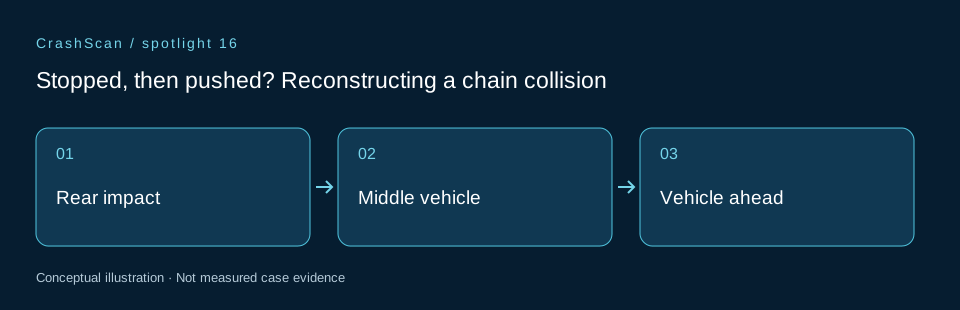
A middle vehicle contacts the vehicle ahead. Its driver says it was stationary until a rear impact pushed it forward. What evidence would help distinguish that sequence from an independent forward collision?
02 / In this resource
Build the sequence
Preserve the original retrieval outputs and identify the available event records. Read pre-crash speed, recorded changes in velocity and timing only within the definitions and limitations of the specific vehicle report. Compare these with damage locations, scene evidence, video and the accounts of all three drivers.
03 / In this resource
Match the event first
A record consistent with a rear impact is not automatically the record of the collision under investigation. When ignition-cycle information or another timing indicator is unavailable, use independent evidence to assess the match and state the remaining uncertainty. Do not invent missing timing information.
04 / In this resource
What the evidence can support
A consistent set of records and physical evidence may support the stopped-and-pushed account. It does not, by itself, resolve every question of responsibility or establish recovery of an insurance payment. Separate the technical sequence from any later claims or legal decision.
05 / In this resource
Practical takeaway
Ask two distinct questions: does this record belong to this incident, and what sequence does the combined evidence support? Document the answer and limitations for each.
06 / In this resource
About this example
This is an original illustrative scenario informed by recurring customer questions. It is not a published customer case, report extract, measured reconstruction or claim of a customer outcome.
Use the Start here — Professional & technical guide and current vehicle-specific report definitions for each assignment.