Collision Sciences inc.
Digital vehicle forensic guideline
EDR collection, validation, interpretation & legal evidence admissibility resource
For Judges, Court Experts, Lawyers, Investigators and Insurers Including a standards mapped review of the CrashScan® process and chain of evidence
Research edition 3 September 2026 | Publication revision 11 October 2026
This resource is educational and technical, not jurisdiction-specific legal advice.
01 / In this resource
Executive summary
Event Data Recorder (EDR) evidence is now a mature form of digital vehicle evidence. Courts in multiple U.S. jurisdictions have admitted EDR/SDM evidence after reliability challenges, and Canadian appellate courts have repeatedly addressed the admissibility and privacy treatment of EDR data. The strongest authorities do not treat EDR evidence as self-proving.
They emphasize a foundation showing that the relevant device was functioning, the data were lawfully obtained, the extraction method is reliable, the data are tied to the subject vehicle/event, known limitations are disclosed, and a qualified witness can explain the retrieval and interpretation. The scientific literature likewise supports use of EDR data as a reconstruction input, while identifying measurable limitations. Published testing has compared EDR-reported speed, delta-V, driver inputs and timing against independent instrumentation.
The recurrent theme is not “perfect accuracy,” but testable accuracy within vehicle- and parameter-specific limits. A legally defensible opinion therefore separates: (1) the vehicle-recorded facts; (2) the extraction/translation process; (3) engineering interpretation; and (4) any further reconstruction, biomechanical or legal inference.
For CrashScan, the available evidence reviewed for this resource establishes a field acquisition workflow through supported vehicle interfaces, cloud-based processing/reporting, access to raw and decoded EDR content in report workflows, engineering review/support, and multiple published or publicly available comparisons against Bosch CDR and OEM diagnostic platforms. Dr. Peter Vertaľ’s 2026 comparative work reports materially consistent key values between CrashScan and Bosch/OEM sources in the tested vehicles, and newer CrashScan-related publications describe bench-top and controlled-test validation.
This guideline specifies a Court-Ready EDR Evidence Package to preserve and produce when litigation is reasonably anticipated. Recommended controls are not a statement that every current or historical acquisition satisfied those controls. Core rule for courts and experts. EDR evidence should be evaluated as a layered digital measurement system. Reliability is strongest when the original vehicle/module, acquisition record, immutable or integrity-verifiable source data, translation/report, software/tool version, event identification, vehicle-specific limitations, and an independent reconstruction cross-check can all be traced and explained.
Key conclusions
• EDR data is widely used and repeatedly admitted in U.S. and Canadian courts, but admissibility is fact- and jurisdiction-specific; privacy/search issues are analytically separate from scientific reliability. • SAE J1698, J1698/1, J1698/2 and J1698/3 provide a recognized technical vocabulary and retrieval/output framework; 49 CFR Part 563 sets U.S. requirements for vehicles voluntarily equipped with EDRs within its scope. • ISO/IEC 27037 is a useful digital-evidence overlay for identification, collection, acquisition and preservation, even though it is not vehicle-specific. • EDR values should never be treated as a substitute for vehicle-specific data limitations, scene evidence and reconstruction judgment. Wheel-speed-based pre-crash values, event timing, trigger logic, truncation, multievent storage and power state can materially affect interpretation. • For court use, the acquisition should be documented contemporaneously. The minimum record should identify vehicle/VIN, module, date/time, examiner, authority/consent, connection method, hardware identifier, app/tool and version, event(s) retrieved, warnings/errors, source-data preservation, report version, and every subsequent transfer or transformation. • CrashScan validation evidence is strongest when its output is cross-verified against Bosch CDR/OEM tools or independent instrumentation for the relevant vehicle family. The Vertaľ publications provide useful platform level evidence; case-specific validation remains preferable when a result is disputed. • A litigation package should include integrity hashes, native/raw exports where technically available, extraction logs, version metadata, immutable server-side audit records, a translation/version statement, and a signed analyst declaration.
Table of contents
Part I — Digital Vehicle Forensics: Scientific and Legal Foundation 1. Scope, Terminology and Evidentiary Model 2. How EDR Systems Record Events 3. Governing Standards, Regulations and Digital-Evidence Principles 4. Court-Ready Collection and Acquisition Protocol 5. Preservation, Chain of Custody and Integrity Controls 6. Validation, Accuracy, Limitations and Reconstruction Use 7. Legal Admissibility Framework — United States 8. Legal Admissibility Framework — Canada and Comparative Notes 9. Courtroom Foundation, Expert Testimony and Cross-Examination Part II — CrashScan Process, Chain of Evidence and Standards Mapping 10.
CrashScan Workflow 11. CrashScan Evidentiary Chain and Controls 12. CrashScan Validation Evidence 13. Court-Ready CrashScan Evidence Package 14. Recommended Evidence Controls Appendix A — Verified Legal Authorities and Docket References Appendix B — Scientific and Technical Validation Literature Appendix C — CrashScan-Specific Scientific/Public References Appendix D — Model Collection, Chain-of-Custody and Testimony Checklists Appendix E — Scope and Source Notes
02 / In this resource
Part I — Digital vehicle forensics: scientific and legal foundation
03 / In this resource
1. Scope, terminology and evidentiary model
This guideline addresses light-duty motor-vehicle Event Data Recorder information and closely related airbag/control-module event data used in collision investigation. “EDR” is used functionally: a device or function in a vehicle that records technical vehicle and occupant information for a brief period before, during and/or after a crash or crash-like event. NHTSA uses a similarly bounded definition and distinguishes EDRs from continuous audio, video or long-duration logging systems. The term “black box” is convenient but imprecise. Depending on manufacturer and model year, EDR functions may reside in an airbag control module (ACM), sensing and diagnostic module (SDM), restraint control module (RCM), supplemental restraint system controller, powertrain control module, active-safety control module, or another ECU. The specific architecture matters because trigger logic, sampling frequency, record duration, event locking behavior, data elements and retrievability differ.
1.1. Four evidentiary layers
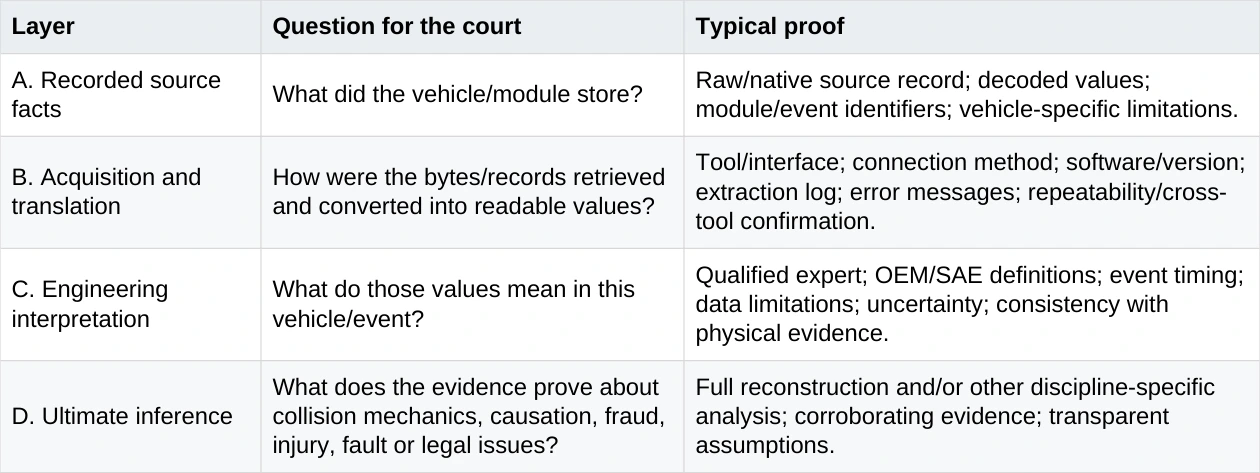
Read table as text
| Layer | Question for the court | Typical proof |
| A. Recorded source facts | What did the vehicle/module store? | Raw/native source record; decoded values; module/event identifiers; vehicle-specific limitations. |
| B. Acquisition and translation | How were the bytes/records retrieved and converted into readable values? | Tool/interface; connection method; software/version; extraction log; error messages; repeatability/cross- tool confirmation. |
| C. Engineering interpretation | What do those values mean in this vehicle/event? | Qualified expert; OEM/SAE definitions; event timing; data limitations; uncertainty; consistency with physical evidence. |
| D. Ultimate inference | What does the evidence prove about collision mechanics, causation, fraud, injury, fault or legal issues? | Full reconstruction and/or other discipline-specific analysis; corroborating evidence; transparent assumptions. |
A weakness in Layer D does not necessarily make Layer A unreliable; conversely, a clean-looking report at Layer D cannot cure an undocumented acquisition at Layer B. Courts should identify which layer is actually disputed.
04 / In this resource
2. How EDR systems record events
Most EDR-capable restraint systems continually monitor vehicle and restraint-system signals. When a manufacturer-defined trigger or deployment/near-deployment criterion is met, selected information is retained in non-volatile memory. Newer systems subject to 49 CFR Part 563 have standardized minimum data and recording requirements, but implementation still varies by manufacturer and model year.
2.1. Common data categories
• Pre-crash vehicle state: indicated vehicle speed, engine speed, accelerator/throttle position, service brake status, steering input, stability-control/ABS status, gear, and other manufacturer-specific signals. • Crash pulse/severity: longitudinal and sometimes lateral delta-V or acceleration over time, time to maximum delta-V, rollover/angular data where supported, event duration and trigger/deployment timing.
• Occupant/restraint state: belt buckle status, seat occupancy/classification, pretensioner and airbag deployment times, warning lamp status and related restraint metadata. • Event metadata: number/order of events, event-lock status, ignition cycles, odometer or mileage, date/time in some architectures, module identifiers, data-completeness status and power status.
2.2. What an EDR does not prove by itself
• The identity of the driver unless independently established. • Exact ground speed in every condition; many systems derive speed from wheel/vehicle bus signals affected by tire size, wheel slip, ABS operation, drivetrain state or signal-update timing. • Absolute collision time unless the module stores a trustworthy time reference and its meaning is validated. • The complete collision sequence if the record window truncates before the crash pulse ends or if multiple impacts/events occurred. • Causation, negligence, criminal intent, injury causation or fraud without additional factual and expert analysis.
05 / In this resource
3. Governing standards, regulations and digital-evidence principles
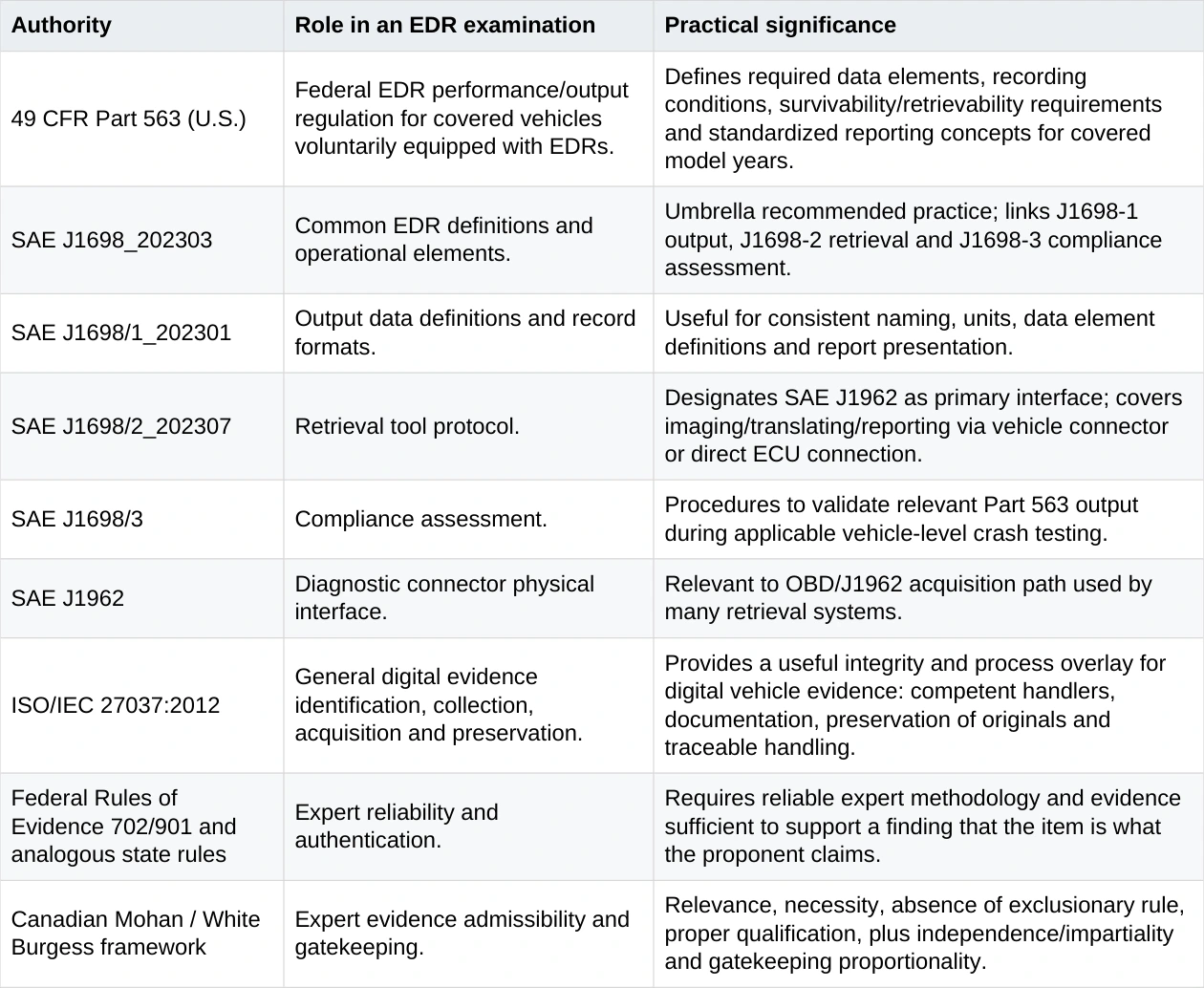
Read table as text
| Authority | Role in an EDR examination | Practical significance |
| 49 CFR Part 563 (U.S.) | Federal EDR performance/output regulation for covered vehicles voluntarily equipped with EDRs. | Defines required data elements, recording conditions, survivability/retrievability requirements and standardized reporting concepts for covered model years. |
| SAE J1698_202303 | Common EDR definitions and operational elements. | Umbrella recommended practice; links J1698-1 output, J1698-2 retrieval and J1698-3 compliance assessment. |
| SAE J1698/1_202301 | Output data definitions and record formats. | Useful for consistent naming, units, data element definitions and report presentation. |
| SAE J1698/2_202307 | Retrieval tool protocol. | Designates SAE J1962 as primary interface; covers imaging/translating/reporting via vehicle connector or direct ECU connection. |
| SAE J1698/3 | Compliance assessment. | Procedures to validate relevant Part 563 output during applicable vehicle-level crash testing. |
| SAE J1962 | Diagnostic connector physical interface. | Relevant to OBD/J1962 acquisition path used by many retrieval systems. |
| ISO/IEC 27037:2012 | General digital evidence identification, collection, acquisition and preservation. | Provides a useful integrity and process overlay for digital vehicle evidence: competent handlers, documentation, preservation of originals and traceable handling. |
| Federal Rules of Evidence 702/901 and analogous state rules | Expert reliability and authentication. | Requires reliable expert methodology and evidence sufficient to support a finding that the item is what the proponent claims. |
| Canadian Mohan / White Burgess framework | Expert evidence admissibility and gatekeeping. | Relevance, necessity, absence of exclusionary rule, proper qualification, plus independence/impartiality and gatekeeping proportionality. |
Standards are not a substitute for vehicle-specific limitations. SAE J1698 expressly recognizes that EDR data originate in onboard electronic systems and may not capture the complete vehicle dynamics of a collision. The examiner must review the specific vehicle/tool data limitations and event status rather than assume that standardization makes every value equally probative.
06 / In this resource
4. Court-ready collection and acquisition protocol
4.1. Before touching the vehicle
1. Confirm legal authority: owner/lessee consent, insurer/policy authority where legally sufficient, court order, warrant, discovery order, statutory authority, or other lawful basis. Record the basis and its scope. 2. Identify and photograph the vehicle: VIN plate, certification labels, exterior condition, odometer/display state if safely available, battery/power condition, airbag deployment condition, and damage affecting modules/connectors. 3. Create a unique case/evidence identifier and open a contemporaneous acquisition log. Record date/time, location, examiner, observers, equipment and purpose. 4. Assess whether OBD/J1962 retrieval risks loss or alteration because of electrical damage, post-crash repair, module replacement or unstable power. If so, preserve the module and consider direct-to- module/bench methods by qualified personnel. 5. Avoid unnecessary ignition cycling, clearing diagnostic trouble codes, programming modules, replacing a battery or performing service procedures before the EDR acquisition. If unavoidable, document it.
4.2. Acquisition
1. Use a supported retrieval pathway for the exact year/make/model/module and market. Confirm tool support before relying on output. 2. Record hardware/interface make, model and identifier; cable/adapter; mobile device/computer where material; software/app version; retrieval/decoder database version if available. 3. Record connection path (J1962/OBD, direct-to-module, bench, OEM tool, manufacturer service) and any external power/back-powering method. 4. Capture the tool’s full status messages, warnings, vehicle identification, module identity, event list and data- completeness indicators. Do not preserve only the final human-readable summary. 5. Preserve the native/raw acquisition artifact where technically available. If the platform uses a server- mediated workflow, preserve the server-side source object or export, request/response identifiers, timestamps and immutable audit event(s) sufficient to prove what was received and what translation version was applied. 6. Generate and preserve a human-readable report without overwriting source data. Distinguish recorded fields from calculations and contextual interpretation. 7. Where a matter is contested or high consequence, perform a repeat acquisition if the manufacturer/tool permits it without altering the record, or cross-verify with a second supported tool/OEM pathway or independent measurement source.
4.3. Immediate post-acquisition checks
• VIN/Module identity agrees with the subject vehicle or any discrepancy is explained.
• Event timing/order and ignition-cycle/odometer metadata plausibly correspond to the investigated collision. • No “unsupported,” “invalid,” “not complete,” “truncated,” “not locked,” “power interruption,” or similar warning is overlooked. • Pre-crash speed and control inputs are physically plausible and compared with available scene/video/GPS/damage evidence. • The applicable OEM/tool data limitations are attached or quoted accurately in the analyst work file. • Any conversion, smoothing, direction convention, sign convention or derived calculation is documented.
07 / In this resource
5. Preservation, chain of custody and integrity controls
Digital evidence can be copied without visible degradation, which makes provenance and integrity records more important—not less. A persuasive chain of evidence should establish both physical custody of the vehicle/module and logical custody of the acquired digital record.
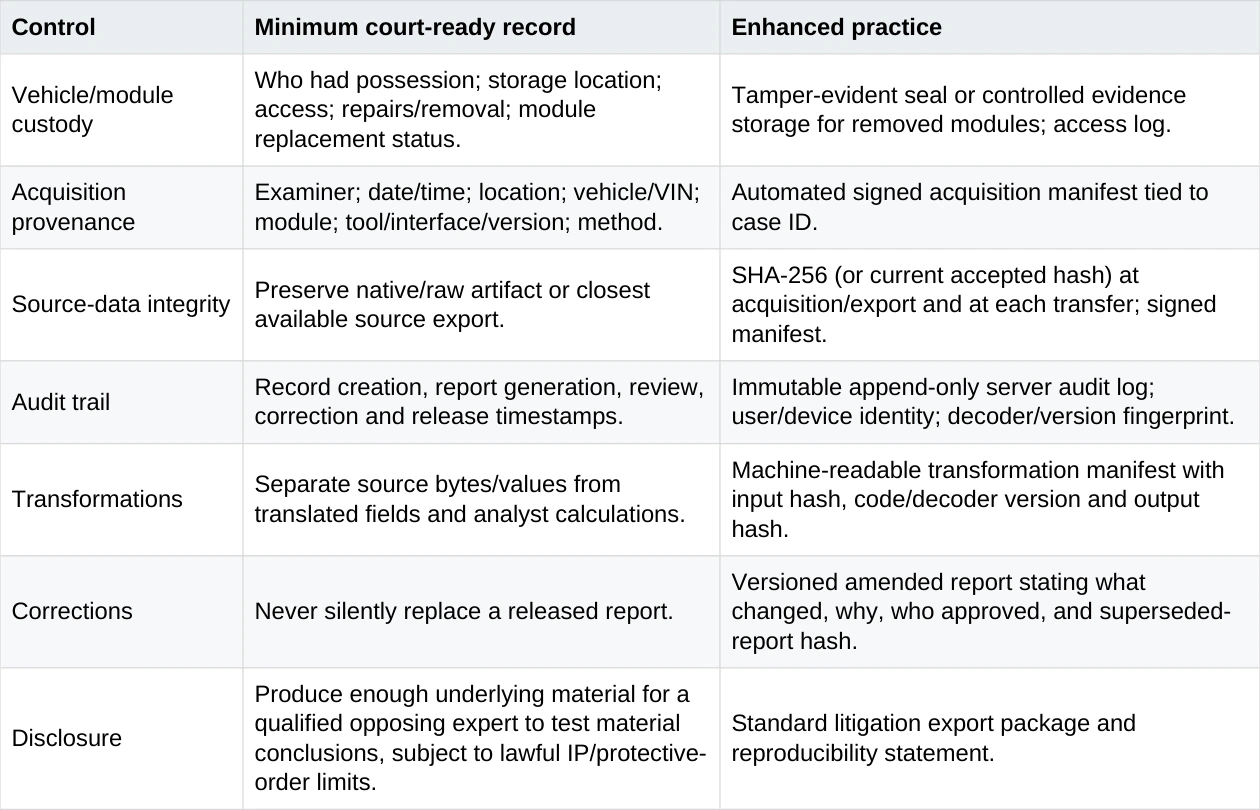
Read table as text
| Control | Minimum court-ready record | Enhanced practice |
| Vehicle/module custody | Who had possession; storage location; access; repairs/removal; module replacement status. | Tamper-evident seal or controlled evidence storage for removed modules; access log. |
| Acquisition provenance | Examiner; date/time; location; vehicle/VIN; module; tool/interface/version; method. | Automated signed acquisition manifest tied to case ID. |
| Source-data integrity | Preserve native/raw artifact or closest available source export. | SHA-256 (or current accepted hash) at acquisition/export and at each transfer; signed manifest. |
| Audit trail | Record creation, report generation, review, correction and release timestamps. | Immutable append-only server audit log; user/device identity; decoder/version fingerprint. |
| Transformations | Separate source bytes/values from translated fields and analyst calculations. | Machine-readable transformation manifest with input hash, code/decoder version and output hash. |
| Corrections | Never silently replace a released report. | Versioned amended report stating what changed, why, who approved, and superseded- report hash. |
| Disclosure | Produce enough underlying material for a qualified opposing expert to test material conclusions, subject to lawful IP/protective- order limits. | Standard litigation export package and reproducibility statement. |
A practical distinction. Chain of custody is not merely a list of people who handled a paper report. For EDR evidence, the more important question is whether the court can trace the report back to the particular vehicle/module acquisition and determine that the underlying digital record and material transformations are intact and explainable.
08 / In this resource
6. Validation, accuracy, limitations and reconstruction use
Published EDR research supports the reliability of many recorded parameters when interpreted within documented limits. Representative studies have compared EDR values with calibrated fifth wheels, GPS/VBOX systems, laboratory accelerometers, CAN-bus recordings and instrumented crash tests. The
literature also identifies predictable error sources: wheel slip during hard braking, sample/update timing, truncation of the crash pulse, sensor range, event thresholds, multi-event behavior and manufacturer- specific logic.
6.1. Validation hierarchy
1. Vehicle/model-specific controlled validation against independent instrumentation is strongest for the exact parameter at issue. 2. Platform/OEM-generation validation is strong when the tested architecture and decoder are materially the same. 3. Cross-tool agreement (e.g., independent retrieval systems producing materially the same decoded values from the same module) supports translation reliability but does not independently validate the vehicle sensor itself. 4. Consistency with scene evidence, video, crush, tire marks and kinematics is an essential case-specific reasonableness check. 5. General literature on EDR technology establishes broad scientific acceptance but should not be used to erase a specific warning or data limitation in the subject report.
6.2. Interpretation principles
• Quote the recorded value and its resolution/units before presenting a derived conclusion. • Apply the manufacturer/tool data limitations that correspond to the exact event and model year. • Distinguish “vehicle speed signal” from ground-truth speed; explain wheel slip, tire-size or drivetrain effects when material. • For delta-V, confirm whether the record contains the full crash pulse. An incomplete record can underestimate total change in velocity. • Do not infer absence of collision simply from “no event” without considering the trigger threshold, event storage logic, overwritten/unlocked records and vehicle support. • Correlate events using independent chronology. Ignition cycles, mileage/date-time, damage/deployment state and event order are stronger together than individually. • Where a high-stakes opinion depends on one EDR field, quantify reasonable uncertainty rather than report false precision.
09 / In this resource
7. Legal admissibility framework — United States
There is no single nationwide “EDR admissibility rule.” In federal and many state courts, the proponent must satisfy ordinary relevance, authentication and expert-evidence rules. Scientific reliability is analyzed under Federal Rule of Evidence 702/Daubert in federal court and Daubert-like regimes, while some jurisdictions use Frye/general-acceptance principles. The reported EDR cases overwhelmingly show that the technology can satisfy those standards when an adequate foundation is laid; challenges often shift from categorical admissibility to the weight of a particular value or extraction.
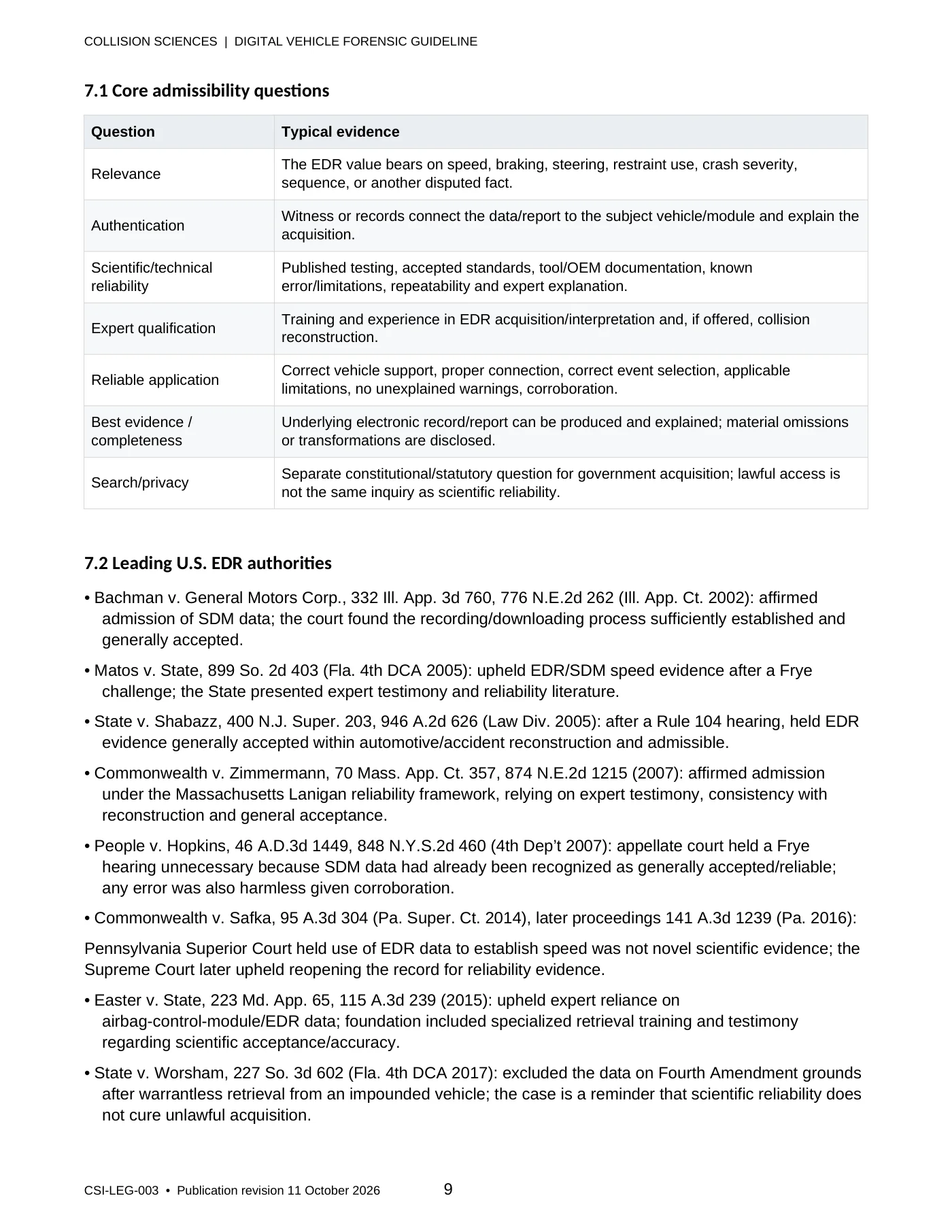
7.1. Core admissibility questions
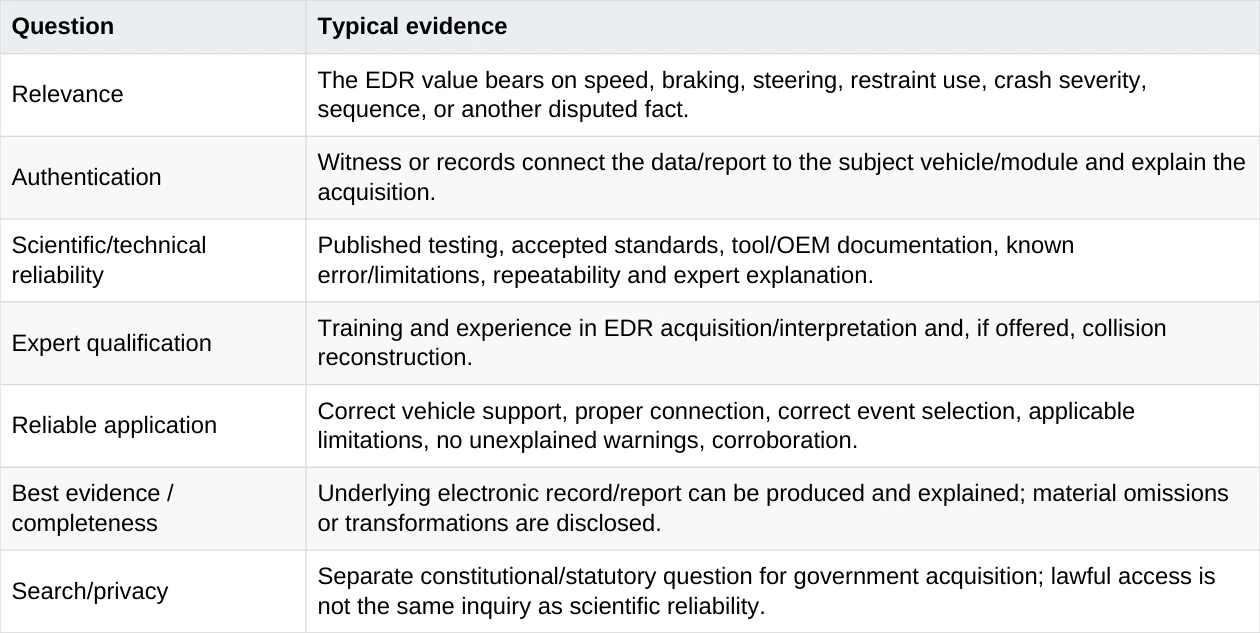
Read table as text
| Question | Typical evidence |
| Relevance | The EDR value bears on speed, braking, steering, restraint use, crash severity, sequence, or another disputed fact. |
| Authentication | Witness or records connect the data/report to the subject vehicle/module and explain the acquisition. |
| Scientific/technical reliability | Published testing, accepted standards, tool/OEM documentation, known error/limitations, repeatability and expert explanation. |
| Expert qualification | Training and experience in EDR acquisition/interpretation and, if offered, collision reconstruction. |
| Reliable application | Correct vehicle support, proper connection, correct event selection, applicable limitations, no unexplained warnings, corroboration. |
| Best evidence / completeness | Underlying electronic record/report can be produced and explained; material omissions or transformations are disclosed. |
| Search/privacy | Separate constitutional/statutory question for government acquisition; lawful access is not the same inquiry as scientific reliability. |
7.2. Leading U.S. EDR authorities
• Bachman v. General Motors Corp., 332 Ill. App. 3d 760, 776 N.E.2d 262 (Ill. App. Ct. 2002): affirmed admission of SDM data; the court found the recording/downloading process sufficiently established and generally accepted. • Matos v. State, 899 So. 2d 403 (Fla. 4th DCA 2005): upheld EDR/SDM speed evidence after a Frye challenge; the State presented expert testimony and reliability literature. • State v. Shabazz, 400 N.J. Super. 203, 946 A.2d 626 (Law Div. 2005): after a Rule 104 hearing, held EDR evidence generally accepted within automotive/accident reconstruction and admissible. • Commonwealth v. Zimmermann, 70 Mass. App. Ct. 357, 874 N.E.2d 1215 (2007): affirmed admission under the Massachusetts Lanigan reliability framework, relying on expert testimony, consistency with reconstruction and general acceptance. • People v. Hopkins, 46 A.D.3d 1449, 848 N.Y.S.2d 460 (4th Dep’t 2007): appellate court held a Frye hearing unnecessary because SDM data had already been recognized as generally accepted/reliable; any error was also harmless given corroboration. • Commonwealth v. Safka, 95 A.3d 304 (Pa. Super. Ct. 2014), later proceedings 141 A.3d 1239 (Pa. 2016): Pennsylvania Superior Court held use of EDR data to establish speed was not novel scientific evidence; the Supreme Court later upheld reopening the record for reliability evidence. • Easter v. State, 223 Md. App. 65, 115 A.3d 239 (2015): upheld expert reliance on airbag-control-module/EDR data; foundation included specialized retrieval training and testimony regarding scientific acceptance/accuracy. • State v. Worsham, 227 So. 3d 602 (Fla. 4th DCA 2017): excluded the data on Fourth Amendment grounds after warrantless retrieval from an impounded vehicle; the case is a reminder that scientific reliability does not cure unlawful acquisition.
10 / In this resource
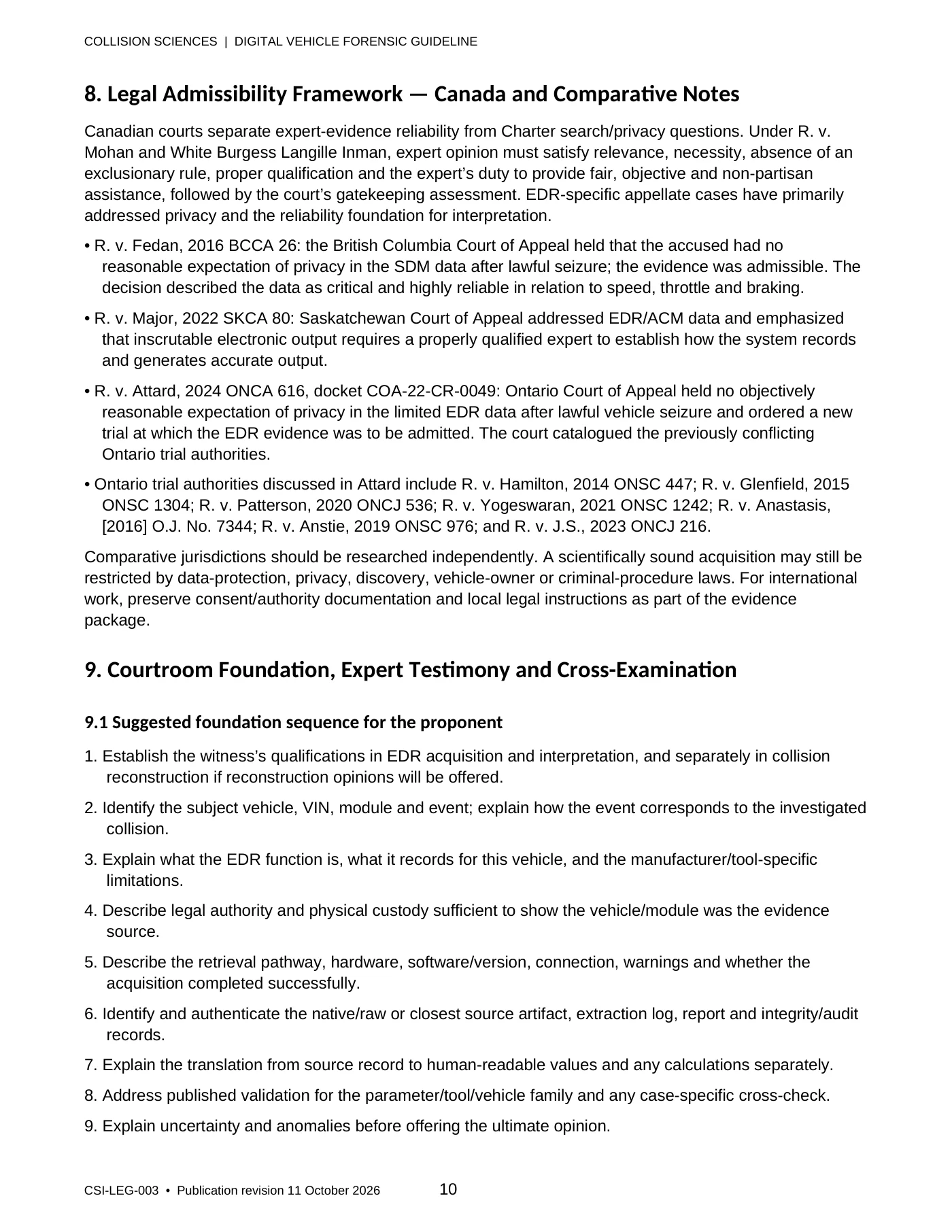
8. Legal admissibility framework — Canada and comparative notes
Canadian courts separate expert-evidence reliability from Charter search/privacy questions. Under R. v. Mohan and White Burgess Langille Inman, expert opinion must satisfy relevance, necessity, absence of an exclusionary rule, proper qualification and the expert’s duty to provide fair, objective and non-partisan assistance, followed by the court’s gatekeeping assessment. EDR-specific appellate cases have primarily addressed privacy and the reliability foundation for interpretation. • R. v.
Fedan, 2016 BCCA 26: the British Columbia Court of Appeal held that the accused had no reasonable expectation of privacy in the SDM data after lawful seizure; the evidence was admissible. The decision described the data as critical and highly reliable in relation to speed, throttle and braking. • R. v. Major, 2022 SKCA 80: Saskatchewan Court of Appeal addressed EDR/ACM data and emphasized that inscrutable electronic output requires a properly qualified expert to establish how the system records and generates accurate output. • R. v.
Attard, 2024 ONCA 616, docket COA-22-CR-0049: Ontario Court of Appeal held no objectively reasonable expectation of privacy in the limited EDR data after lawful vehicle seizure and ordered a new trial at which the EDR evidence was to be admitted. The court catalogued the previously conflicting Ontario trial authorities. • Ontario trial authorities discussed in Attard include R. v. Hamilton, 2014 ONSC 447; R. v. Glenfield, 2015 ONSC 1304; R. v. Patterson, 2020 ONCJ 536; R. v. Yogeswaran, 2021 ONSC 1242; R. v. Anastasis, [2016] O.J. No. 7344; R. v. Anstie, 2019 ONSC 976; and R. v. J.S., 2023 ONCJ 216.
Comparative jurisdictions should be researched independently. A scientifically sound acquisition may still be restricted by data-protection, privacy, discovery, vehicle-owner or criminal-procedure laws. For international work, preserve consent/authority documentation and local legal instructions as part of the evidence package.
11 / In this resource
9. Courtroom foundation, expert testimony and cross-examination
9.1. Suggested foundation sequence for the proponent
1. Establish the witness’s qualifications in EDR acquisition and interpretation, and separately in collision reconstruction if reconstruction opinions will be offered. 2. Identify the subject vehicle, VIN, module and event; explain how the event corresponds to the investigated collision. 3. Explain what the EDR function is, what it records for this vehicle, and the manufacturer/tool-specific limitations. 4. Describe legal authority and physical custody sufficient to show the vehicle/module was the evidence source. 5. Describe the retrieval pathway, hardware, software/version, connection, warnings and whether the acquisition completed successfully. 6. Identify and authenticate the native/raw or closest source artifact, extraction log, report and integrity/audit records. 7. Explain the translation from source record to human-readable values and any calculations separately. 8. Address published validation for the parameter/tool/vehicle family and any case-specific cross-check. 9. Explain uncertainty and anomalies before offering the ultimate opinion.
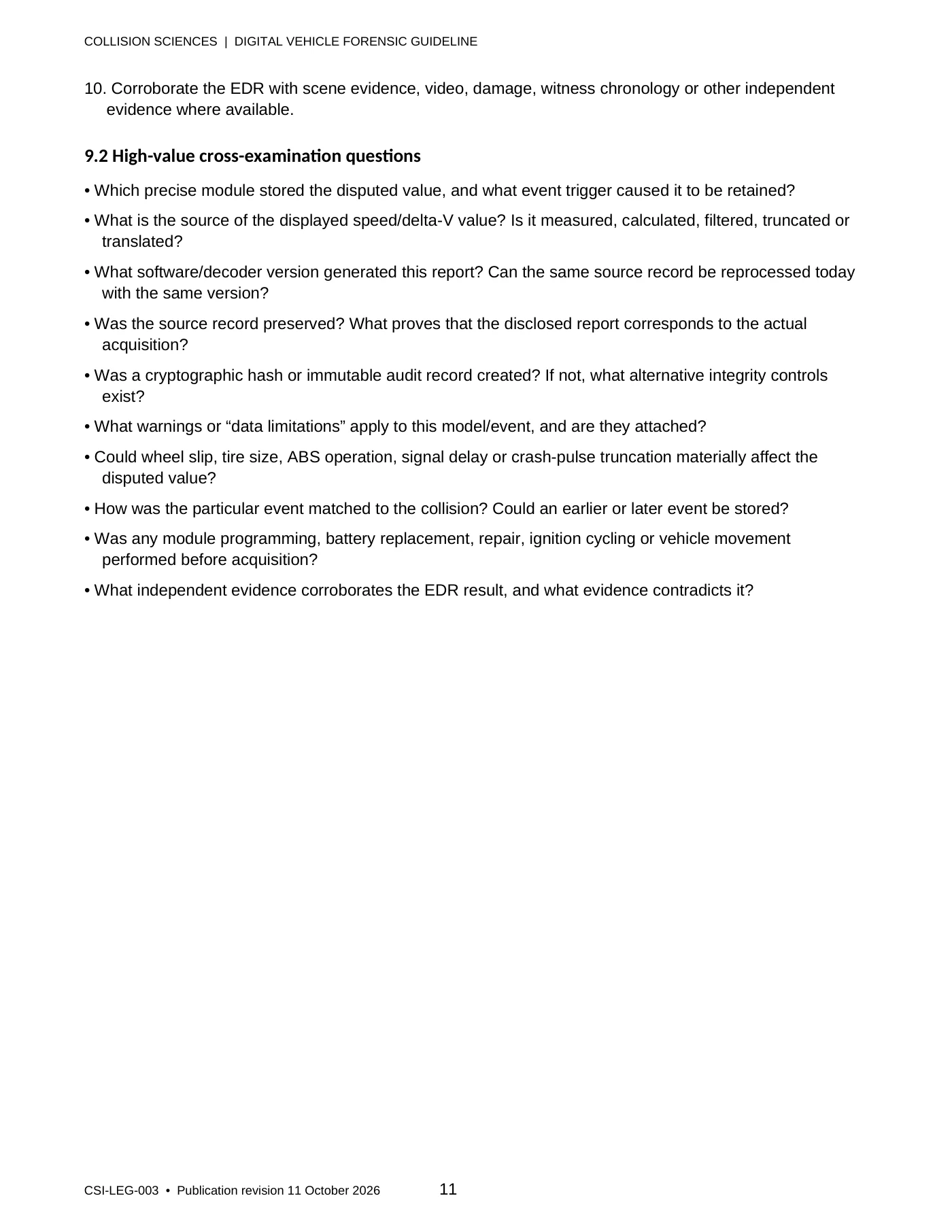
10. Corroborate the EDR with scene evidence, video, damage, witness chronology or other independent evidence where available.
9.2. High-value cross-examination questions
• Which precise module stored the disputed value, and what event trigger caused it to be retained? • What is the source of the displayed speed/delta-V value? Is it measured, calculated, filtered, truncated or translated? • What software/decoder version generated this report? Can the same source record be reprocessed today with the same version? • Was the source record preserved? What proves that the disclosed report corresponds to the actual acquisition? • Was a cryptographic hash or immutable audit record created? If not, what alternative integrity controls exist? • What warnings or “data limitations” apply to this model/event, and are they attached? • Could wheel slip, tire size, ABS operation, signal delay or crash-pulse truncation materially affect the disputed value? • How was the particular event matched to the collision? Could an earlier or later event be stored? • Was any module programming, battery replacement, repair, ignition cycling or vehicle movement performed before acquisition? • What independent evidence corroborates the EDR result, and what evidence contradicts it?
12 / In this resource
Part II — CrashScan process, chain of evidence and standards mapping
13 / In this resource
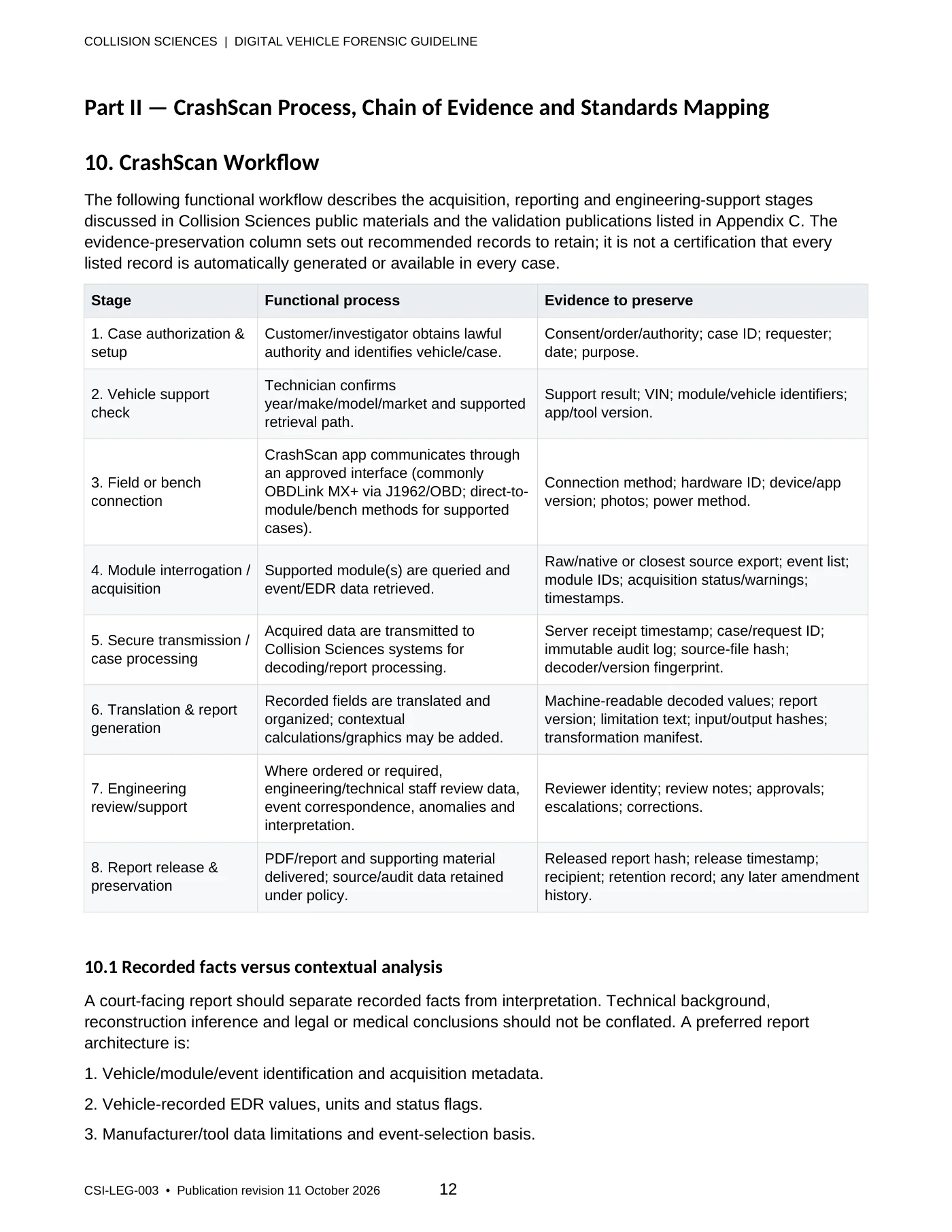
10. CrashScan workflow
The following functional workflow describes the acquisition, reporting and engineering-support stages discussed in Collision Sciences public materials and the validation publications listed in Appendix C. The evidence-preservation column sets out recommended records to retain; it is not a certification that every listed record is automatically generated or available in every case.
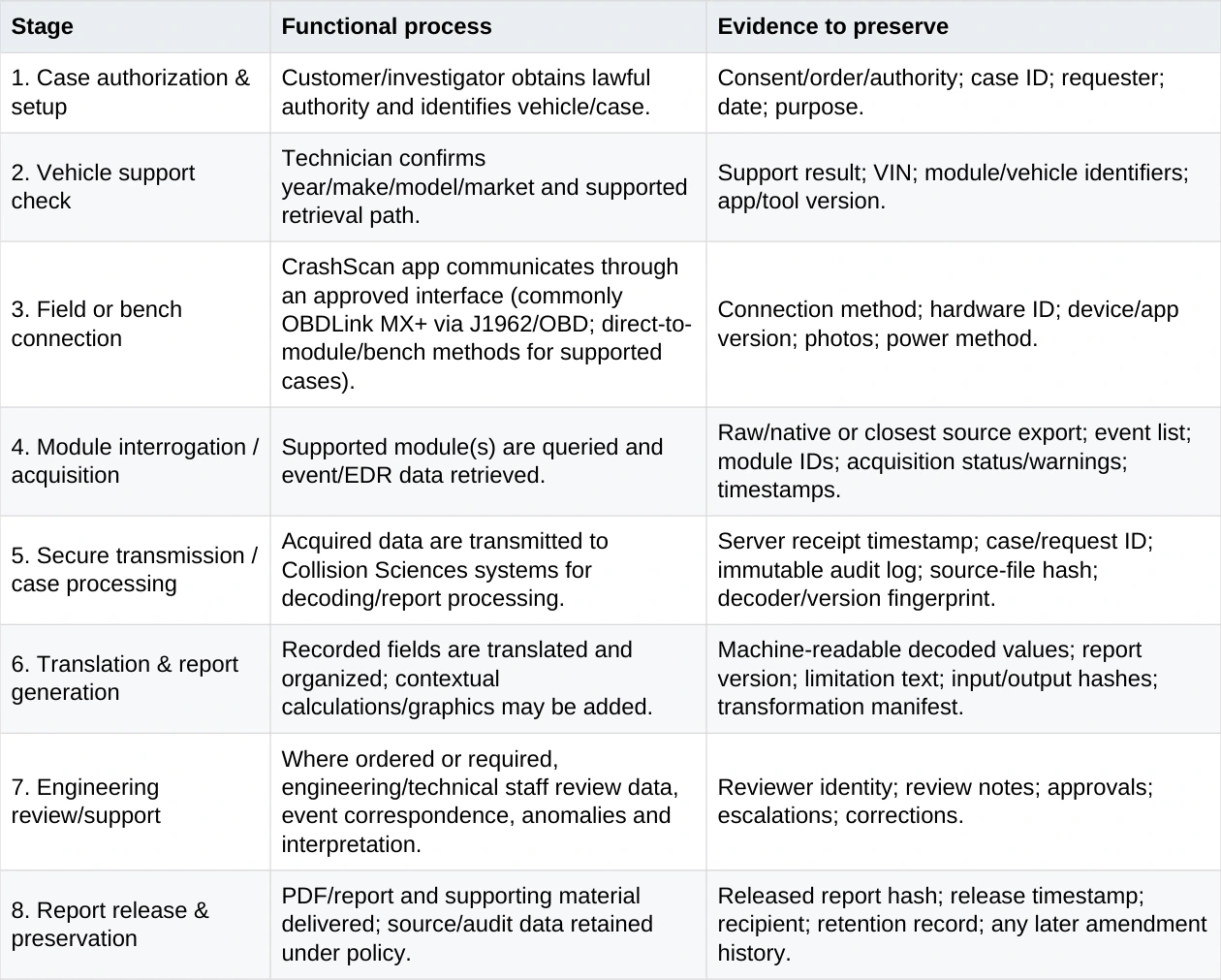
Read table as text
| Stage | Functional process | Evidence to preserve |
| 1. Case authorization & setup | Customer/investigator obtains lawful authority and identifies vehicle/case. | Consent/order/authority; case ID; requester; date; purpose. |
| 2. Vehicle support check | Technician confirms year/make/model/market and supported retrieval path. | Support result; VIN; module/vehicle identifiers; app/tool version. |
| 3. Field or bench connection | CrashScan app communicates through an approved interface (commonly OBDLink MX+ via J1962/OBD; direct-to- module/bench methods for supported cases). | Connection method; hardware ID; device/app version; photos; power method. |
| 4. Module interrogation / acquisition | Supported module(s) are queried and event/EDR data retrieved. | Raw/native or closest source export; event list; module IDs; acquisition status/warnings; timestamps. |
| 5. Secure transmission / case processing | Acquired data are transmitted to Collision Sciences systems for decoding/report processing. | Server receipt timestamp; case/request ID; immutable audit log; source-file hash; decoder/version fingerprint. |
| 6. Translation & report generation | Recorded fields are translated and organized; contextual calculations/graphics may be added. | Machine-readable decoded values; report version; limitation text; input/output hashes; transformation manifest. |
| 7. Engineering review/support | Where ordered or required, engineering/technical staff review data, event correspondence, anomalies and interpretation. | Reviewer identity; review notes; approvals; escalations; corrections. |
| 8. Report release & preservation | PDF/report and supporting material delivered; source/audit data retained under policy. | Released report hash; release timestamp; recipient; retention record; any later amendment history. |
10.1. Recorded facts versus contextual analysis
A court-facing report should separate recorded facts from interpretation. Technical background, reconstruction inference and legal or medical conclusions should not be conflated. A preferred report architecture is: 1. Vehicle/module/event identification and acquisition metadata. 2. Vehicle-recorded EDR values, units and status flags. 3. Manufacturer/tool data limitations and event-selection basis.
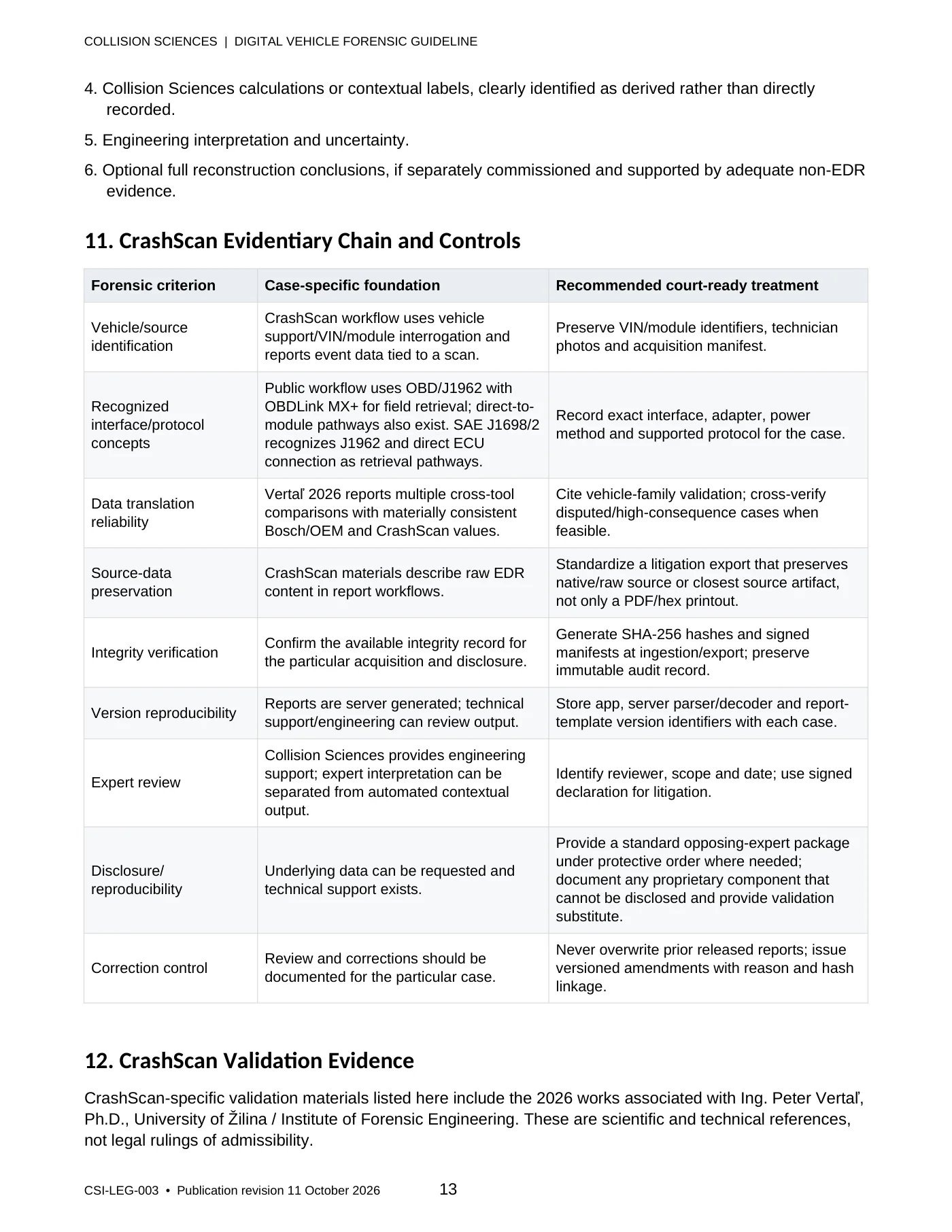
4. Collision Sciences calculations or contextual labels, clearly identified as derived rather than directly recorded. 5. Engineering interpretation and uncertainty. 6. Optional full reconstruction conclusions, if separately commissioned and supported by adequate non-EDR evidence.
14 / In this resource
11. CrashScan evidentiary chain and controls
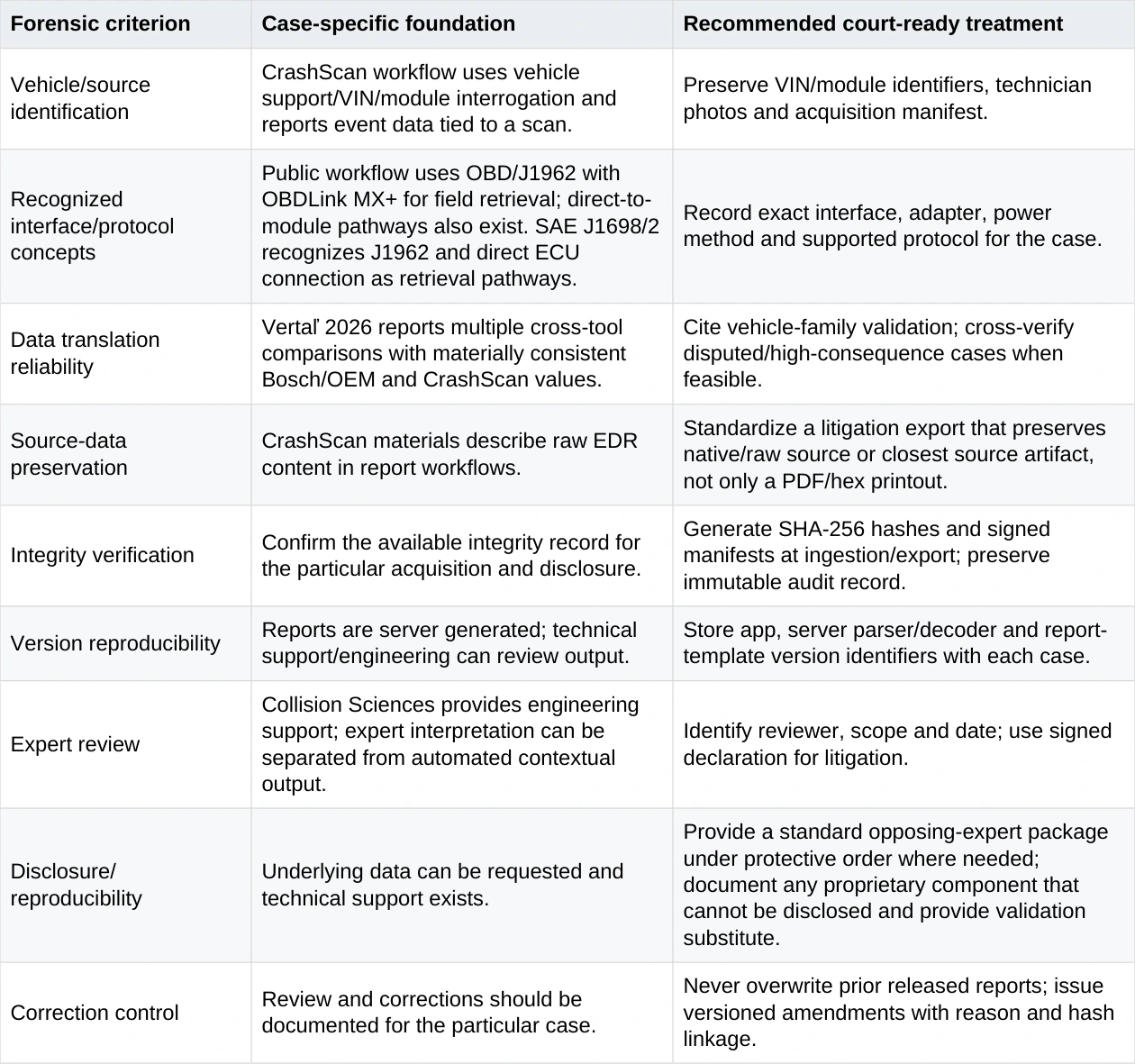
Read table as text
| Forensic criterion | Case-specific foundation | Recommended court-ready treatment |
| Vehicle/source identification | CrashScan workflow uses vehicle support/VIN/module interrogation and reports event data tied to a scan. | Preserve VIN/module identifiers, technician photos and acquisition manifest. |
| Recognized interface/protocol concepts | Public workflow uses OBD/J1962 with OBDLink MX+ for field retrieval; direct-to- module pathways also exist. SAE J1698/2 recognizes J1962 and direct ECU connection as retrieval pathways. | Record exact interface, adapter, power method and supported protocol for the case. |
| Data translation reliability | Vertaľ 2026 reports multiple cross-tool comparisons with materially consistent Bosch/OEM and CrashScan values. | Cite vehicle-family validation; cross-verify disputed/high-consequence cases when feasible. |
| Source-data preservation | CrashScan materials describe raw EDR content in report workflows. | Standardize a litigation export that preserves native/raw source or closest source artifact, not only a PDF/hex printout. |
| Integrity verification | Confirm the available integrity record for the particular acquisition and disclosure. | Generate SHA-256 hashes and signed manifests at ingestion/export; preserve immutable audit record. |
| Version reproducibility | Reports are server generated; technical support/engineering can review output. | Store app, server parser/decoder and report- template version identifiers with each case. |
| Expert review | Collision Sciences provides engineering support; expert interpretation can be separated from automated contextual output. | Identify reviewer, scope and date; use signed declaration for litigation. |
| Disclosure/ reproducibility | Underlying data can be requested and technical support exists. | Provide a standard opposing-expert package under protective order where needed; document any proprietary component that cannot be disclosed and provide validation substitute. |
| Correction control | Review and corrections should be documented for the particular case. | Never overwrite prior released reports; issue versioned amendments with reason and hash linkage. |
15 / In this resource
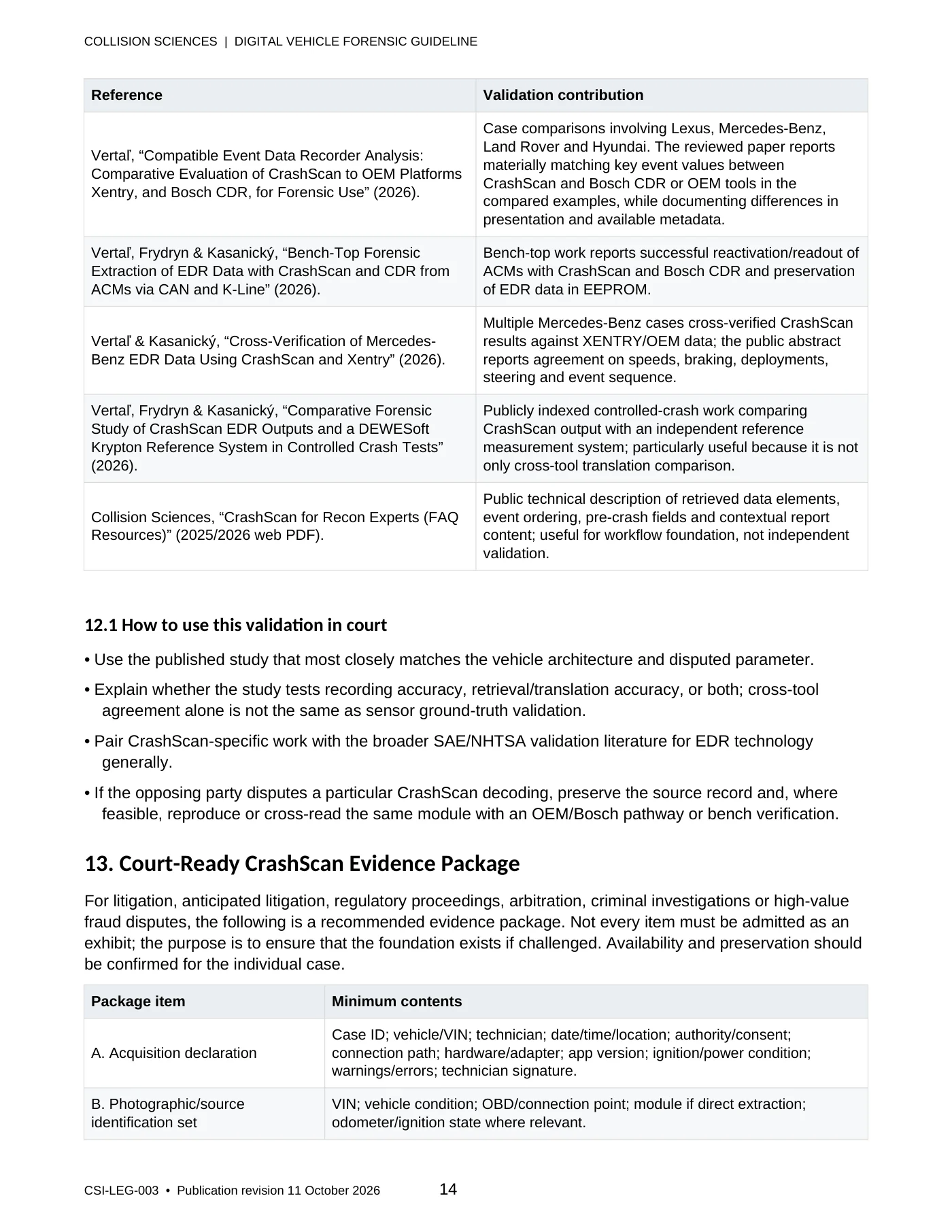
12. CrashScan validation evidence
CrashScan-specific validation materials listed here include the 2026 works associated with Ing. Peter Vertaľ, Ph.D., University of Žilina / Institute of Forensic Engineering. These are scientific and technical references, not legal rulings of admissibility.
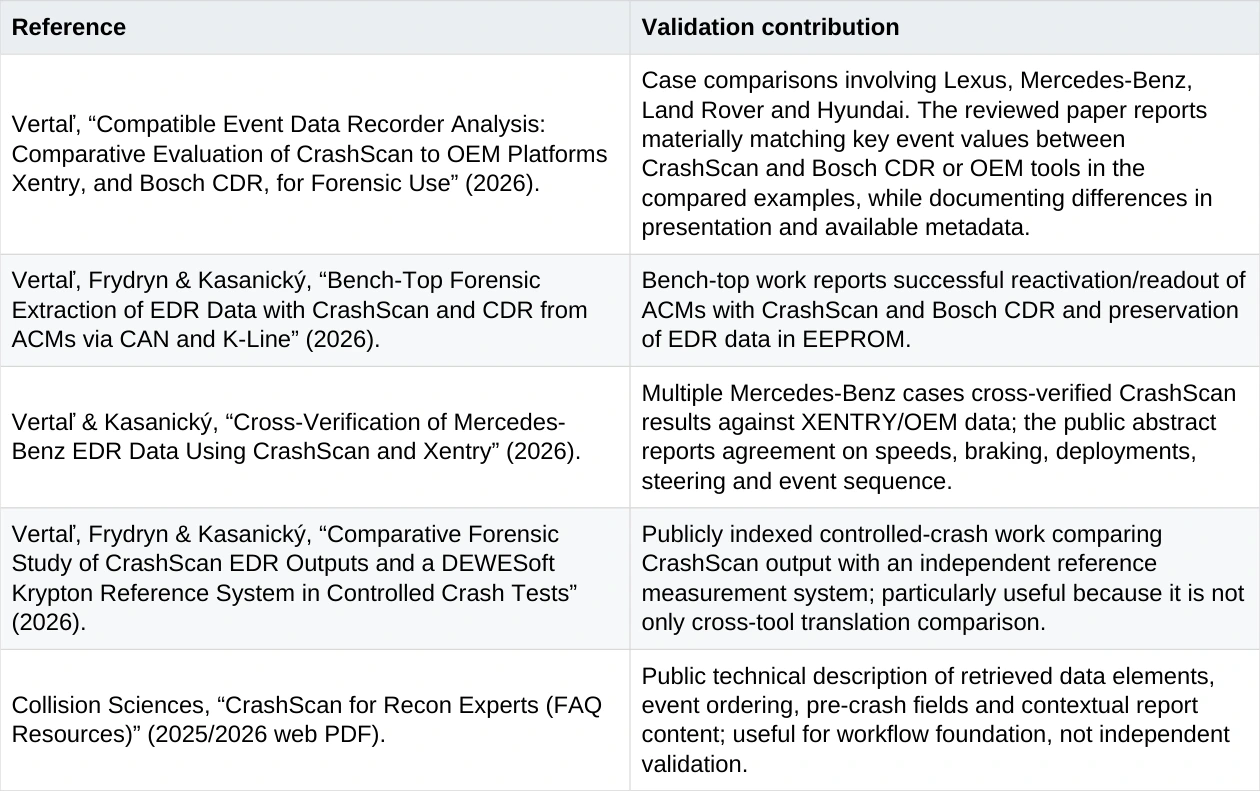
Read table as text
| Reference | Validation contribution |
| Vertaľ, “Compatible Event Data Recorder Analysis: Comparative Evaluation of CrashScan to OEM Platforms Xentry, and Bosch CDR, for Forensic Use” (2026). | Case comparisons involving Lexus, Mercedes-Benz, Land Rover and Hyundai. The reviewed paper reports materially matching key event values between CrashScan and Bosch CDR or OEM tools in the compared examples, while documenting differences in presentation and available metadata. |
| Vertaľ, Frydryn & Kasanický, “Bench-Top Forensic Extraction of EDR Data with CrashScan and CDR from ACMs via CAN and K-Line” (2026). | Bench-top work reports successful reactivation/readout of ACMs with CrashScan and Bosch CDR and preservation of EDR data in EEPROM. |
| Vertaľ & Kasanický, “Cross-Verification of Mercedes- Benz EDR Data Using CrashScan and Xentry” (2026). | Multiple Mercedes-Benz cases cross-verified CrashScan results against XENTRY/OEM data; the public abstract reports agreement on speeds, braking, deployments, steering and event sequence. |
| Vertaľ, Frydryn & Kasanický, “Comparative Forensic Study of CrashScan EDR Outputs and a DEWESoft Krypton Reference System in Controlled Crash Tests” (2026). | Publicly indexed controlled-crash work comparing CrashScan output with an independent reference measurement system; particularly useful because it is not only cross-tool translation comparison. |
| Collision Sciences, “CrashScan for Recon Experts (FAQ Resources)” (2025/2026 web PDF). | Public technical description of retrieved data elements, event ordering, pre-crash fields and contextual report content; useful for workflow foundation, not independent validation. |
12.1. How to use this validation in court
• Use the published study that most closely matches the vehicle architecture and disputed parameter. • Explain whether the study tests recording accuracy, retrieval/translation accuracy, or both; cross-tool agreement alone is not the same as sensor ground-truth validation. • Pair CrashScan-specific work with the broader SAE/NHTSA validation literature for EDR technology generally. • If the opposing party disputes a particular CrashScan decoding, preserve the source record and, where feasible, reproduce or cross-read the same module with an OEM/Bosch pathway or bench verification.
16 / In this resource
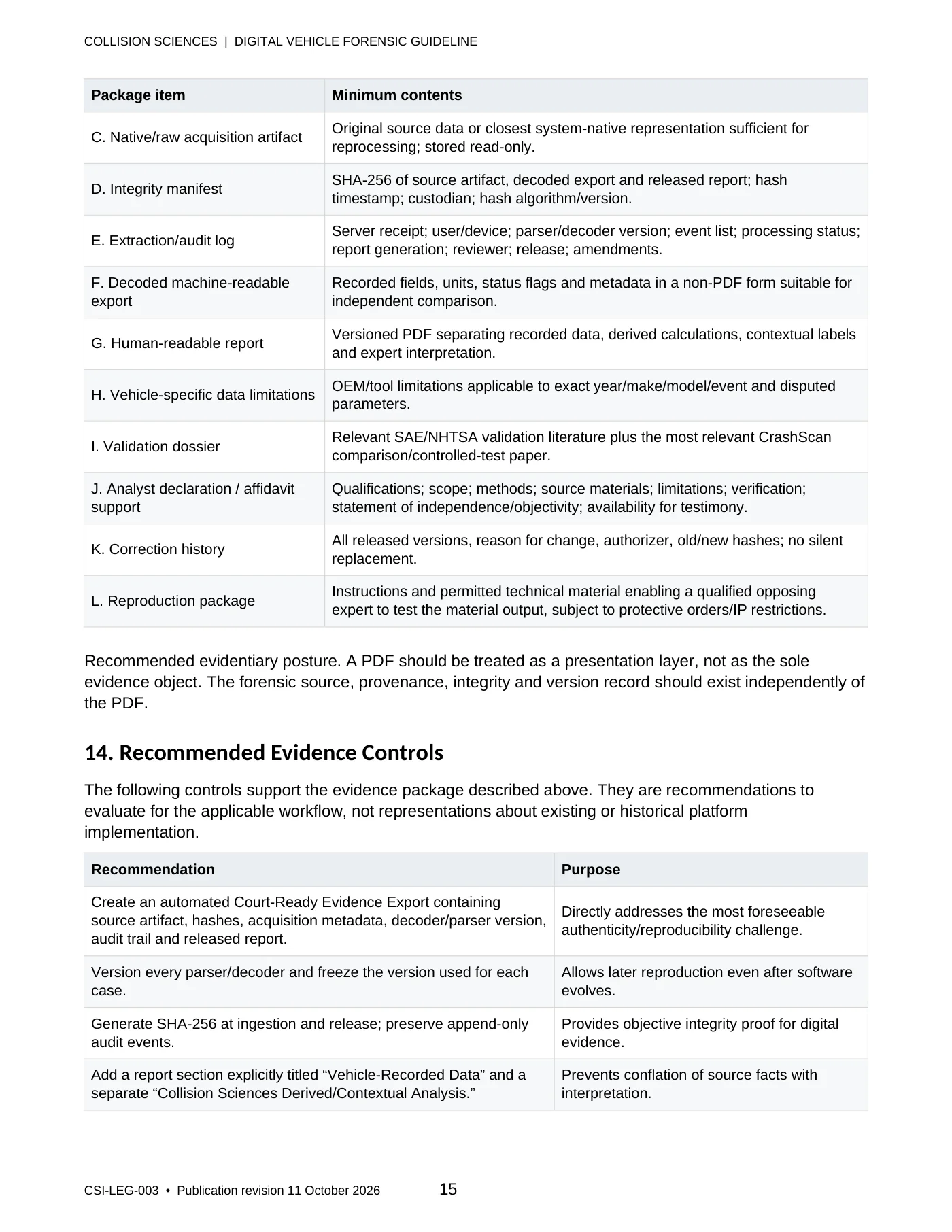
13. Court-ready CrashScan evidence package
For litigation, anticipated litigation, regulatory proceedings, arbitration, criminal investigations or high-value fraud disputes, the following is a recommended evidence package. Not every item must be admitted as an exhibit; the purpose is to ensure that the foundation exists if challenged. Availability and preservation should be confirmed for the individual case.

Read table as text
| Package item | Minimum contents |
| A. Acquisition declaration | Case ID; vehicle/VIN; technician; date/time/location; authority/consent; connection path; hardware/adapter; app version; ignition/power condition; warnings/errors; technician signature. |
| B. Photographic/source identification set | VIN; vehicle condition; OBD/connection point; module if direct extraction; odometer/ignition state where relevant. |
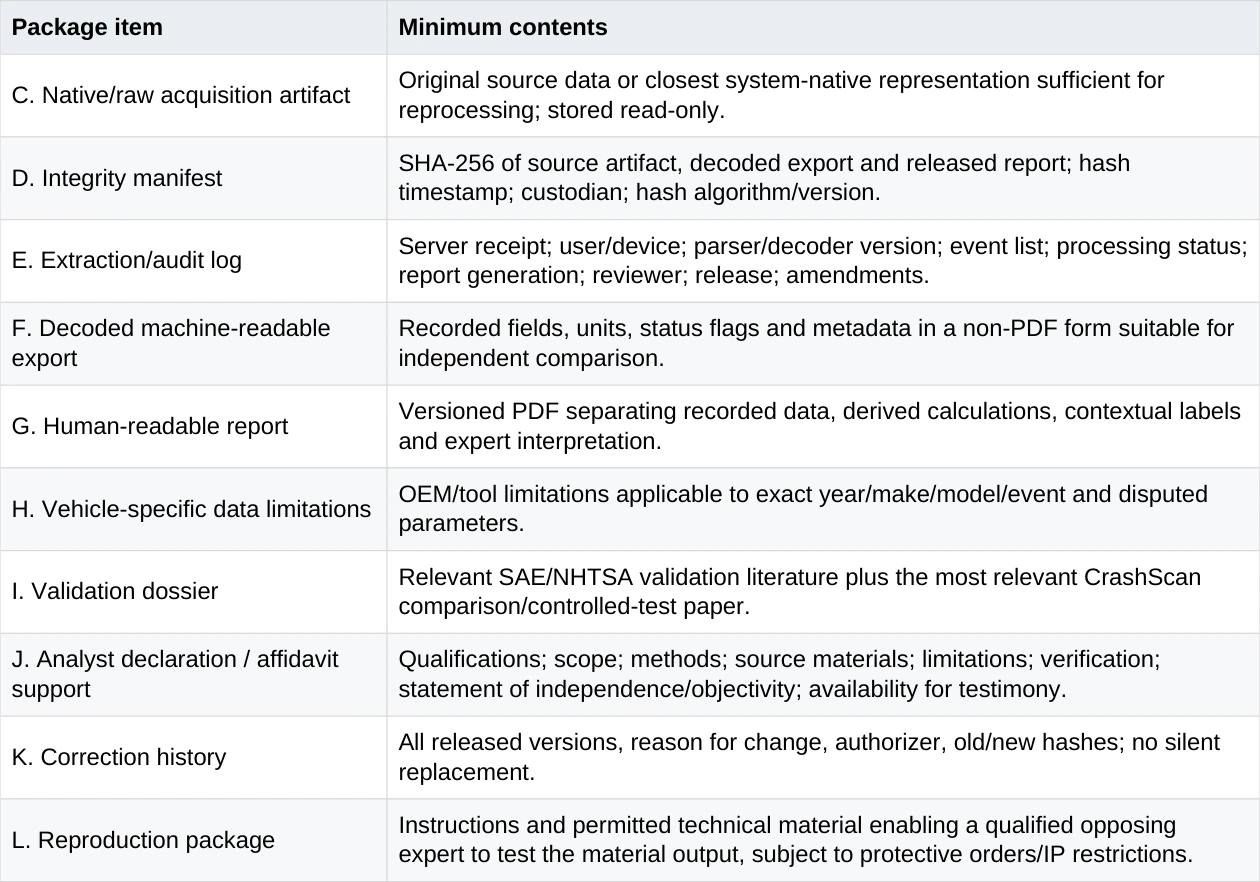
Read table as text
| Package item | Minimum contents |
| C. Native/raw acquisition artifact | Original source data or closest system-native representation sufficient for reprocessing; stored read-only. |
| D. Integrity manifest | SHA-256 of source artifact, decoded export and released report; hash timestamp; custodian; hash algorithm/version. |
| E. Extraction/audit log | Server receipt; user/device; parser/decoder version; event list; processing status; report generation; reviewer; release; amendments. |
| F. Decoded machine-readable export | Recorded fields, units, status flags and metadata in a non-PDF form suitable for independent comparison. |
| G. Human-readable report | Versioned PDF separating recorded data, derived calculations, contextual labels and expert interpretation. |
| H. Vehicle-specific data limitations | OEM/tool limitations applicable to exact year/make/model/event and disputed parameters. |
| I. Validation dossier | Relevant SAE/NHTSA validation literature plus the most relevant CrashScan comparison/controlled-test paper. |
| J. Analyst declaration / affidavit support | Qualifications; scope; methods; source materials; limitations; verification; statement of independence/objectivity; availability for testimony. |
| K. Correction history | All released versions, reason for change, authorizer, old/new hashes; no silent replacement. |
| L. Reproduction package | Instructions and permitted technical material enabling a qualified opposing expert to test the material output, subject to protective orders/IP restrictions. |
Recommended evidentiary posture. A PDF should be treated as a presentation layer, not as the sole evidence object. The forensic source, provenance, integrity and version record should exist independently of the PDF.
17 / In this resource
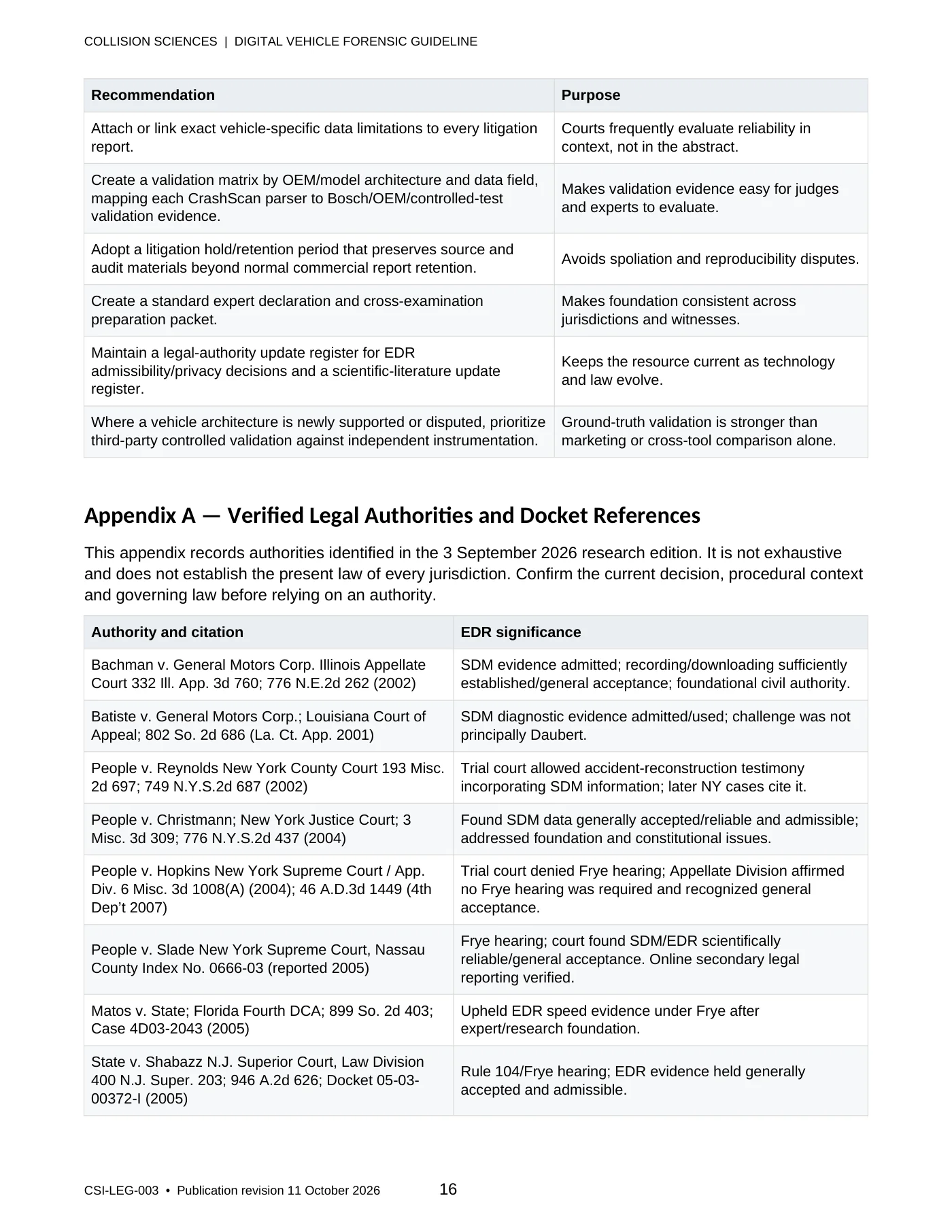
14. Recommended evidence controls
The following controls support the evidence package described above. They are recommendations to evaluate for the applicable workflow, not representations about existing or historical platform implementation.
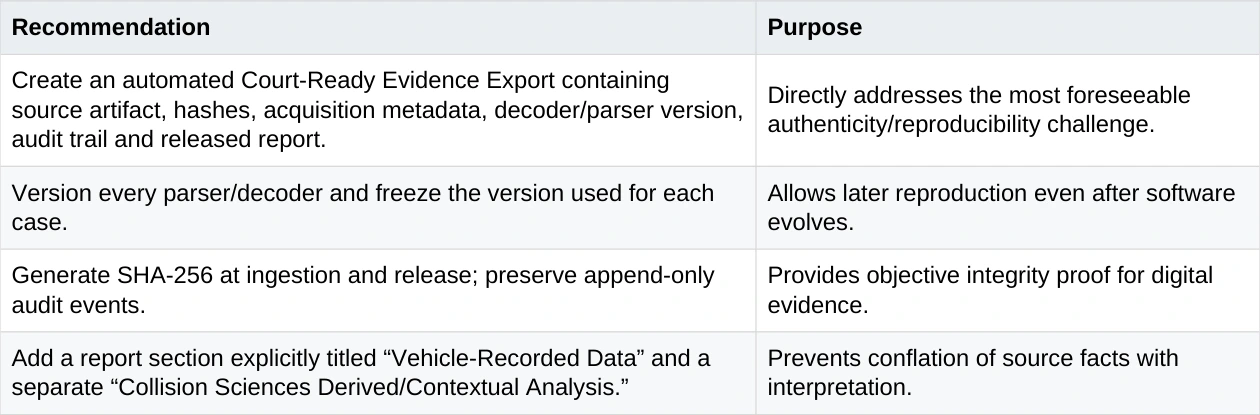
Read table as text
| Recommendation | Purpose |
| Create an automated Court-Ready Evidence Export containing source artifact, hashes, acquisition metadata, decoder/parser version, audit trail and released report. | Directly addresses the most foreseeable authenticity/reproducibility challenge. |
| Version every parser/decoder and freeze the version used for each case. | Allows later reproduction even after software evolves. |
| Generate SHA-256 at ingestion and release; preserve append-only audit events. | Provides objective integrity proof for digital evidence. |
| Add a report section explicitly titled “Vehicle-Recorded Data” and a separate “Collision Sciences Derived/Contextual Analysis.” | Prevents conflation of source facts with interpretation. |
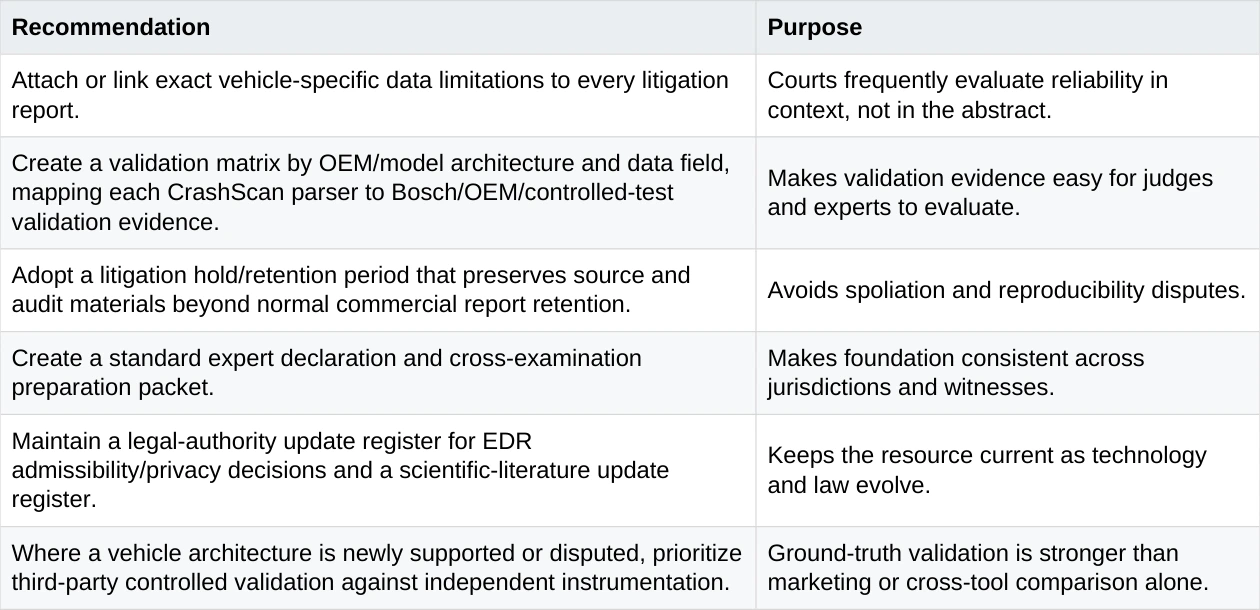
Read table as text
| Recommendation | Purpose |
| Attach or link exact vehicle-specific data limitations to every litigation report. | Courts frequently evaluate reliability in context, not in the abstract. |
| Create a validation matrix by OEM/model architecture and data field, mapping each CrashScan parser to Bosch/OEM/controlled-test validation evidence. | Makes validation evidence easy for judges and experts to evaluate. |
| Adopt a litigation hold/retention period that preserves source and audit materials beyond normal commercial report retention. | Avoids spoliation and reproducibility disputes. |
| Create a standard expert declaration and cross-examination preparation packet. | Makes foundation consistent across jurisdictions and witnesses. |
| Maintain a legal-authority update register for EDR admissibility/privacy decisions and a scientific-literature update register. | Keeps the resource current as technology and law evolve. |
| Where a vehicle architecture is newly supported or disputed, prioritize third-party controlled validation against independent instrumentation. | Ground-truth validation is stronger than marketing or cross-tool comparison alone. |
18 / In this resource
Appendix A — Verified legal authorities and docket references
This appendix records authorities identified in the 3 September 2026 research edition. It is not exhaustive and does not establish the present law of every jurisdiction. Confirm the current decision, procedural context and governing law before relying on an authority.
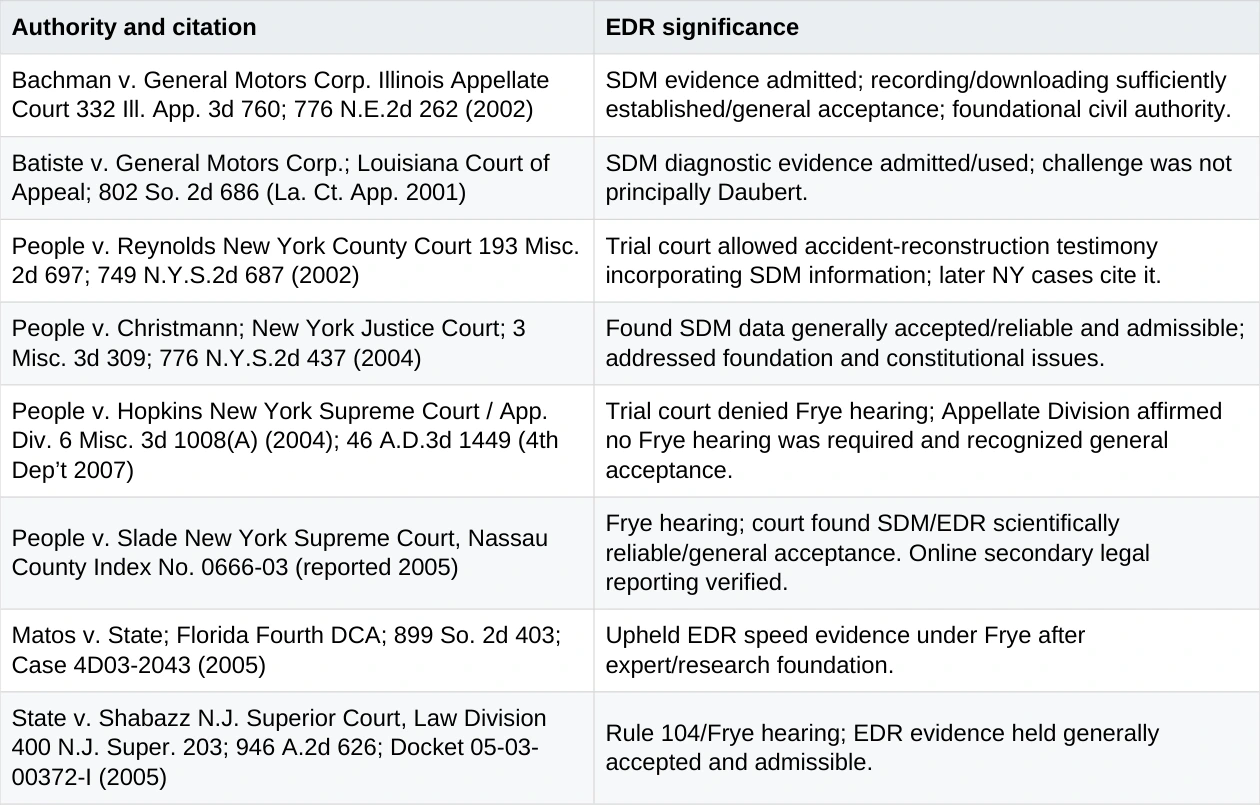
Read table as text
| Authority and citation | EDR significance |
| Bachman v. General Motors Corp. Illinois Appellate Court 332 Ill. App. 3d 760; 776 N.E.2d 262 (2002) | SDM evidence admitted; recording/downloading sufficiently established/general acceptance; foundational civil authority. |
| Batiste v. General Motors Corp.; Louisiana Court of Appeal; 802 So. 2d 686 (La. Ct. App. 2001) | SDM diagnostic evidence admitted/used; challenge was not principally Daubert. |
| People v. Reynolds New York County Court 193 Misc. 2d 697; 749 N.Y.S.2d 687 (2002) | Trial court allowed accident-reconstruction testimony incorporating SDM information; later NY cases cite it. |
| People v. Christmann; New York Justice Court; 3 Misc. 3d 309; 776 N.Y.S.2d 437 (2004) | Found SDM data generally accepted/reliable and admissible; addressed foundation and constitutional issues. |
| People v. Hopkins New York Supreme Court / App. Div. 6 Misc. 3d 1008(A) (2004); 46 A.D.3d 1449 (4th Dep’t 2007) | Trial court denied Frye hearing; Appellate Division affirmed no Frye hearing was required and recognized general acceptance. |
| People v. Slade New York Supreme Court, Nassau County Index No. 0666-03 (reported 2005) | Frye hearing; court found SDM/EDR scientifically reliable/general acceptance. Online secondary legal reporting verified. |
| Matos v. State; Florida Fourth DCA; 899 So. 2d 403; Case 4D03-2043 (2005) | Upheld EDR speed evidence under Frye after expert/research foundation. |
| State v. Shabazz N.J. Superior Court, Law Division 400 N.J. Super. 203; 946 A.2d 626; Docket 05-03- 00372-I (2005) | Rule 104/Frye hearing; EDR evidence held generally accepted and admissible. |
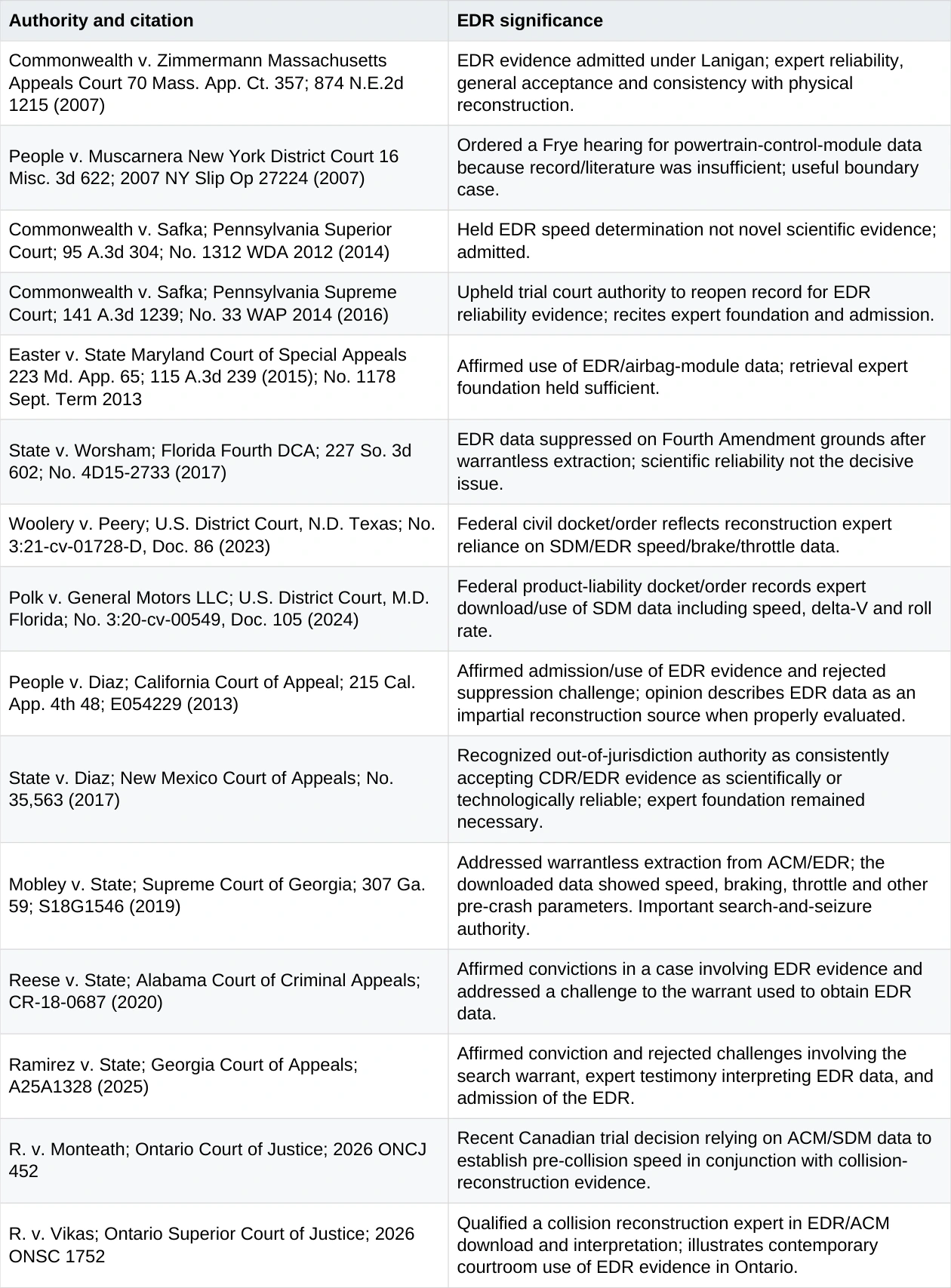
Read table as text
| Authority and citation | EDR significance |
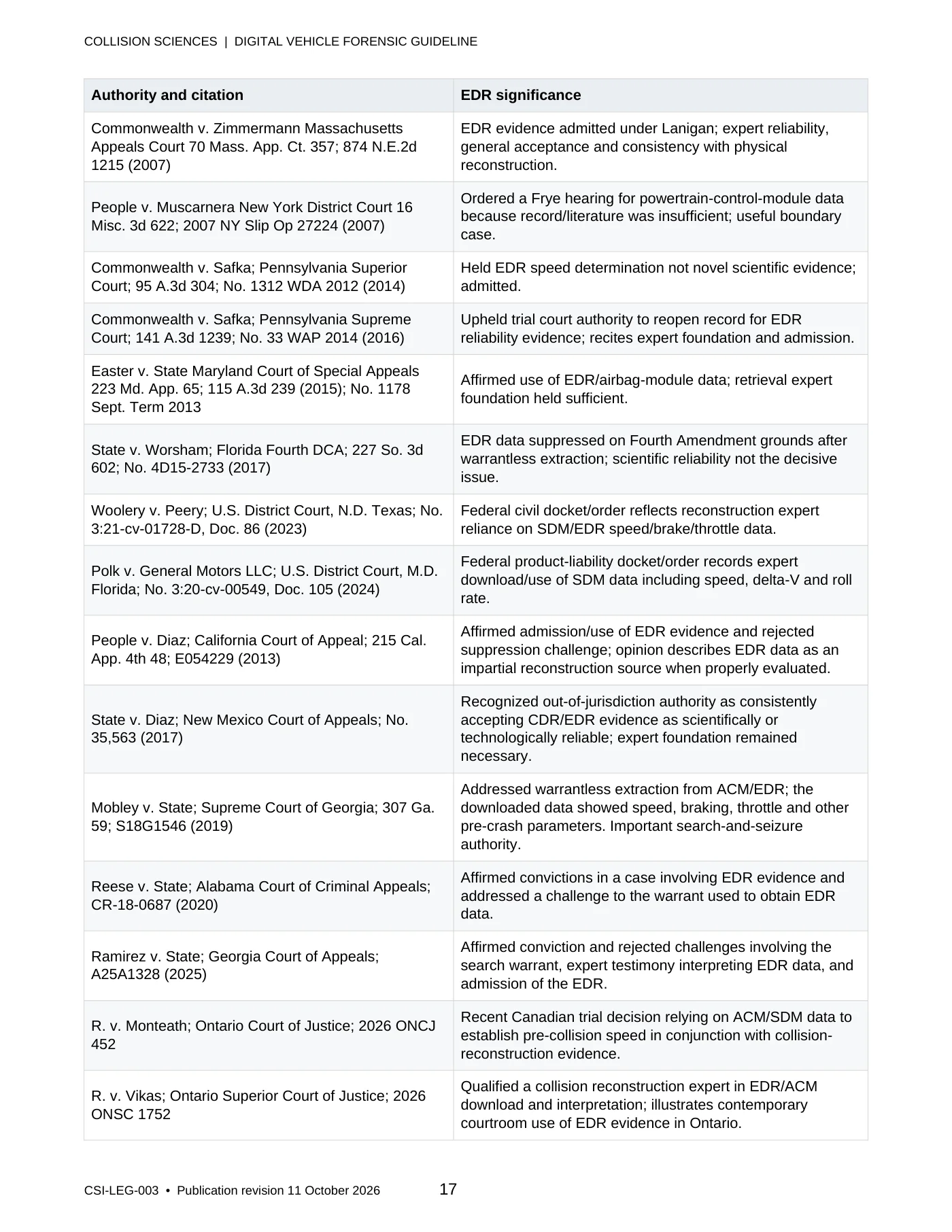
| Commonwealth v. Zimmermann Massachusetts Appeals Court 70 Mass. App. Ct. 357; 874 N.E.2d 1215 (2007) | EDR evidence admitted under Lanigan; expert reliability, general acceptance and consistency with physical reconstruction. |
| People v. Muscarnera New York District Court 16 Misc. 3d 622; 2007 NY Slip Op 27224 (2007) | Ordered a Frye hearing for powertrain-control-module data because record/literature was insufficient; useful boundary case. |
| Commonwealth v. Safka; Pennsylvania Superior Court; 95 A.3d 304; No. 1312 WDA 2012 (2014) | Held EDR speed determination not novel scientific evidence; admitted. |
| Commonwealth v. Safka; Pennsylvania Supreme Court; 141 A.3d 1239; No. 33 WAP 2014 (2016) | Upheld trial court authority to reopen record for EDR reliability evidence; recites expert foundation and admission. |
| Easter v. State Maryland Court of Special Appeals 223 Md. App. 65; 115 A.3d 239 (2015); No. 1178 Sept. Term 2013 | Affirmed use of EDR/airbag-module data; retrieval expert foundation held sufficient. |
| State v. Worsham; Florida Fourth DCA; 227 So. 3d 602; No. 4D15-2733 (2017) | EDR data suppressed on Fourth Amendment grounds after warrantless extraction; scientific reliability not the decisive issue. |
| Woolery v. Peery; U.S. District Court, N.D. Texas; No. 3:21-cv-01728-D, Doc. 86 (2023) | Federal civil docket/order reflects reconstruction expert reliance on SDM/EDR speed/brake/throttle data. |
| Polk v. General Motors LLC; U.S. District Court, M.D. Florida; No. 3:20-cv-00549, Doc. 105 (2024) | Federal product-liability docket/order records expert download/use of SDM data including speed, delta-V and roll rate. |
| People v. Diaz; California Court of Appeal; 215 Cal. App. 4th 48; E054229 (2013) | Affirmed admission/use of EDR evidence and rejected suppression challenge; opinion describes EDR data as an impartial reconstruction source when properly evaluated. |
| State v. Diaz; New Mexico Court of Appeals; No. 35,563 (2017) | Recognized out-of-jurisdiction authority as consistently accepting CDR/EDR evidence as scientifically or technologically reliable; expert foundation remained necessary. |
| Mobley v. State; Supreme Court of Georgia; 307 Ga. 59; S18G1546 (2019) | Addressed warrantless extraction from ACM/EDR; the downloaded data showed speed, braking, throttle and other pre-crash parameters. Important search-and-seizure authority. |
| Reese v. State; Alabama Court of Criminal Appeals; CR-18-0687 (2020) | Affirmed convictions in a case involving EDR evidence and addressed a challenge to the warrant used to obtain EDR data. |
| Ramirez v. State; Georgia Court of Appeals; A25A1328 (2025) | Affirmed conviction and rejected challenges involving the search warrant, expert testimony interpreting EDR data, and admission of the EDR. |
| R. v. Monteath; Ontario Court of Justice; 2026 ONCJ 452 | Recent Canadian trial decision relying on ACM/SDM data to establish pre-collision speed in conjunction with collision- reconstruction evidence. |
| R. v. Vikas; Ontario Superior Court of Justice; 2026 ONSC 1752 | Qualified a collision reconstruction expert in EDR/ACM download and interpretation; illustrates contemporary courtroom use of EDR evidence in Ontario. |
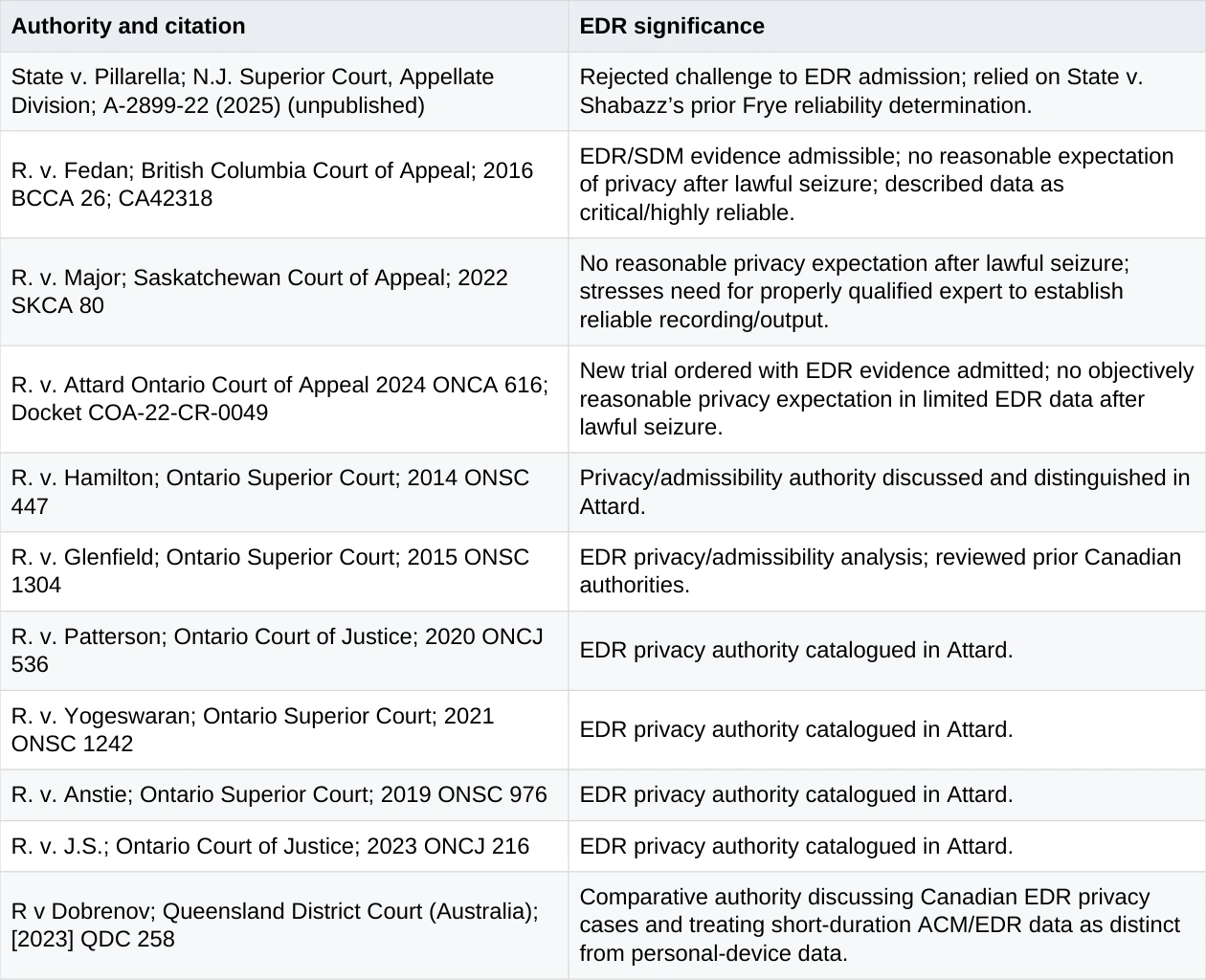
Read table as text
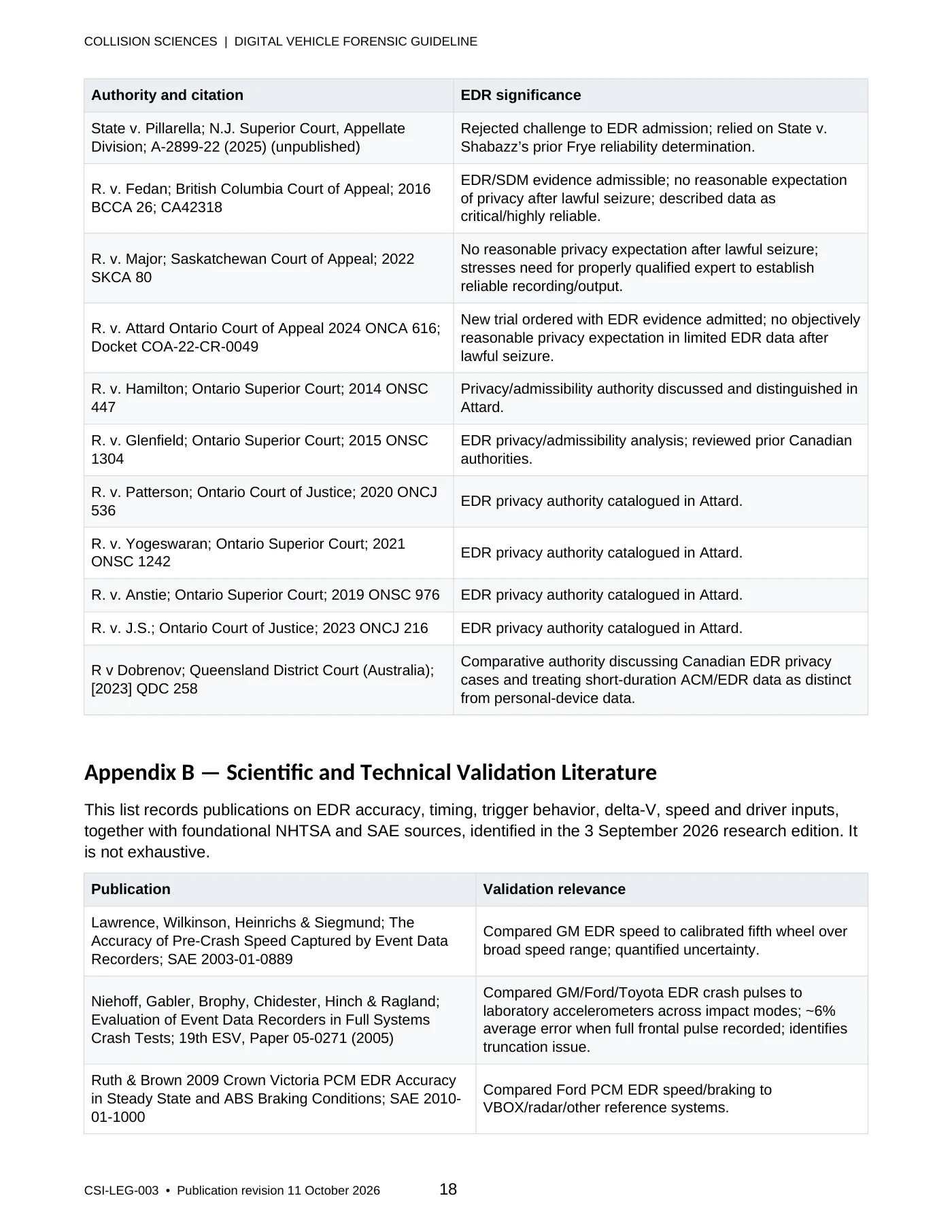
| Authority and citation | EDR significance |
| State v. Pillarella; N.J. Superior Court, Appellate Division; A-2899-22 (2025) (unpublished) | Rejected challenge to EDR admission; relied on State v. Shabazz’s prior Frye reliability determination. |
| R. v. Fedan; British Columbia Court of Appeal; 2016 BCCA 26; CA42318 | EDR/SDM evidence admissible; no reasonable expectation of privacy after lawful seizure; described data as critical/highly reliable. |
| R. v. Major; Saskatchewan Court of Appeal; 2022 SKCA 80 | No reasonable privacy expectation after lawful seizure; stresses need for properly qualified expert to establish reliable recording/output. |
| R. v. Attard Ontario Court of Appeal 2024 ONCA 616; Docket COA-22-CR-0049 | New trial ordered with EDR evidence admitted; no objectively reasonable privacy expectation in limited EDR data after lawful seizure. |
| R. v. Hamilton; Ontario Superior Court; 2014 ONSC 447 | Privacy/admissibility authority discussed and distinguished in Attard. |
| R. v. Glenfield; Ontario Superior Court; 2015 ONSC 1304 | EDR privacy/admissibility analysis; reviewed prior Canadian authorities. |
| R. v. Patterson; Ontario Court of Justice; 2020 ONCJ 536 | EDR privacy authority catalogued in Attard. |
| R. v. Yogeswaran; Ontario Superior Court; 2021 ONSC 1242 | EDR privacy authority catalogued in Attard. |
| R. v. Anstie; Ontario Superior Court; 2019 ONSC 976 | EDR privacy authority catalogued in Attard. |
| R. v. J.S.; Ontario Court of Justice; 2023 ONCJ 216 | EDR privacy authority catalogued in Attard. |
| R v Dobrenov; Queensland District Court (Australia); [2023] QDC 258 | Comparative authority discussing Canadian EDR privacy cases and treating short-duration ACM/EDR data as distinct from personal-device data. |
19 / In this resource
Appendix B — Scientific and technical validation literature
This list records publications on EDR accuracy, timing, trigger behavior, delta-V, speed and driver inputs, together with foundational NHTSA and SAE sources, identified in the 3 September 2026 research edition. It is not exhaustive.
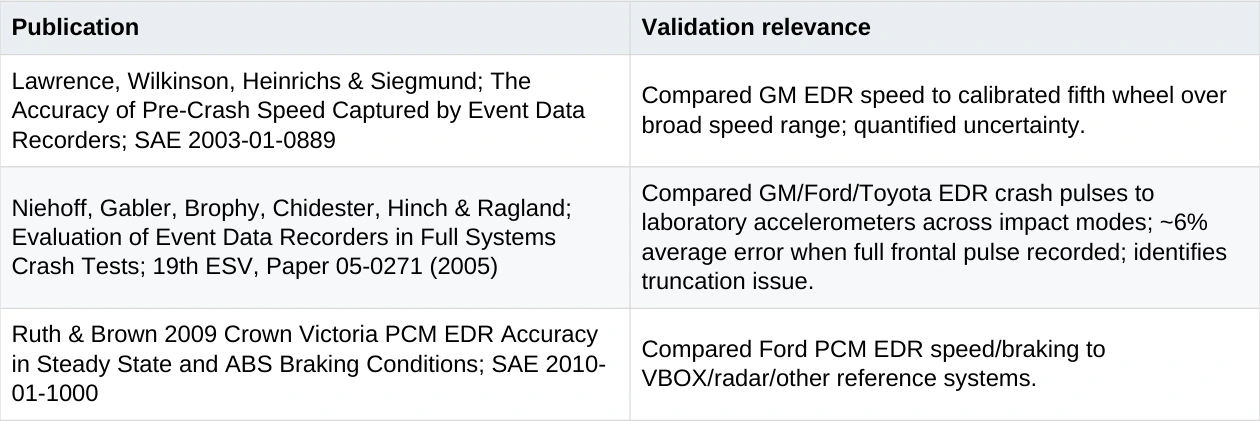
Read table as text
| Publication | Validation relevance |
| Lawrence, Wilkinson, Heinrichs & Siegmund; The Accuracy of Pre-Crash Speed Captured by Event Data Recorders; SAE 2003-01-0889 | Compared GM EDR speed to calibrated fifth wheel over broad speed range; quantified uncertainty. |
| Niehoff, Gabler, Brophy, Chidester, Hinch & Ragland; Evaluation of Event Data Recorders in Full Systems Crash Tests; 19th ESV, Paper 05-0271 (2005) | Compared GM/Ford/Toyota EDR crash pulses to laboratory accelerometers across impact modes; ~6% average error when full frontal pulse recorded; identifies truncation issue. |
| Ruth & Brown 2009 Crown Victoria PCM EDR Accuracy in Steady State and ABS Braking Conditions; SAE 2010- 01-1000 | Compared Ford PCM EDR speed/braking to VBOX/radar/other reference systems. |
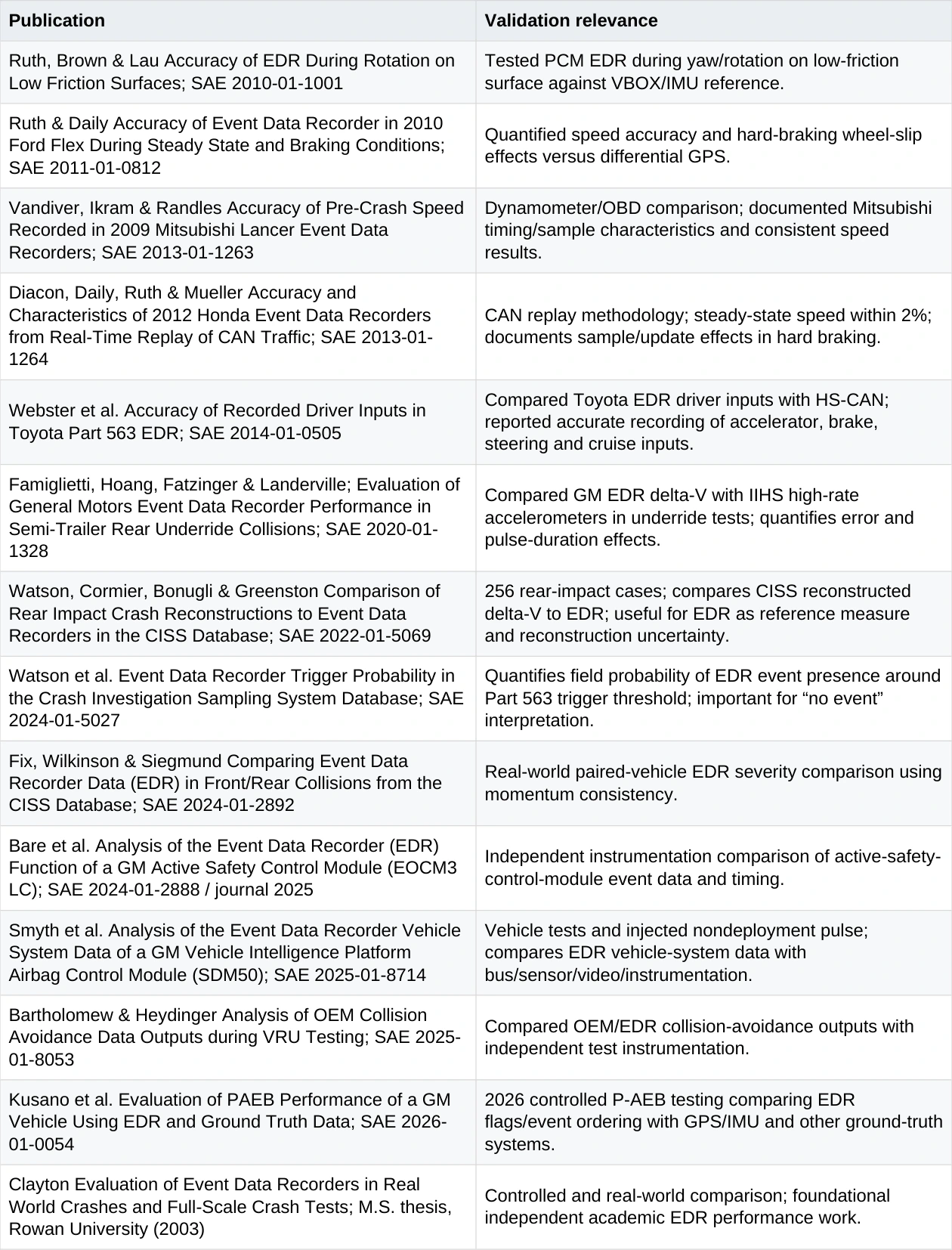
Read table as text
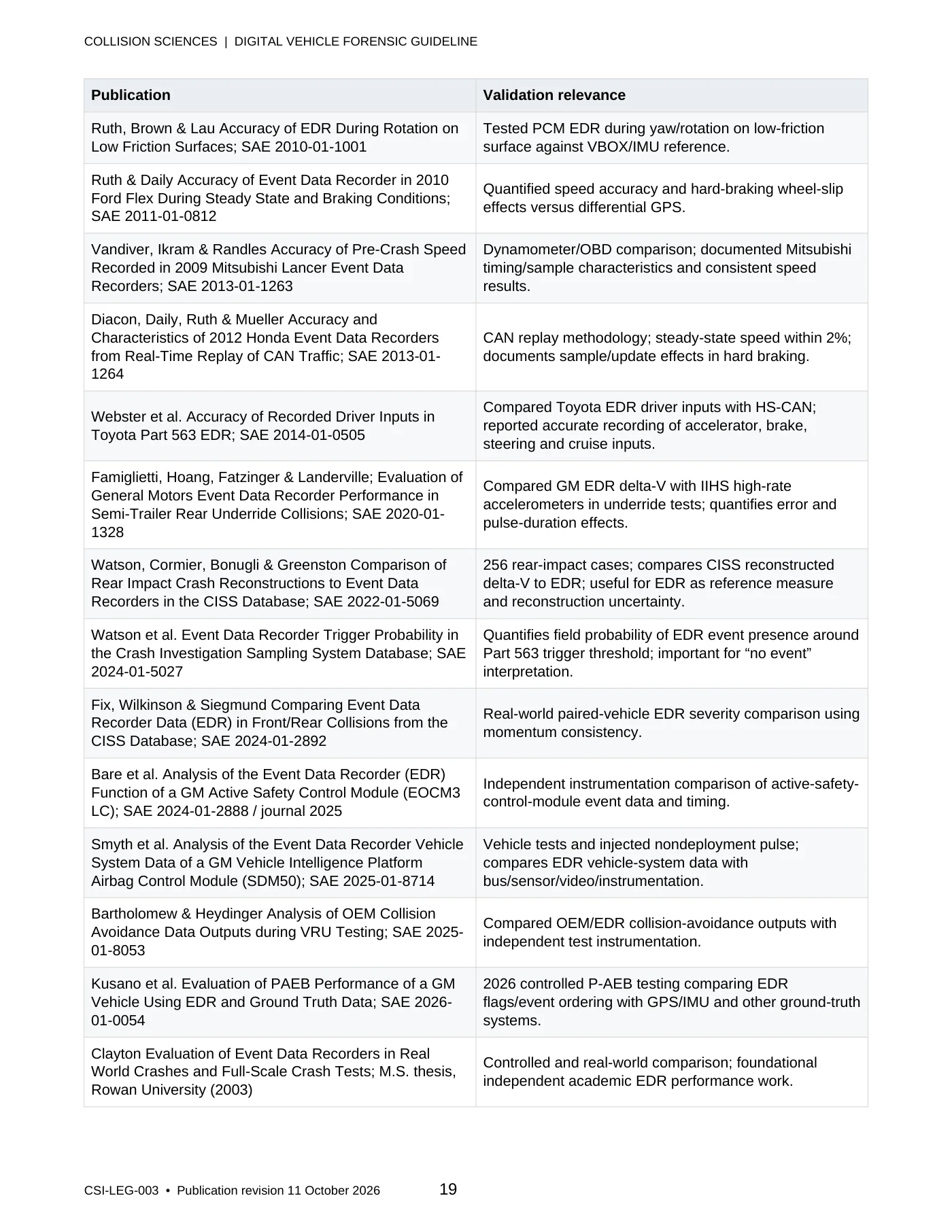
| Publication | Validation relevance |
| Ruth, Brown & Lau Accuracy of EDR During Rotation on Low Friction Surfaces; SAE 2010-01-1001 | Tested PCM EDR during yaw/rotation on low-friction surface against VBOX/IMU reference. |
| Ruth & Daily Accuracy of Event Data Recorder in 2010 Ford Flex During Steady State and Braking Conditions; SAE 2011-01-0812 | Quantified speed accuracy and hard-braking wheel-slip effects versus differential GPS. |
| Vandiver, Ikram & Randles Accuracy of Pre-Crash Speed Recorded in 2009 Mitsubishi Lancer Event Data Recorders; SAE 2013-01-1263 | Dynamometer/OBD comparison; documented Mitsubishi timing/sample characteristics and consistent speed results. |
| Diacon, Daily, Ruth & Mueller Accuracy and Characteristics of 2012 Honda Event Data Recorders from Real-Time Replay of CAN Traffic; SAE 2013-01- 1264 | CAN replay methodology; steady-state speed within 2%; documents sample/update effects in hard braking. |
| Webster et al. Accuracy of Recorded Driver Inputs in Toyota Part 563 EDR; SAE 2014-01-0505 | Compared Toyota EDR driver inputs with HS-CAN; reported accurate recording of accelerator, brake, steering and cruise inputs. |
| Famiglietti, Hoang, Fatzinger & Landerville; Evaluation of General Motors Event Data Recorder Performance in Semi-Trailer Rear Underride Collisions; SAE 2020-01- 1328 | Compared GM EDR delta-V with IIHS high-rate accelerometers in underride tests; quantifies error and pulse-duration effects. |
| Watson, Cormier, Bonugli & Greenston Comparison of Rear Impact Crash Reconstructions to Event Data Recorders in the CISS Database; SAE 2022-01-5069 | 256 rear-impact cases; compares CISS reconstructed delta-V to EDR; useful for EDR as reference measure and reconstruction uncertainty. |
| Watson et al. Event Data Recorder Trigger Probability in the Crash Investigation Sampling System Database; SAE 2024-01-5027 | Quantifies field probability of EDR event presence around Part 563 trigger threshold; important for “no event” interpretation. |
| Fix, Wilkinson & Siegmund Comparing Event Data Recorder Data (EDR) in Front/Rear Collisions from the CISS Database; SAE 2024-01-2892 | Real-world paired-vehicle EDR severity comparison using momentum consistency. |
| Bare et al. Analysis of the Event Data Recorder (EDR) Function of a GM Active Safety Control Module (EOCM3 LC); SAE 2024-01-2888 / journal 2025 | Independent instrumentation comparison of active-safety- control-module event data and timing. |
| Smyth et al. Analysis of the Event Data Recorder Vehicle System Data of a GM Vehicle Intelligence Platform Airbag Control Module (SDM50); SAE 2025-01-8714 | Vehicle tests and injected nondeployment pulse; compares EDR vehicle-system data with bus/sensor/video/instrumentation. |
| Bartholomew & Heydinger Analysis of OEM Collision Avoidance Data Outputs during VRU Testing; SAE 2025- 01-8053 | Compared OEM/EDR collision-avoidance outputs with independent test instrumentation. |
| Kusano et al. Evaluation of PAEB Performance of a GM Vehicle Using EDR and Ground Truth Data; SAE 2026- 01-0054 | 2026 controlled P-AEB testing comparing EDR flags/event ordering with GPS/IMU and other ground-truth systems. |
| Clayton Evaluation of Event Data Recorders in Real World Crashes and Full-Scale Crash Tests; M.S. thesis, Rowan University (2003) | Controlled and real-world comparison; foundational independent academic EDR performance work. |

Read table as text
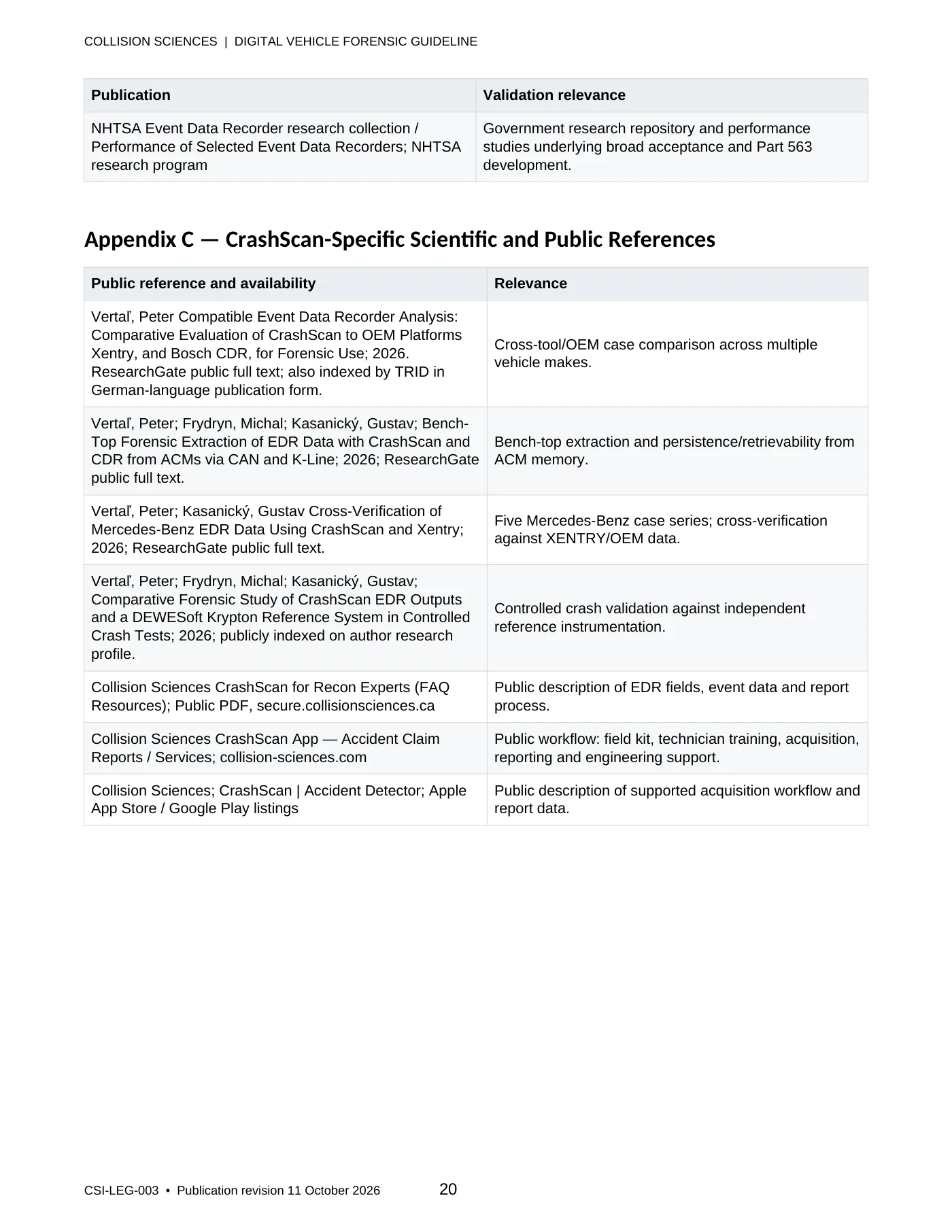
| Publication | Validation relevance |
| NHTSA Event Data Recorder research collection / Performance of Selected Event Data Recorders; NHTSA research program | Government research repository and performance studies underlying broad acceptance and Part 563 development. |
20 / In this resource
Appendix C — CrashScan-specific scientific and public references
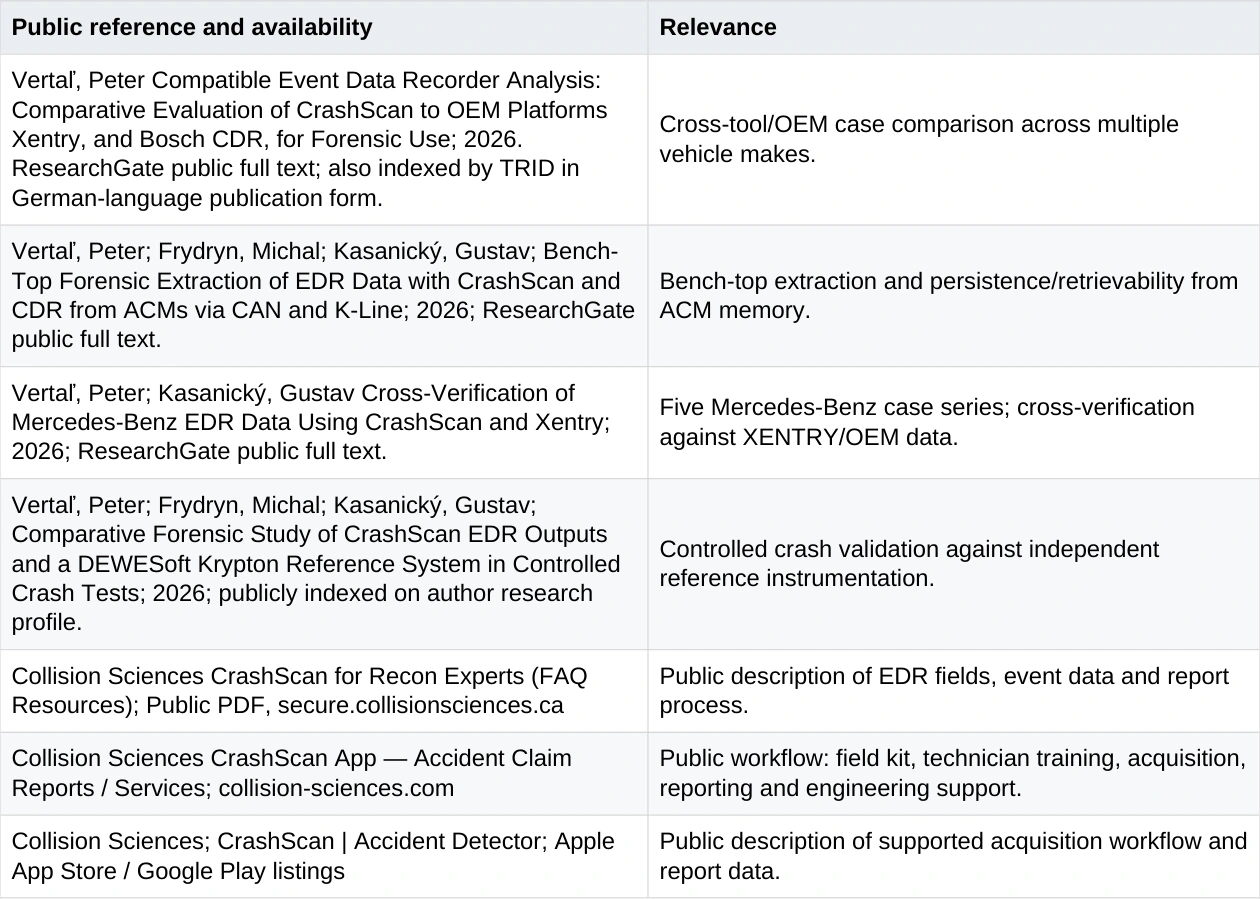
Read table as text
| Public reference and availability | Relevance |
| Vertaľ, Peter Compatible Event Data Recorder Analysis: Comparative Evaluation of CrashScan to OEM Platforms Xentry, and Bosch CDR, for Forensic Use; 2026. ResearchGate public full text; also indexed by TRID in German-language publication form. | Cross-tool/OEM case comparison across multiple vehicle makes. |
| Vertaľ, Peter; Frydryn, Michal; Kasanický, Gustav; Bench- Top Forensic Extraction of EDR Data with CrashScan and CDR from ACMs via CAN and K-Line; 2026; ResearchGate public full text. | Bench-top extraction and persistence/retrievability from ACM memory. |
| Vertaľ, Peter; Kasanický, Gustav Cross-Verification of Mercedes-Benz EDR Data Using CrashScan and Xentry; 2026; ResearchGate public full text. | Five Mercedes-Benz case series; cross-verification against XENTRY/OEM data. |
| Vertaľ, Peter; Frydryn, Michal; Kasanický, Gustav; Comparative Forensic Study of CrashScan EDR Outputs and a DEWESoft Krypton Reference System in Controlled Crash Tests; 2026; publicly indexed on author research profile. | Controlled crash validation against independent reference instrumentation. |
| Collision Sciences CrashScan for Recon Experts (FAQ Resources); Public PDF, secure.collisionsciences.ca | Public description of EDR fields, event data and report process. |
| Collision Sciences CrashScan App — Accident Claim Reports / Services; collision-sciences.com | Public workflow: field kit, technician training, acquisition, reporting and engineering support. |
| Collision Sciences; CrashScan | Accident Detector; Apple App Store / Google Play listings | Public description of supported acquisition workflow and report data. |
21 / In this resource
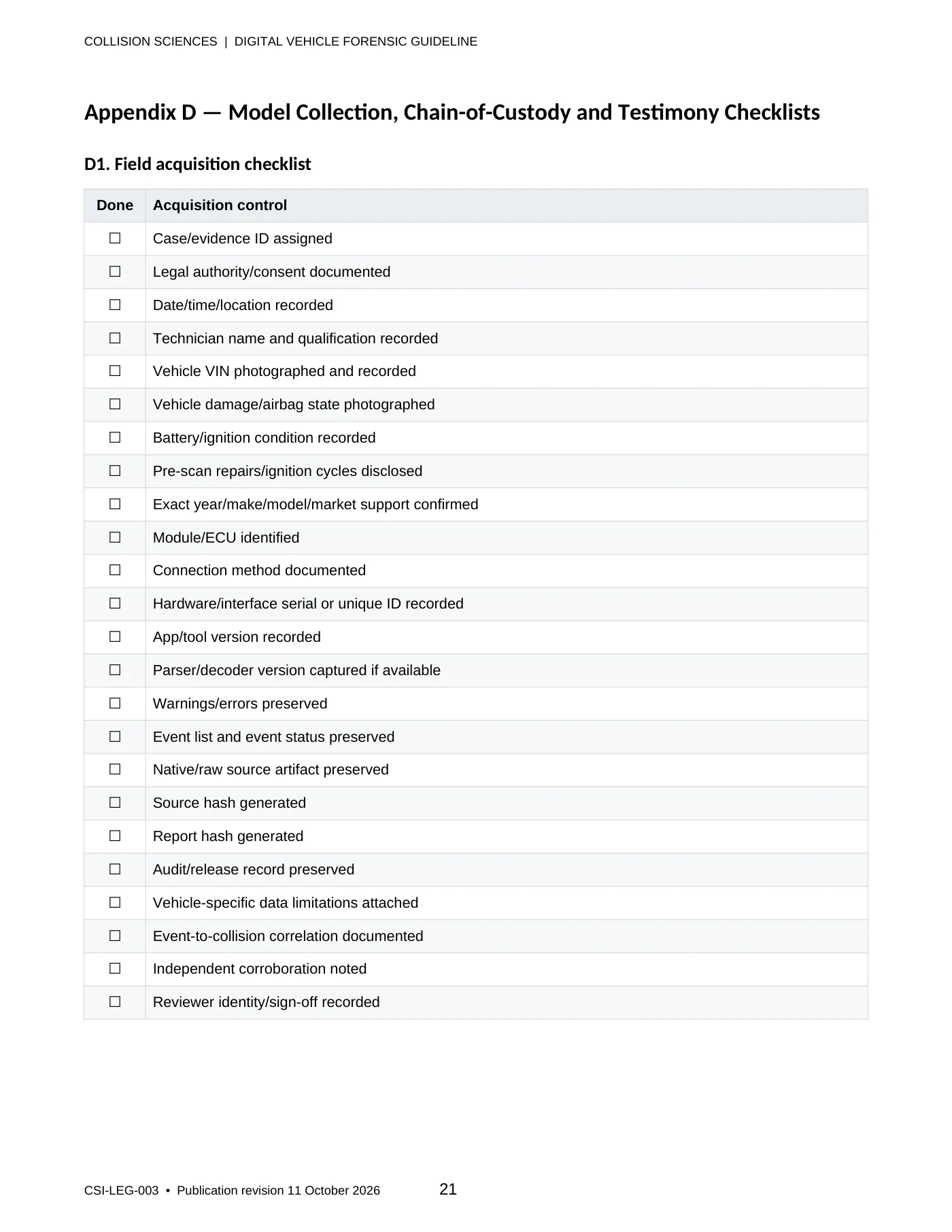
Appendix D — Model collection, chain-of-custody and testimony checklists
D1. Field acquisition checklist
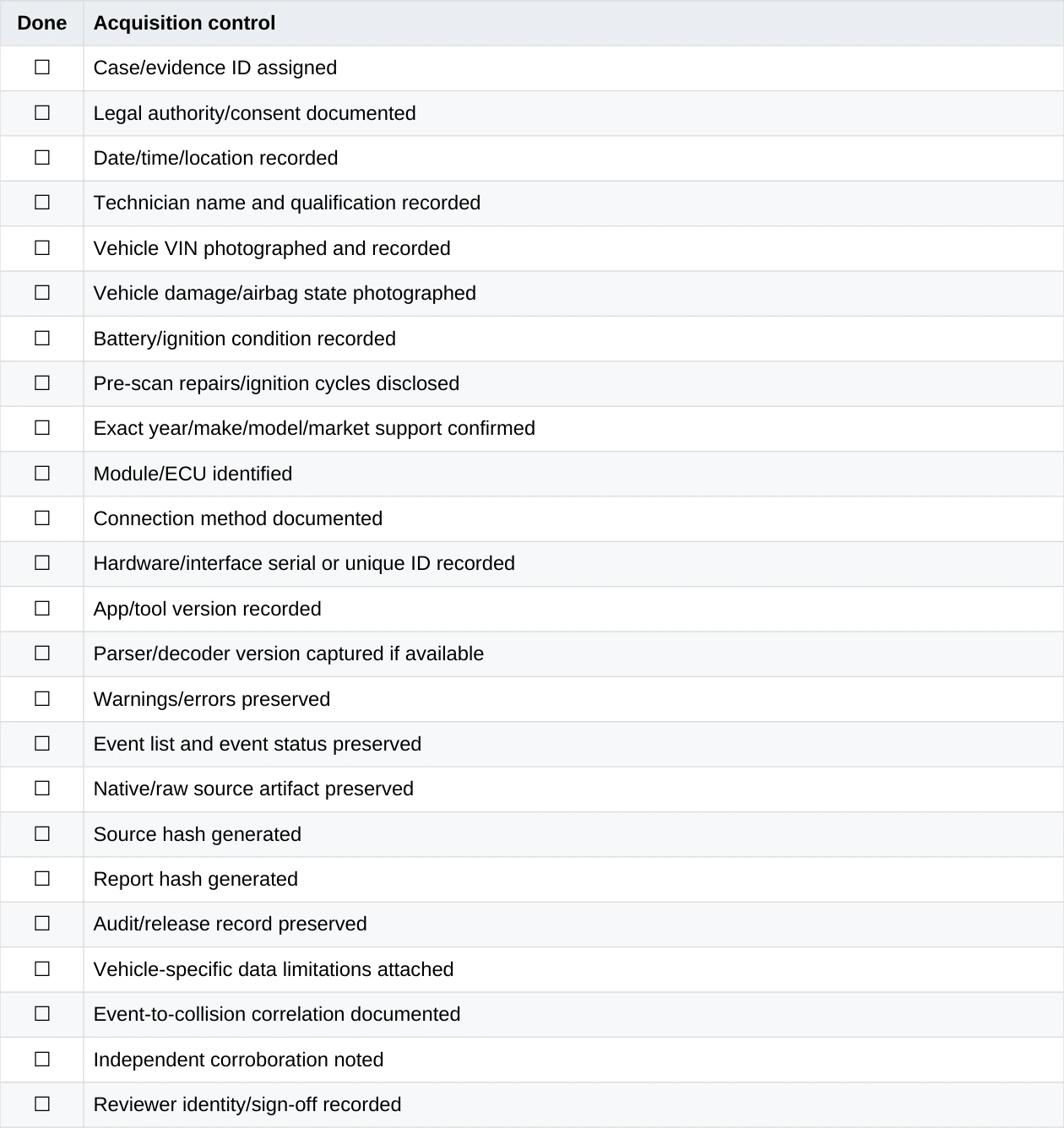
Read table as text
| Done | Acquisition control |
| ☐ | Case/evidence ID assigned |
| ☐ | Legal authority/consent documented |
| ☐ | Date/time/location recorded |
| ☐ | Technician name and qualification recorded |
| ☐ | Vehicle VIN photographed and recorded |
| ☐ | Vehicle damage/airbag state photographed |
| ☐ | Battery/ignition condition recorded |
| ☐ | Pre-scan repairs/ignition cycles disclosed |
| ☐ | Exact year/make/model/market support confirmed |
| ☐ | Module/ECU identified |
| ☐ | Connection method documented |
| ☐ | Hardware/interface serial or unique ID recorded |
| ☐ | App/tool version recorded |
| ☐ | Parser/decoder version captured if available |
| ☐ | Warnings/errors preserved |
| ☐ | Event list and event status preserved |
| ☐ | Native/raw source artifact preserved |
| ☐ | Source hash generated |
| ☐ | Report hash generated |
| ☐ | Audit/release record preserved |
| ☐ | Vehicle-specific data limitations attached |
| ☐ | Event-to-collision correlation documented |
| ☐ | Independent corroboration noted |
| ☐ | Reviewer identity/sign-off recorded |
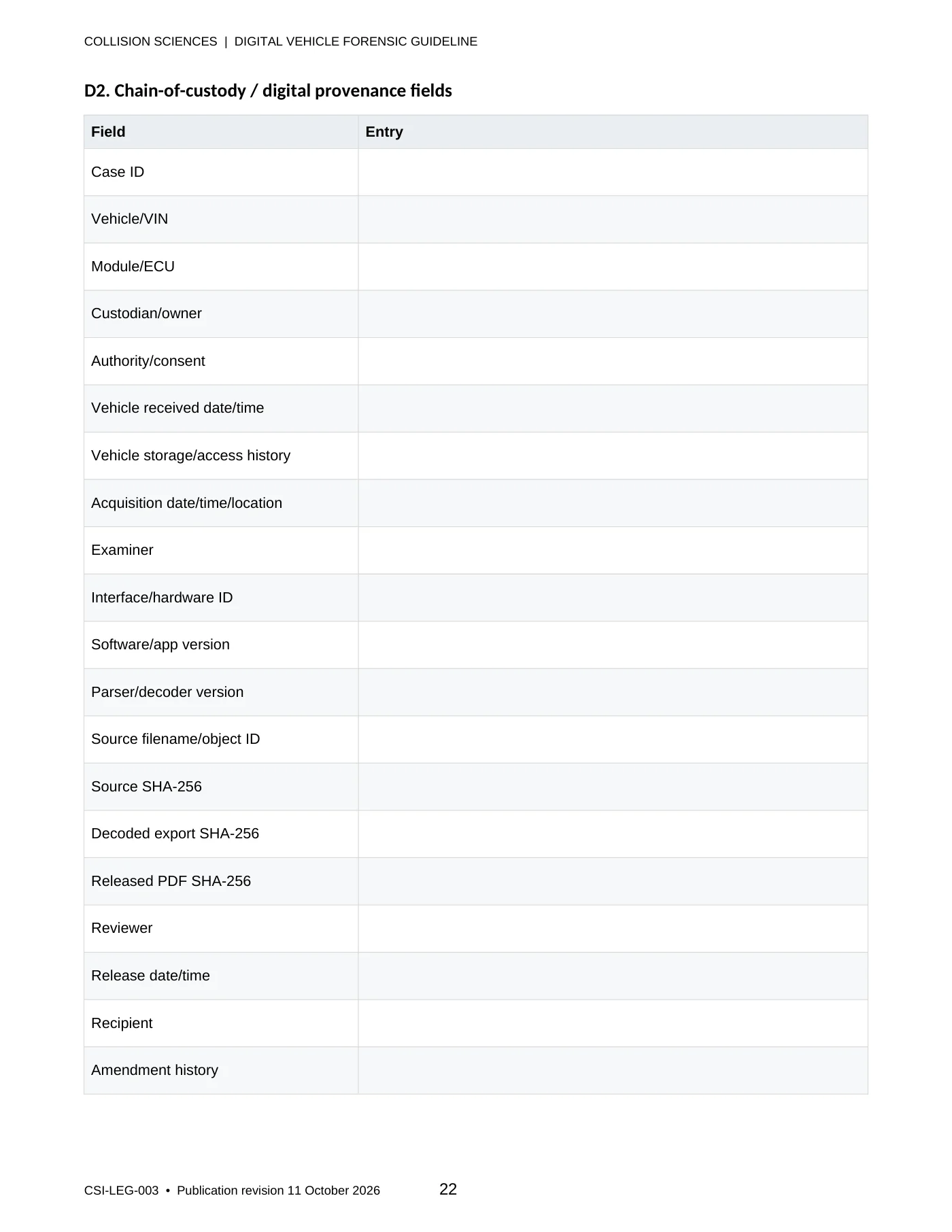
D2. Chain-of-custody / digital provenance fields
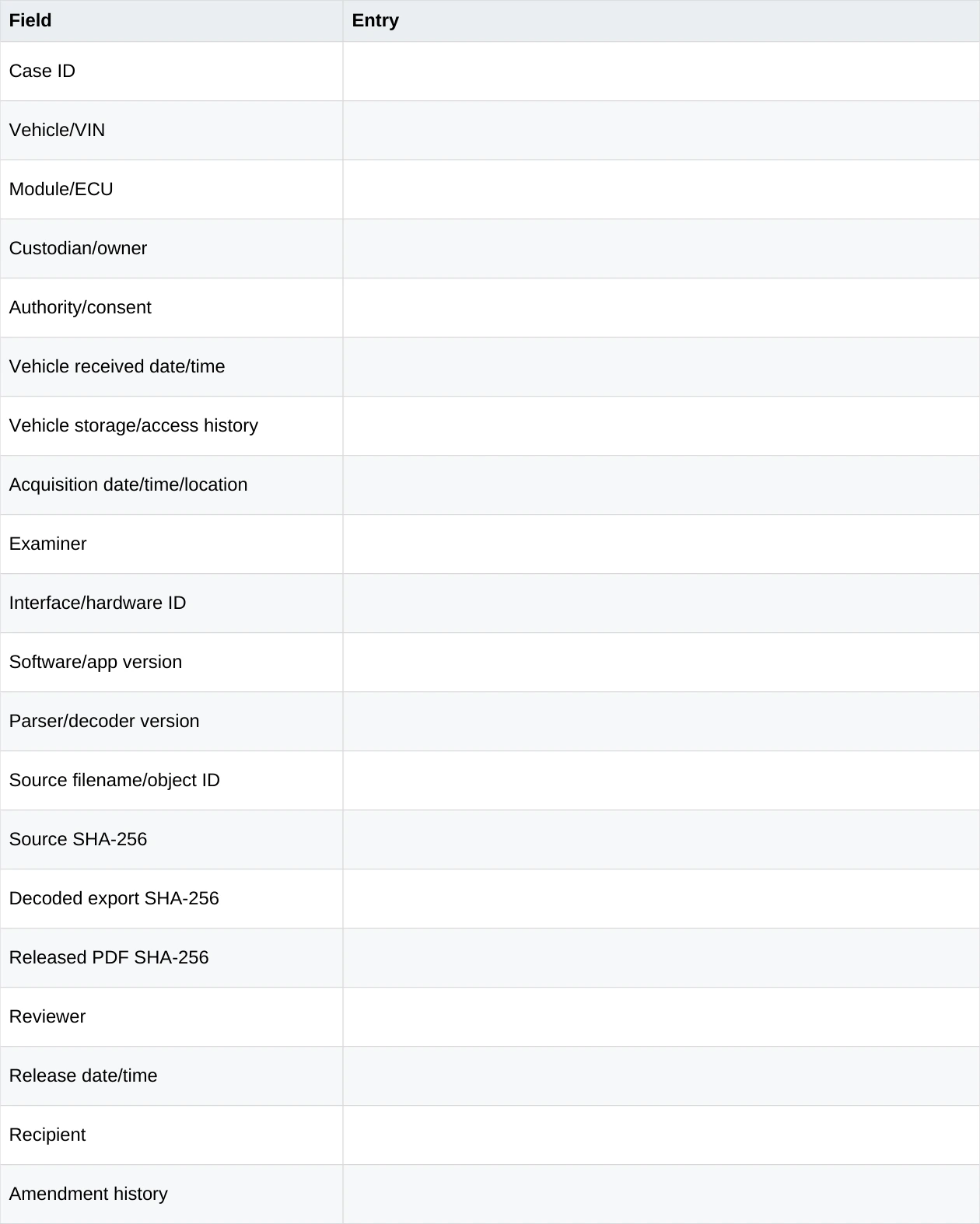
Read table as text
| Field | Entry |
| Case ID | |
| Vehicle/VIN | |
| Module/ECU | |
| Custodian/owner | |
| Authority/consent | |
| Vehicle received date/time | |
| Vehicle storage/access history | |
| Acquisition date/time/location | |
| Examiner | |
| Interface/hardware ID | |
| Software/app version | |
| Parser/decoder version | |
| Source filename/object ID | |
| Source SHA-256 | |
| Decoded export SHA-256 | |
| Released PDF SHA-256 | |
| Reviewer | |
| Release date/time | |
| Recipient | |
| Amendment history |
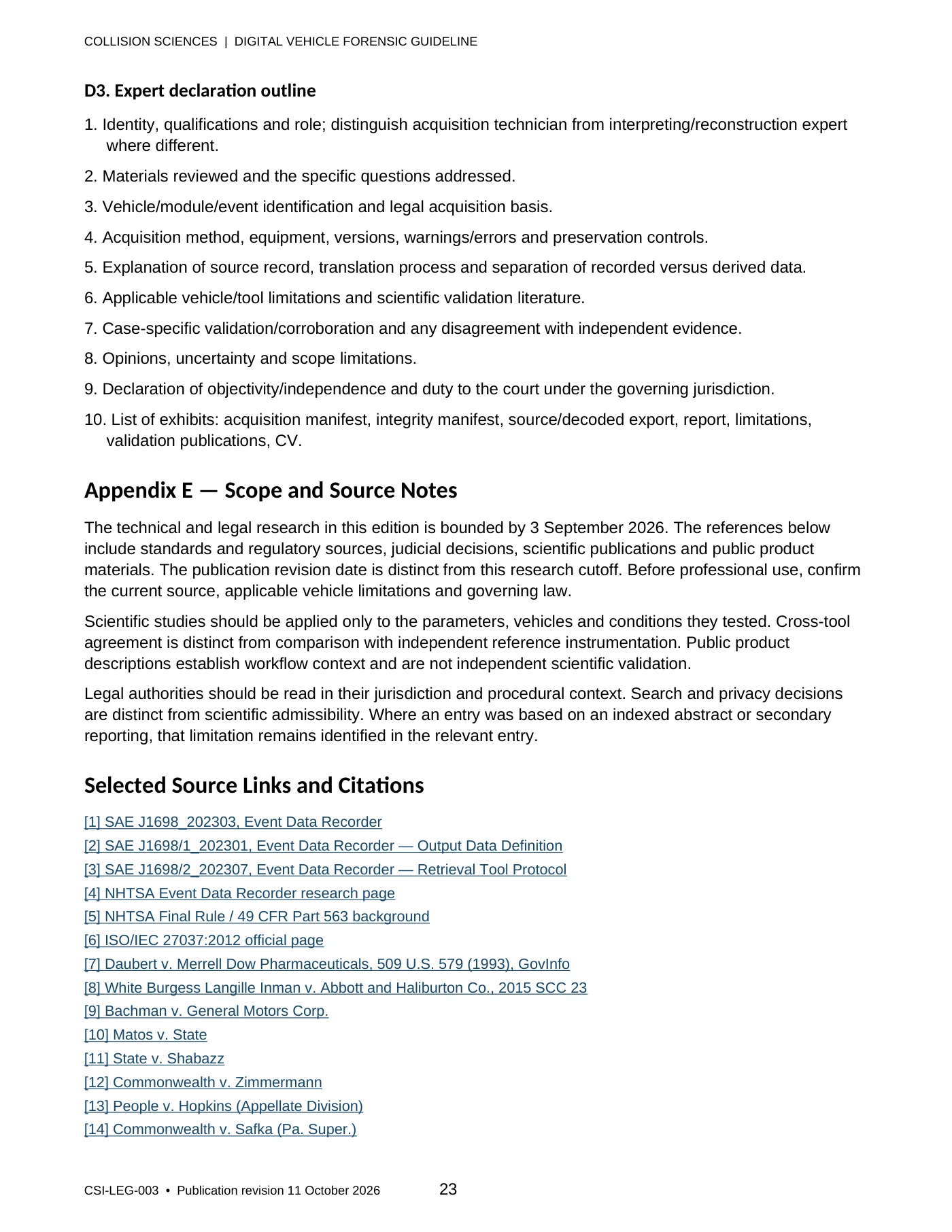
D3. Expert declaration outline
1. Identity, qualifications and role; distinguish acquisition technician from interpreting/reconstruction expert where different. 2. Materials reviewed and the specific questions addressed. 3. Vehicle/module/event identification and legal acquisition basis. 4. Acquisition method, equipment, versions, warnings/errors and preservation controls. 5. Explanation of source record, translation process and separation of recorded versus derived data. 6. Applicable vehicle/tool limitations and scientific validation literature. 7. Case-specific validation/corroboration and any disagreement with independent evidence. 8. Opinions, uncertainty and scope limitations. 9. Declaration of objectivity/independence and duty to the court under the governing jurisdiction. 10. List of exhibits: acquisition manifest, integrity manifest, source/decoded export, report, limitations, validation publications, CV.
22 / In this resource
Appendix E — Scope and source notes
The technical and legal research in this edition is bounded by 3 September 2026. The references below include standards and regulatory sources, judicial decisions, scientific publications and public product materials. The publication revision date is distinct from this research cutoff. Before professional use, confirm the current source, applicable vehicle limitations and governing law. Scientific studies should be applied only to the parameters, vehicles and conditions they tested. Cross-tool agreement is distinct from comparison with independent reference instrumentation. Public product descriptions establish workflow context and are not independent scientific validation. Legal authorities should be read in their jurisdiction and procedural context. Search and privacy decisions are distinct from scientific admissibility. Where an entry was based on an indexed abstract or secondary reporting, that limitation remains identified in the relevant entry.
23 / In this resource
Selected source links and citations
[1] SAE J1698_202303, Event Data Recorder [2] SAE J1698/1_202301, Event Data Recorder — Output Data Definition [3] SAE J1698/2_202307, Event Data Recorder — Retrieval Tool Protocol [4] NHTSA Event Data Recorder research page [5] NHTSA Final Rule / 49 CFR Part 563 background [6] ISO/IEC 27037:2012 official page [7] Daubert v. Merrell Dow Pharmaceuticals, 509 U.S. 579 (1993), GovInfo [8] White Burgess Langille Inman v. Abbott and Haliburton Co., 2015 SCC 23 [9] Bachman v. General Motors Corp. [10] Matos v. State [11] State v. Shabazz [12] Commonwealth v. Zimmermann [13] People v. Hopkins (Appellate Division) [14] Commonwealth v. Safka (Pa. Super.)
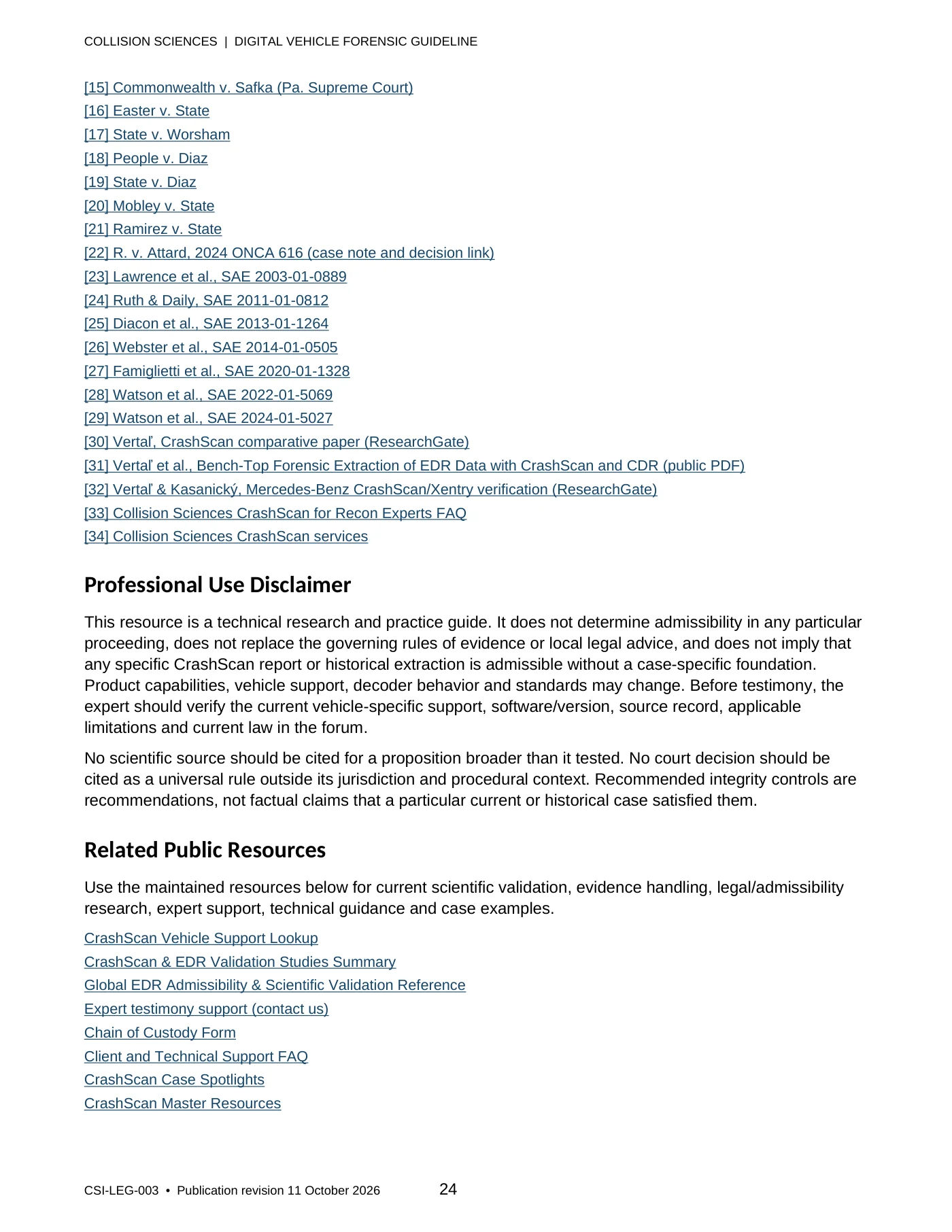
[15] Commonwealth v. Safka (Pa. Supreme Court) [16] Easter v. State [17] State v. Worsham [18] People v. Diaz [19] State v. Diaz [20] Mobley v. State [21] Ramirez v. State [22] R. v. Attard, 2024 ONCA 616 (case note and decision link) [23] Lawrence et al., SAE 2003-01-0889 [24] Ruth & Daily, SAE 2011-01-0812 [25] Diacon et al., SAE 2013-01-1264 [26] Webster et al., SAE 2014-01-0505 [27] Famiglietti et al., SAE 2020-01-1328 [28] Watson et al., SAE 2022-01-5069 [29] Watson et al., SAE 2024-01-5027 [30] Vertaľ, CrashScan comparative paper (ResearchGate) [31] Vertaľ et al., Bench-Top Forensic Extraction of EDR Data with CrashScan and CDR (public PDF) [32] Vertaľ & Kasanický, Mercedes-Benz CrashScan/Xentry verification (ResearchGate) [33] Collision Sciences CrashScan for Recon Experts FAQ [34] Collision Sciences CrashScan services
24 / In this resource
Professional use disclaimer
This resource is a technical research and practice guide. It does not determine admissibility in any particular proceeding, does not replace the governing rules of evidence or local legal advice, and does not imply that any specific CrashScan report or historical extraction is admissible without a case-specific foundation. Product capabilities, vehicle support, decoder behavior and standards may change. Before testimony, the expert should verify the current vehicle-specific support, software/version, source record, applicable limitations and current law in the forum. No scientific source should be cited for a proposition broader than it tested. No court decision should be cited as a universal rule outside its jurisdiction and procedural context. Recommended integrity controls are recommendations, not factual claims that a particular current or historical case satisfied them.
25 / In this resource
Related public resources
Use the maintained resources below for current scientific validation, evidence handling, legal/admissibility research, expert support, technical guidance and case examples.
CrashScan Vehicle Support Lookup CrashScan & EDR Validation Studies Summary Global EDR Admissibility & Scientific Validation Reference Expert testimony support (contact us) Chain of Custody Form Client and Technical Support FAQ CrashScan Case Spotlights CrashScan Master Resources