Collision Sciences
Global EDR admissibility & scientific validation reference
Court authorities, evidentiary foundation, scientific validation and global forensic-use evidence
Public reference edition | September 2026
01 / In this resource
Core conclusion
EDR evidence has been repeatedly admitted or relied upon in courts across multiple jurisdictions and has a substantial scientific validation literature. Reliability remains parameter-, vehicle-, event-, retrieval- and foundation-specific; EDR evidence should be corroborated and interpreted within known limitations. Educational and technical reference. Not jurisdiction-specific legal advice.
02 / In this resource
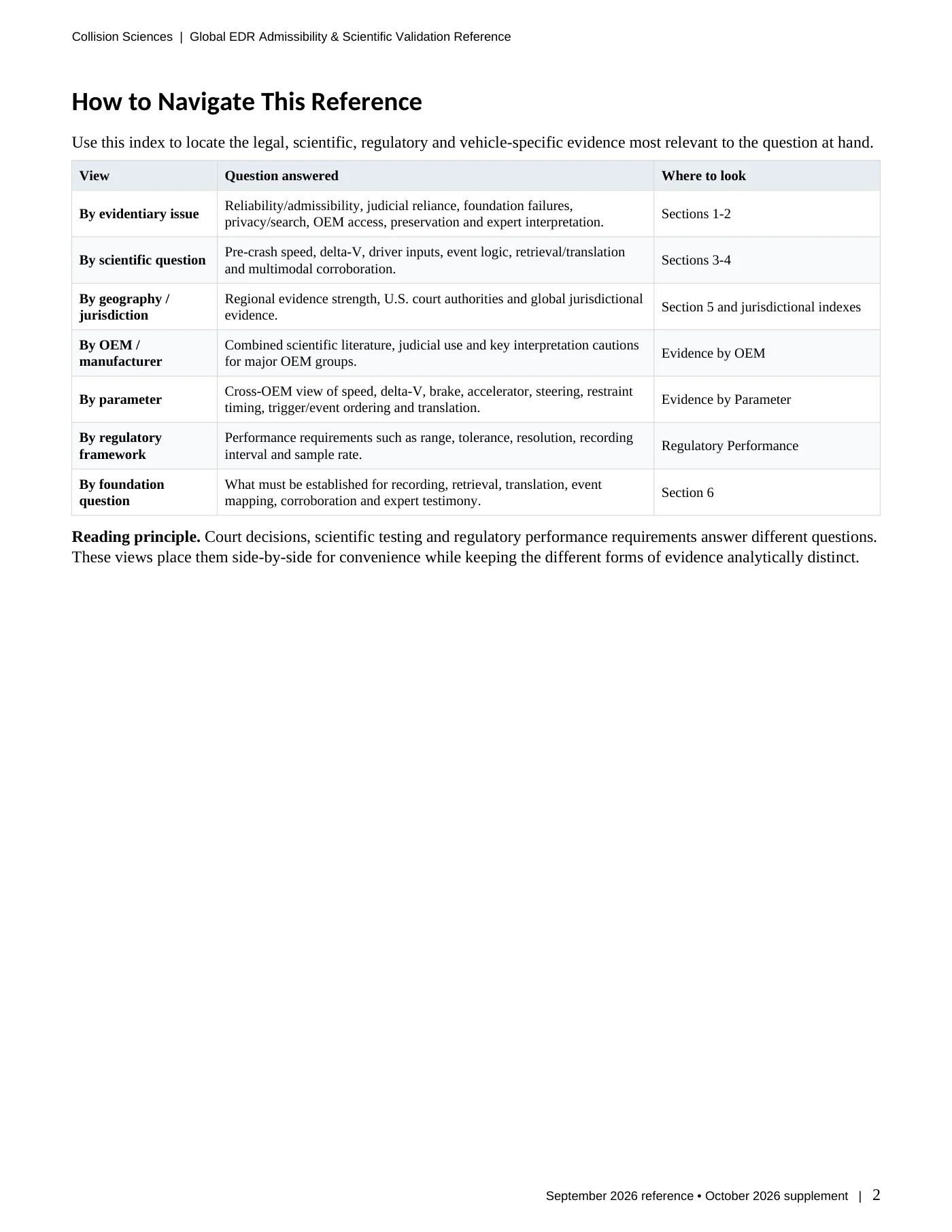
How to navigate this reference
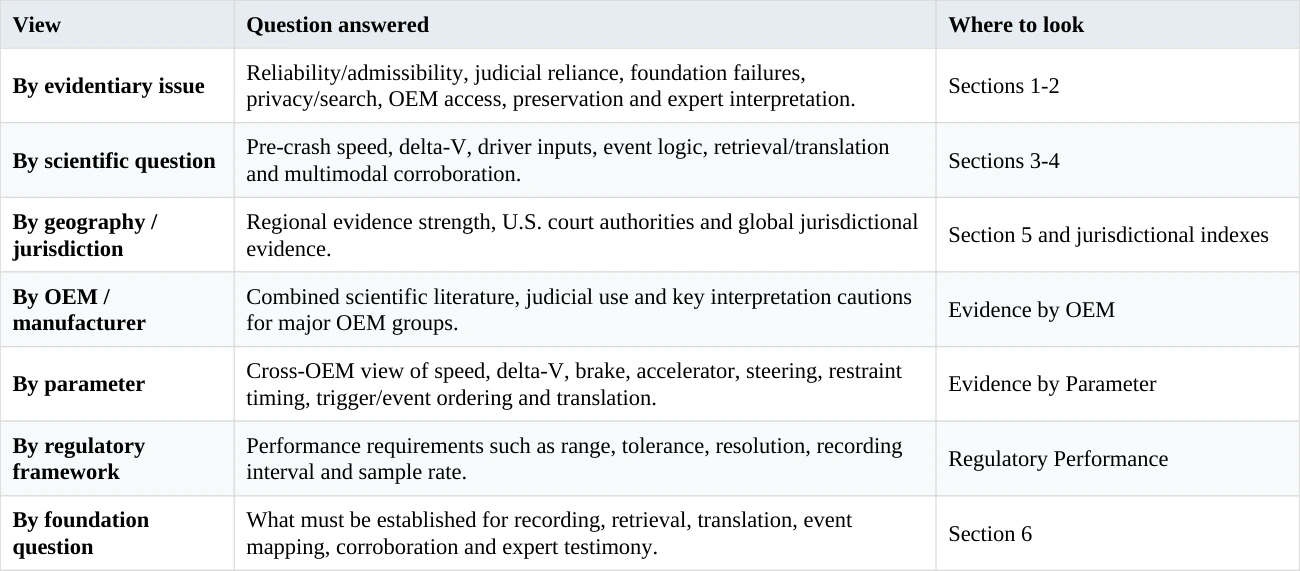
Use this index to locate the legal, scientific, regulatory and vehicle-specific evidence most relevant to the question at hand.
Read table as text
| View | Question answered | Where to look |
| By evidentiary issue | Reliability/admissibility, judicial reliance, foundation failures, privacy/search, OEM access, preservation and expert interpretation. | Sections 1-2 |
| By scientific question | Pre-crash speed, delta-V, driver inputs, event logic, retrieval/translation and multimodal corroboration. | Sections 3-4 |
| By geography / jurisdiction | Regional evidence strength, U.S. court authorities and global jurisdictional evidence. | Section 5 and jurisdictional indexes |
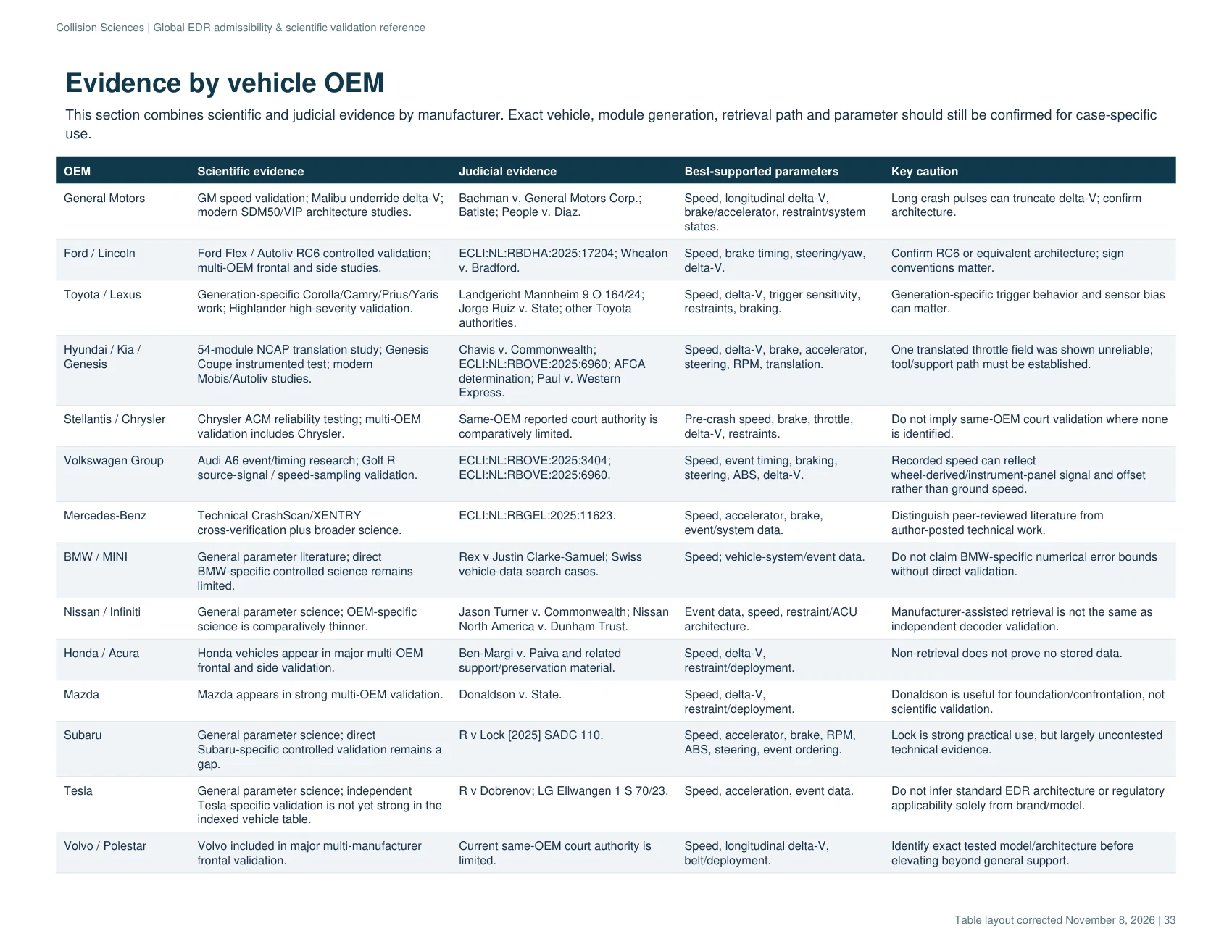
| By OEM / manufacturer | Combined scientific literature, judicial use and key interpretation cautions for major OEM groups. | Evidence by OEM |
| By parameter | Cross-OEM view of speed, delta-V, brake, accelerator, steering, restraint timing, trigger/event ordering and translation. | Evidence by Parameter |
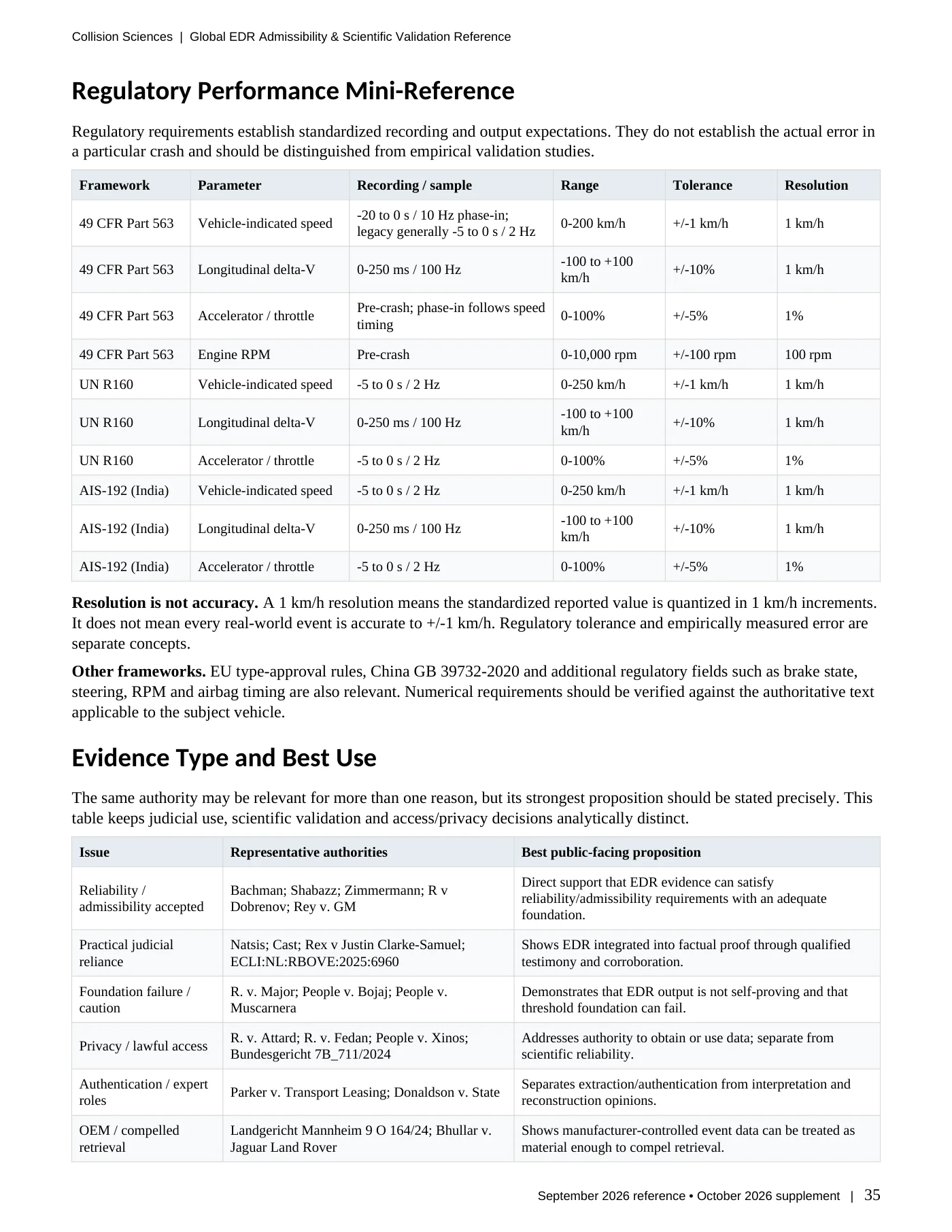
| By regulatory framework | Performance requirements such as range, tolerance, resolution, recording interval and sample rate. | Regulatory Performance |
| By foundation question | What must be established for recording, retrieval, translation, event mapping, corroboration and expert testimony. | Section 6 |
Reading principle. Court decisions, scientific testing and regulatory performance requirements answer different questions. These views place them side-by-side for convenience while keeping the different forms of evidence analytically distinct.
03 / In this resource
Executive summary
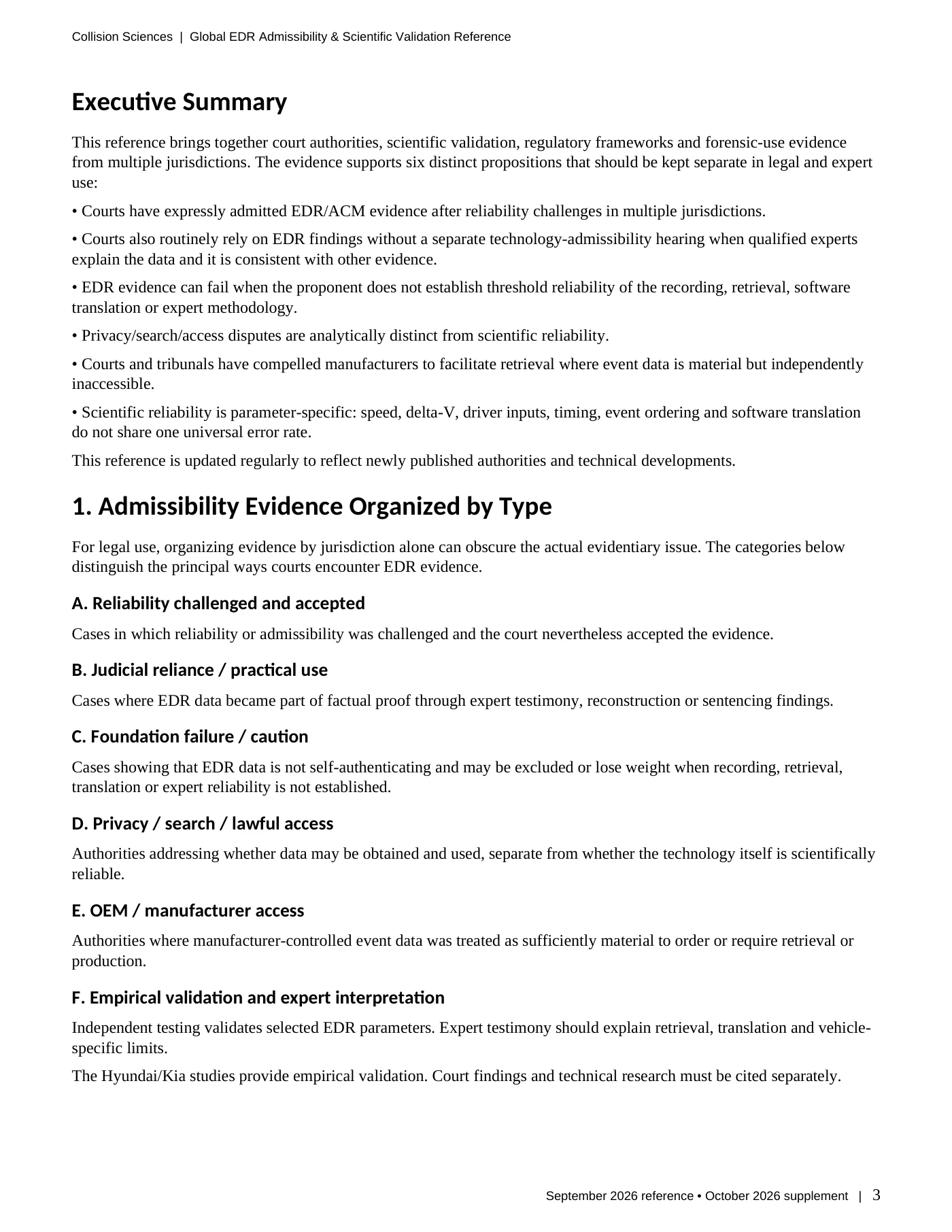
This reference brings together court authorities, scientific validation, regulatory frameworks and forensic-use evidence from multiple jurisdictions. The evidence supports six distinct propositions that should be kept separate in legal and expert use:
- Courts have expressly admitted EDR/ACM evidence after reliability challenges in multiple jurisdictions.
- Courts also routinely rely on EDR findings without a separate technology-admissibility hearing when qualified experts explain the data and it is consistent with other evidence.
- EDR evidence can fail when the proponent does not establish threshold reliability of the recording, retrieval, software translation or expert methodology.
- Privacy/search/access disputes are analytically distinct from scientific reliability.
- Courts and tribunals have compelled manufacturers to facilitate retrieval where event data is material but independently inaccessible.
- Scientific reliability is parameter-specific: speed, delta-V, driver inputs, timing, event ordering and software translation do not share one universal error rate. This reference is updated regularly to reflect newly published authorities and technical developments.
04 / In this resource
1. Admissibility evidence organized by type
For legal use, organizing evidence by jurisdiction alone can obscure the actual evidentiary issue. The categories below distinguish the principal ways courts encounter EDR evidence.
A. Reliability challenged and accepted
Cases in which reliability or admissibility was challenged and the court nevertheless accepted the evidence.
B. Judicial reliance / practical use
Cases where EDR data became part of factual proof through expert testimony, reconstruction or sentencing findings.
C. Foundation failure / caution
Cases showing that EDR data is not self-authenticating and may be excluded or lose weight when recording, retrieval, translation or expert reliability is not established.
D. Privacy / search / lawful access
Authorities addressing whether data may be obtained and used, separate from whether the technology itself is scientifically reliable.
E. OEM / manufacturer access
Authorities where manufacturer-controlled event data was treated as sufficiently material to order or require retrieval or production.
F. Empirical validation and expert interpretation
Independent testing validates selected EDR parameters. Expert testimony should explain retrieval, translation and vehicle-specific limits. The Hyundai/Kia studies provide empirical validation. Court findings and technical research must be cited separately.
05 / In this resource
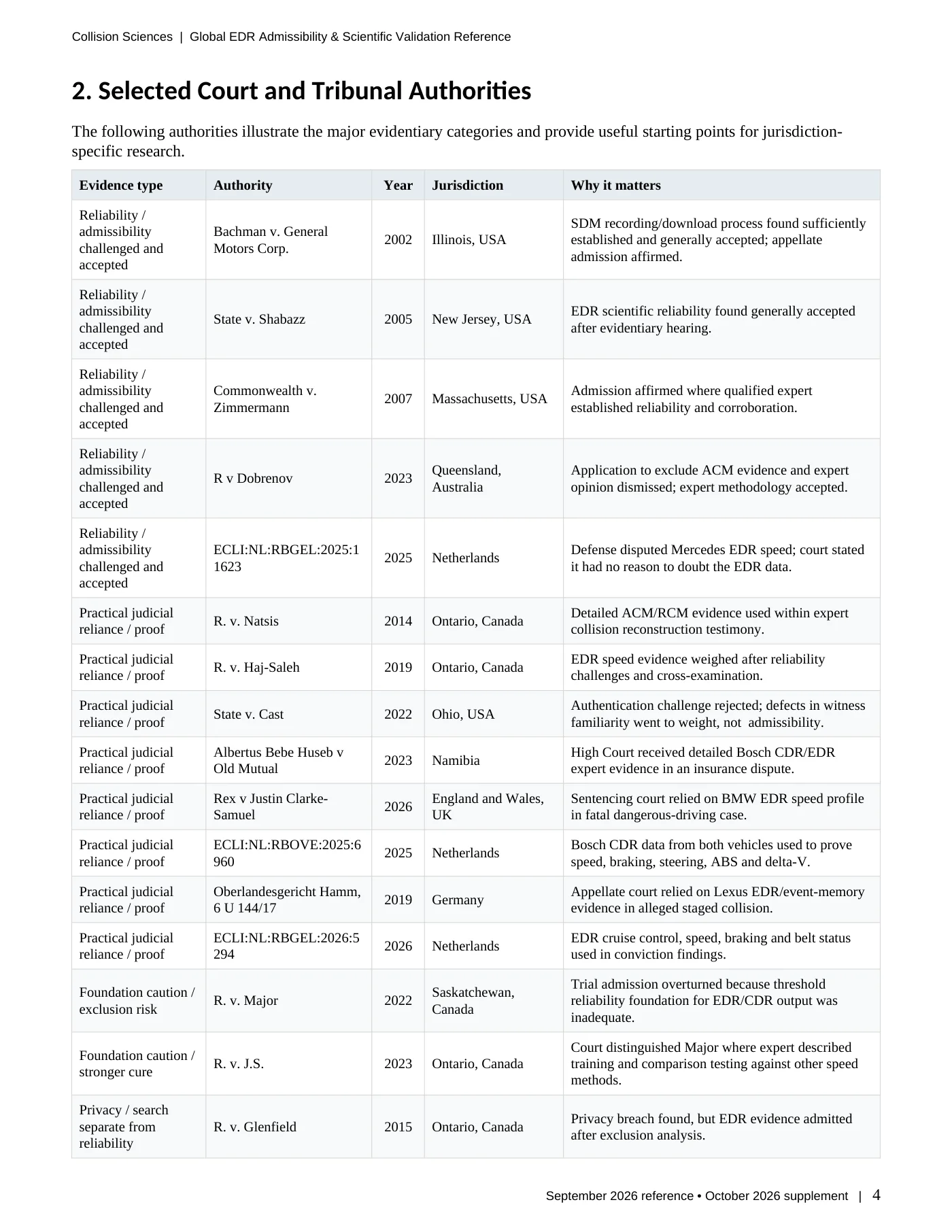
2. Selected court and tribunal authorities
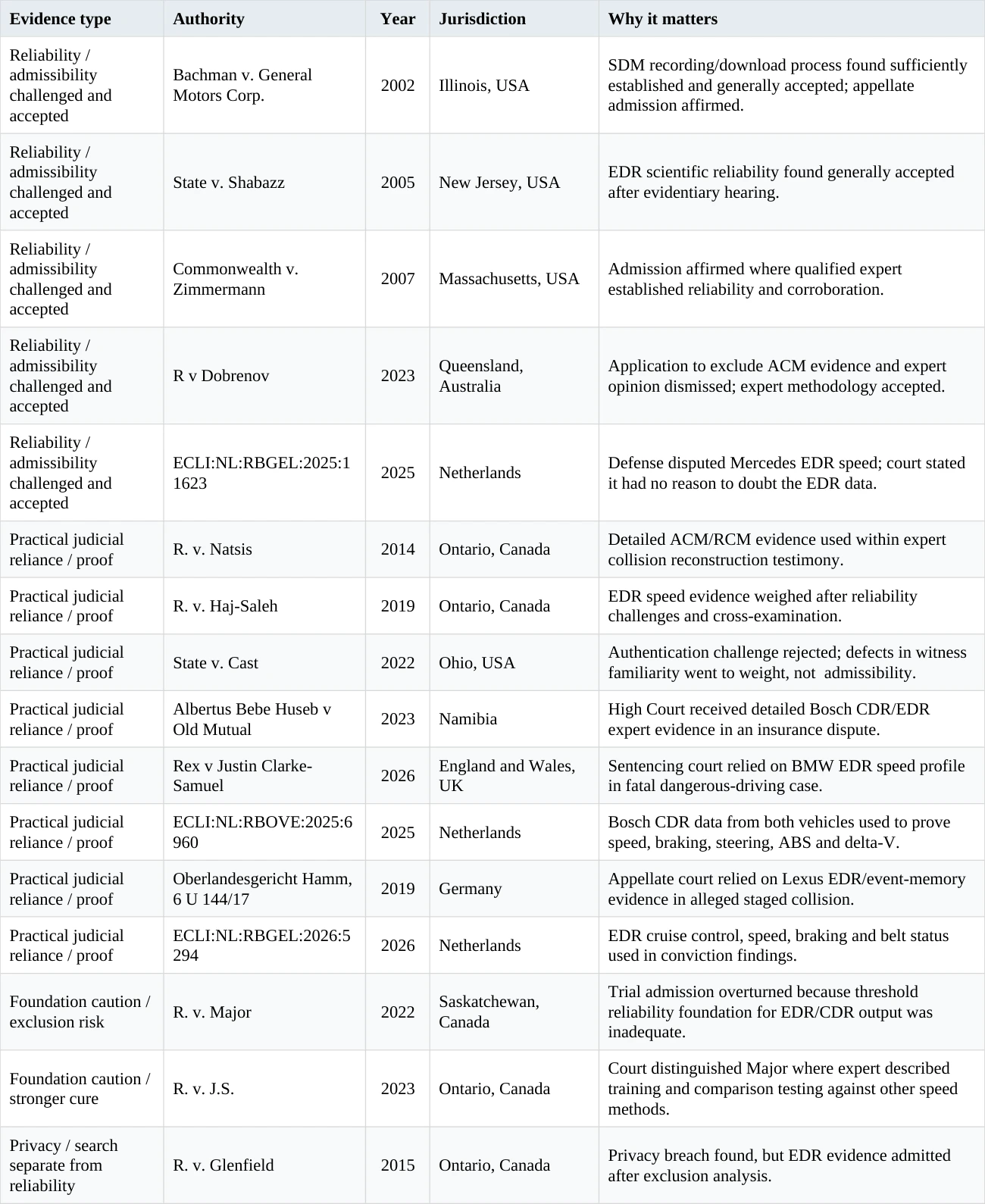
The following authorities illustrate the major evidentiary categories and provide useful starting points for jurisdiction-specific research.
Read table as text
| Evidence type | Authority | Year | Jurisdiction | Why it matters |
| Reliability / admissibility challenged and accepted | Bachman v. General Motors Corp. | 2002 | Illinois, USA | SDM recording/download process found sufficiently established and generally accepted; appellate admission affirmed. |
| Reliability / admissibility challenged and accepted | State v. Shabazz | 2005 | New Jersey, USA | EDR scientific reliability found generally accepted after evidentiary hearing. |
| Reliability / admissibility challenged and accepted | Commonwealth v. Zimmermann | 2007 | Massachusetts, USA | Admission affirmed where qualified expert established reliability and corroboration. |
| Reliability / admissibility challenged and accepted | R v Dobrenov | 2023 | Queensland, Australia | Application to exclude ACM evidence and expert opinion dismissed; expert methodology accepted. |
| Reliability / admissibility challenged and accepted | ECLI:NL:RBGEL:2025:1 1623 | 2025 | Netherlands | Defense disputed Mercedes EDR speed; court stated it had no reason to doubt the EDR data. |
| Practical judicial reliance / proof | R. v. Natsis | 2014 | Ontario, Canada | Detailed ACM/RCM evidence used within expert collision reconstruction testimony. |
| Practical judicial reliance / proof | R. v. Haj-Saleh | 2019 | Ontario, Canada | EDR speed evidence weighed after reliability challenges and cross-examination. |
| Practical judicial reliance / proof | State v. Cast | 2022 | Ohio, USA | Authentication challenge rejected; defects in witness familiarity went to weight, not admissibility. |
| Practical judicial reliance / proof | Albertus Bebe Huseb v Old Mutual | 2023 | Namibia | High Court received detailed Bosch CDR/EDR expert evidence in an insurance dispute. |
| Practical judicial reliance / proof | Rex v Justin Clarke- Samuel | 2026 | England and Wales, UK | Sentencing court relied on BMW EDR speed profile in fatal dangerous-driving case. |
| Practical judicial reliance / proof | ECLI:NL:RBOVE:2025:6 960 | 2025 | Netherlands | Bosch CDR data from both vehicles used to prove speed, braking, steering, ABS and delta-V. |
| Practical judicial reliance / proof | Oberlandesgericht Hamm, 6 U 144/17 | 2019 | Germany | Appellate court relied on Lexus EDR/event-memory evidence in alleged staged collision. |
| Practical judicial reliance / proof | ECLI:NL:RBGEL:2026:5 294 | 2026 | Netherlands | EDR cruise control, speed, braking and belt status used in conviction findings. |
| Foundation caution / exclusion risk | R. v. Major | 2022 | Saskatchewan, Canada | Trial admission overturned because threshold reliability foundation for EDR/CDR output was inadequate. |
| Foundation caution / stronger cure | R. v. J.S. | 2023 | Ontario, Canada | Court distinguished Major where expert described training and comparison testing against other speed methods. |
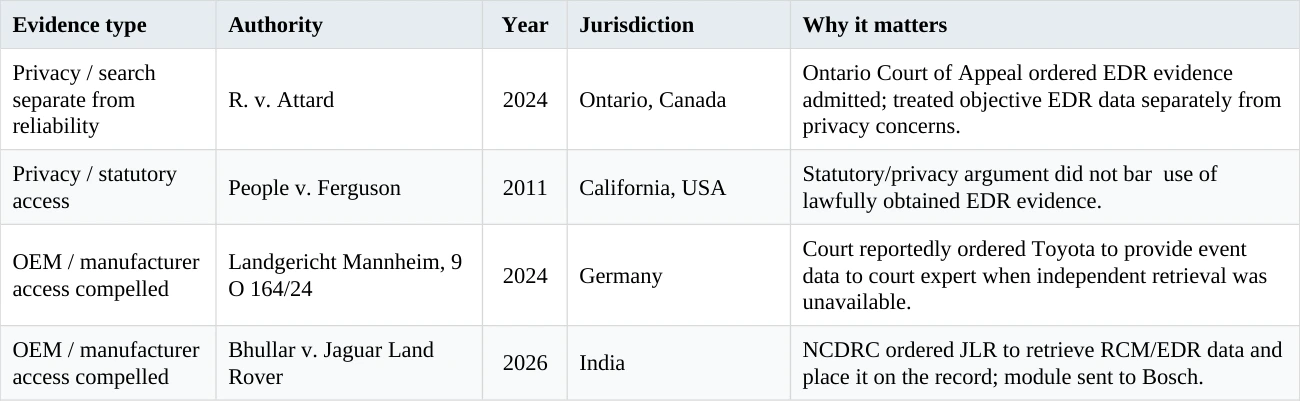
| Privacy / search separate from reliability | R. v. Glenfield | 2015 | Ontario, Canada | Privacy breach found, but EDR evidence admitted after exclusion analysis. |
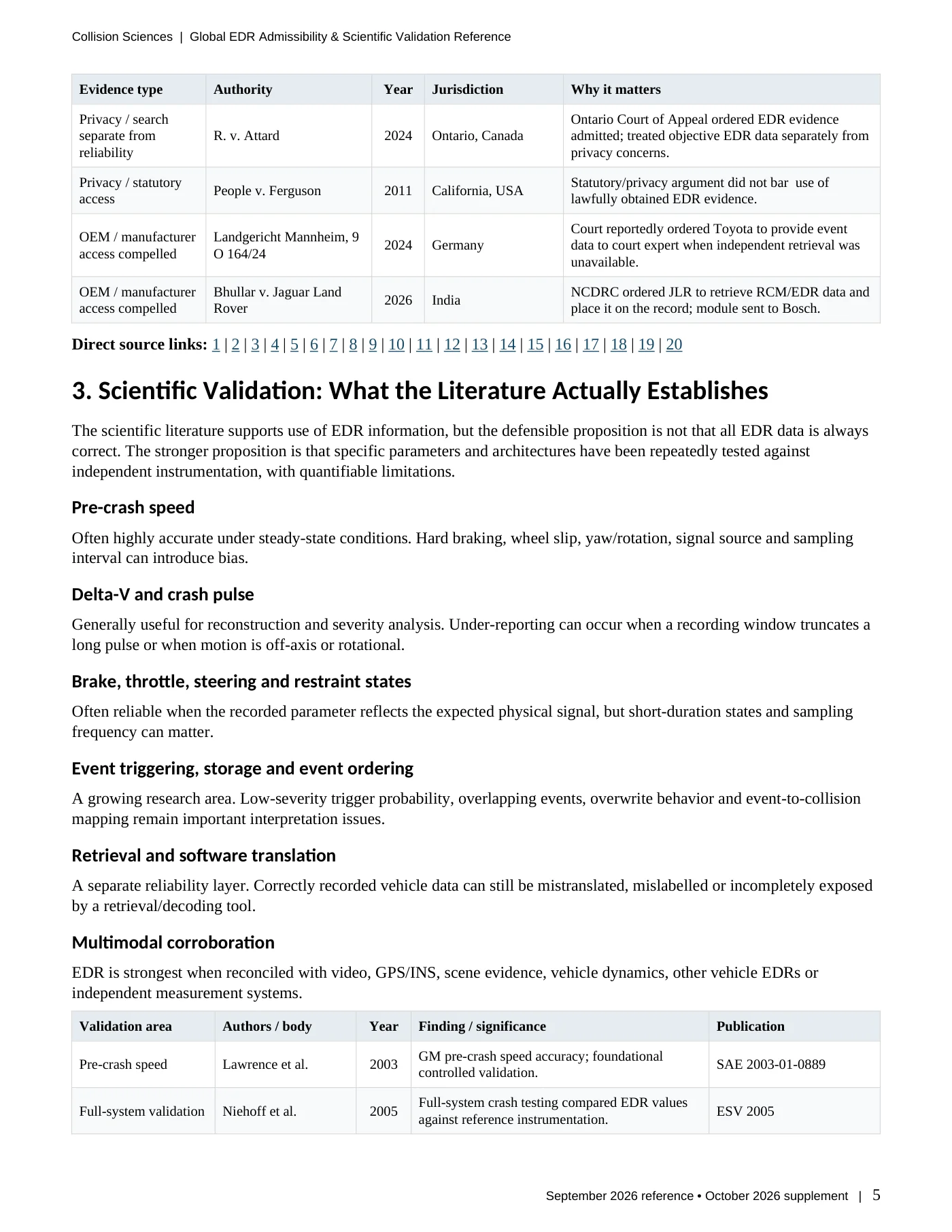
Read table as text
| Evidence type | Authority | Year | Jurisdiction | Why it matters |
| Privacy / search separate from reliability | R. v. Attard | 2024 | Ontario, Canada | Ontario Court of Appeal ordered EDR evidence admitted; treated objective EDR data separately from privacy concerns. |
| Privacy / statutory access | People v. Ferguson | 2011 | California, USA | Statutory/privacy argument did not bar use of lawfully obtained EDR evidence. |
| OEM / manufacturer access compelled | Landgericht Mannheim, 9 O 164/24 | 2024 | Germany | Court reportedly ordered Toyota to provide event data to court expert when independent retrieval was unavailable. |
| OEM / manufacturer access compelled | Bhullar v. Jaguar Land Rover | 2026 | India | NCDRC ordered JLR to retrieve RCM/EDR data and place it on the record; module sent to Bosch. |
Direct source links: 1 | 2 | 3 | 4 | 5 | 6 | 7 | 8 | 9 | 10 | 11 | 12 | 13 | 14 | 15 | 16 | 17 | 18 | 19 | 20
06 / In this resource
3. Scientific validation: what the literature actually establishes
The scientific literature supports use of EDR information, but the defensible proposition is not that all EDR data is always correct. The stronger proposition is that specific parameters and architectures have been repeatedly tested against independent instrumentation, with quantifiable limitations.
Pre-crash speed
Often highly accurate under steady-state conditions. Hard braking, wheel slip, yaw/rotation, signal source and sampling interval can introduce bias.
Delta-V and crash pulse
Generally useful for reconstruction and severity analysis. Under-reporting can occur when a recording window truncates a long pulse or when motion is off-axis or rotational.
Brake, throttle, steering and restraint states
Often reliable when the recorded parameter reflects the expected physical signal, but short-duration states and sampling frequency can matter.
Event triggering, storage and event ordering
A growing research area. Low-severity trigger probability, overlapping events, overwrite behavior and event-to-collision mapping remain important interpretation issues.
Retrieval and software translation
A separate reliability layer. Correctly recorded vehicle data can still be mistranslated, mislabelled or incompletely exposed by a retrieval/decoding tool.
Multimodal corroboration
EDR is strongest when reconciled with video, GPS/INS, scene evidence, vehicle dynamics, other vehicle EDRs or independent measurement systems.

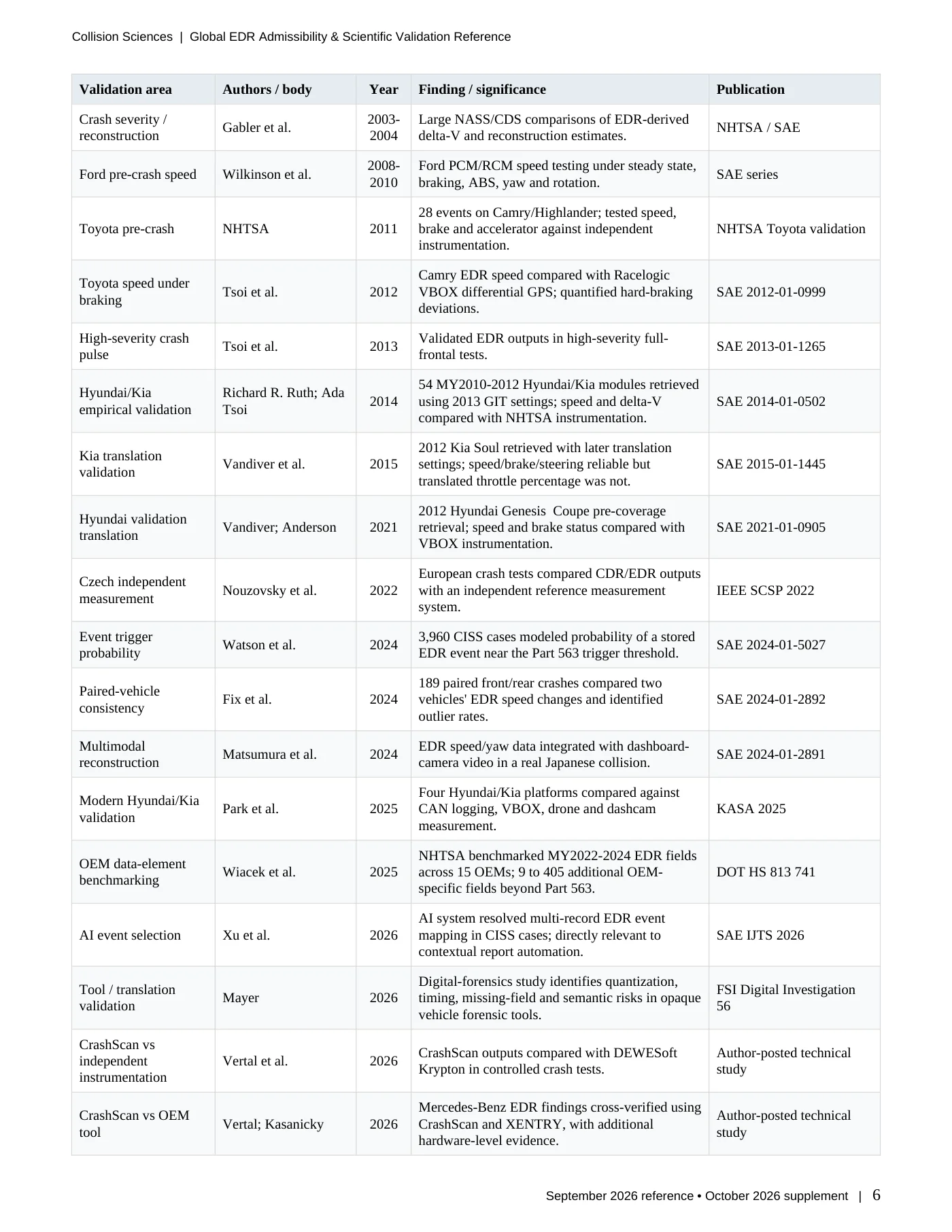
Read table as text
| Validation area | Authors / body | Year | Finding / significance | Publication |
| Pre-crash speed | Lawrence et al. | 2003 | GM pre-crash speed accuracy; foundational controlled validation. | SAE 2003-01-0889 |
| Full-system validation | Niehoff et al. | 2005 | Full-system crash testing compared EDR values against reference instrumentation. | ESV 2005 |
Read table as text
| Validation area | Authors / body | Year | Finding / significance | Publication |
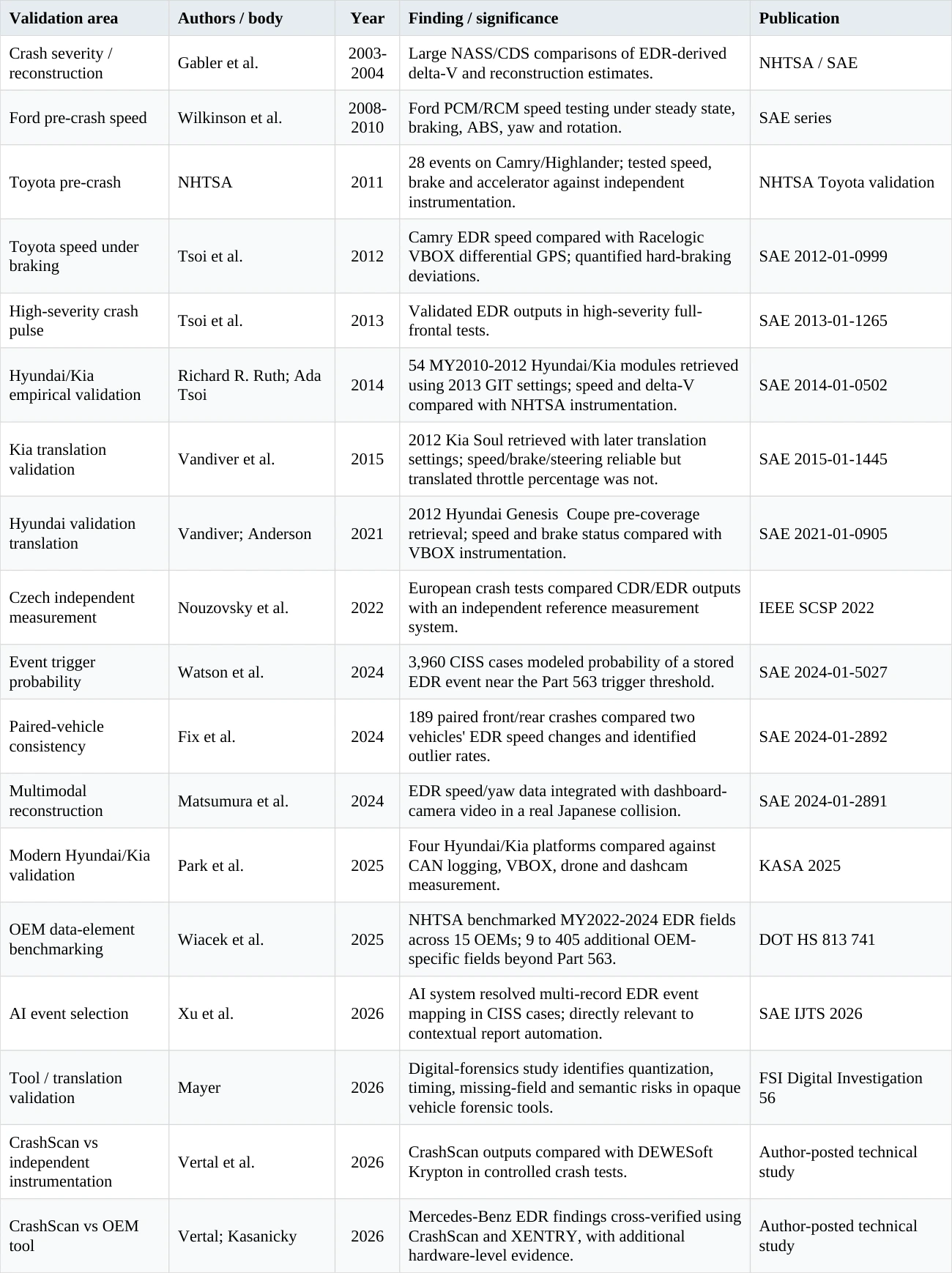
| Crash severity / reconstruction | Gabler et al. | 2003- 2004 | Large NASS/CDS comparisons of EDR-derived delta-V and reconstruction estimates. | NHTSA / SAE |
| Ford pre-crash speed | Wilkinson et al. | 2008- 2010 | Ford PCM/RCM speed testing under steady state, braking, ABS, yaw and rotation. | SAE series |
| Toyota pre-crash | NHTSA | 2011 | 28 events on Camry/Highlander; tested speed, brake and accelerator against independent instrumentation. | NHTSA Toyota validation |
| Toyota speed under braking | Tsoi et al. | 2012 | Camry EDR speed compared with Racelogic VBOX differential GPS; quantified hard-braking deviations. | SAE 2012-01-0999 |
| High-severity crash pulse | Tsoi et al. | 2013 | Validated EDR outputs in high-severity full- frontal tests. | SAE 2013-01-1265 |
| Hyundai/Kia empirical validation | Richard R. Ruth; Ada Tsoi | 2014 | 54 MY2010-2012 Hyundai/Kia modules retrieved using 2013 GIT settings; speed and delta-V compared with NHTSA instrumentation. | SAE 2014-01-0502 |
| Kia translation validation | Vandiver et al. | 2015 | 2012 Kia Soul retrieved with later translation settings; speed/brake/steering reliable but translated throttle percentage was not. | SAE 2015-01-1445 |
| Hyundai validation translation | Vandiver; Anderson | 2021 | 2012 Hyundai Genesis Coupe pre-coverage retrieval; speed and brake status compared with VBOX instrumentation. | SAE 2021-01-0905 |
| Czech independent measurement | Nouzovsky et al. | 2022 | European crash tests compared CDR/EDR outputs with an independent reference measurement system. | IEEE SCSP 2022 |
| Event trigger probability | Watson et al. | 2024 | 3,960 CISS cases modeled probability of a stored EDR event near the Part 563 trigger threshold. | SAE 2024-01-5027 |
| Paired-vehicle consistency | Fix et al. | 2024 | 189 paired front/rear crashes compared two vehicles' EDR speed changes and identified outlier rates. | SAE 2024-01-2892 |
| Multimodal reconstruction | Matsumura et al. | 2024 | EDR speed/yaw data integrated with dashboard- camera video in a real Japanese collision. | SAE 2024-01-2891 |
| Modern Hyundai/Kia validation | Park et al. | 2025 | Four Hyundai/Kia platforms compared against CAN logging, VBOX, drone and dashcam measurement. | KASA 2025 |
| OEM data-element benchmarking | Wiacek et al. | 2025 | NHTSA benchmarked MY2022-2024 EDR fields across 15 OEMs; 9 to 405 additional OEM- specific fields beyond Part 563. | DOT HS 813 741 |
| AI event selection | Xu et al. | 2026 | AI system resolved multi-record EDR event mapping in CISS cases; directly relevant to contextual report automation. | SAE IJTS 2026 |
| Tool / translation validation | Mayer | 2026 | Digital-forensics study identifies quantization, timing, missing-field and semantic risks in opaque vehicle forensic tools. | FSI Digital Investigation 56 |
| CrashScan vs independent instrumentation | Vertal et al. | 2026 | CrashScan outputs compared with DEWESoft Krypton in controlled crash tests. | Author-posted technical study |
| CrashScan vs OEM tool | Vertal; Kasanicky | 2026 | Mercedes-Benz EDR findings cross-verified using CrashScan and XENTRY, with additional hardware-level evidence. | Author-posted technical study |

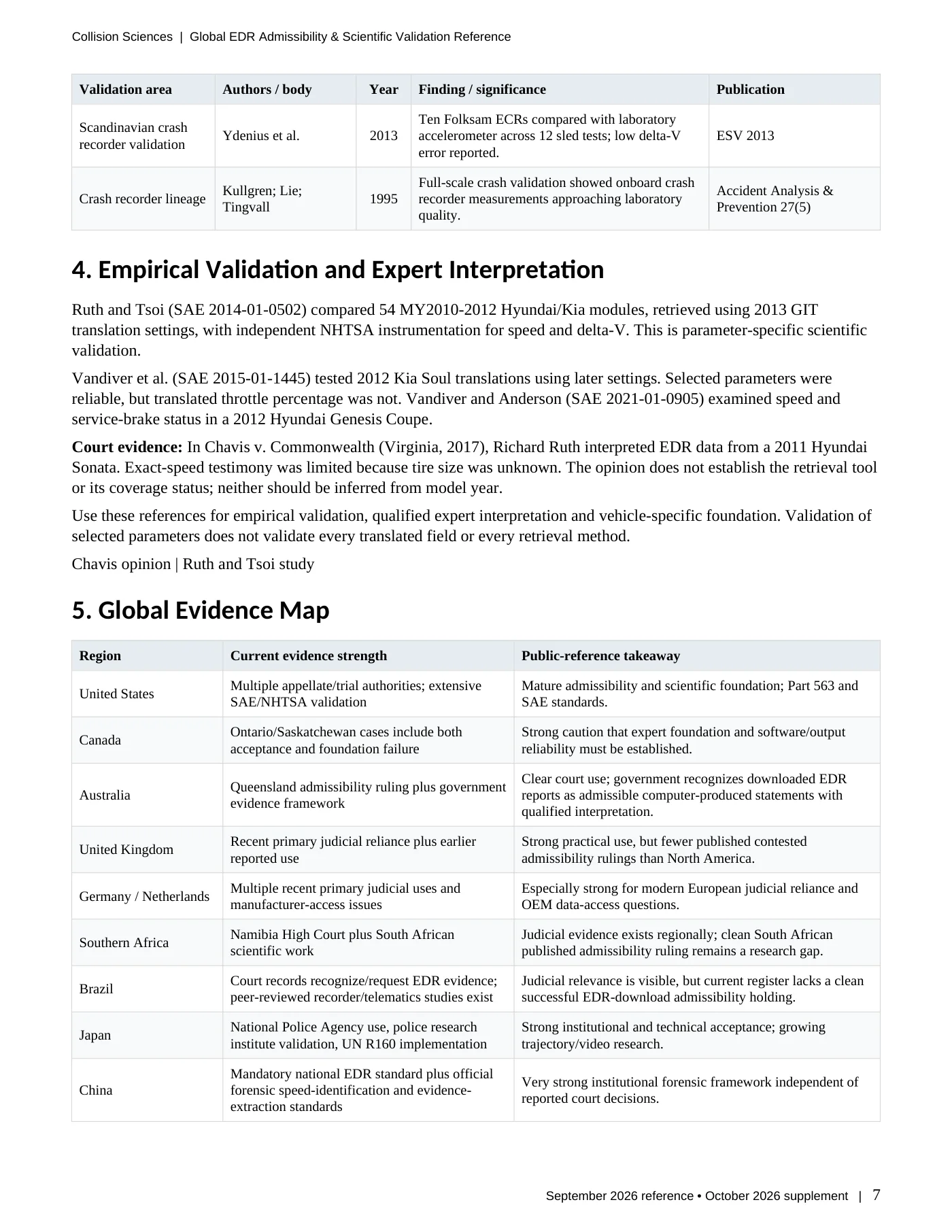
Read table as text
| Validation area | Authors / body | Year | Finding / significance | Publication |
| Scandinavian crash recorder validation | Ydenius et al. | 2013 | Ten Folksam ECRs compared with laboratory accelerometer across 12 sled tests; low delta-V error reported. | ESV 2013 |
| Crash recorder lineage | Kullgren; Lie; Tingvall | 1995 | Full-scale crash validation showed onboard crash recorder measurements approaching laboratory quality. | Accident Analysis & Prevention 27(5) |
07 / In this resource
4. Empirical validation and expert interpretation
Ruth and Tsoi (SAE 2014-01-0502) compared 54 MY2010-2012 Hyundai/Kia modules, retrieved using 2013 GIT translation settings, with independent NHTSA instrumentation for speed and delta-V. This is parameter-specific scientific validation. Vandiver et al. (SAE 2015-01-1445) tested 2012 Kia Soul translations using later settings. Selected parameters were reliable, but translated throttle percentage was not. Vandiver and Anderson (SAE 2021-01-0905) examined speed and service-brake status in a 2012 Hyundai Genesis Coupe. Court evidence: In Chavis v. Commonwealth (Virginia, 2017), Richard Ruth interpreted EDR data from a 2011 Hyundai Sonata.
Exact-speed testimony was limited because tire size was unknown. The opinion does not establish the retrieval tool or its coverage status; neither should be inferred from model year. Use these references for empirical validation, qualified expert interpretation and vehicle-specific foundation. Validation of selected parameters does not validate every translated field or every retrieval method. Chavis opinion | Ruth and Tsoi study
08 / In this resource
5. Global evidence map
Read table as text
| Region | Current evidence strength | Public-reference takeaway |
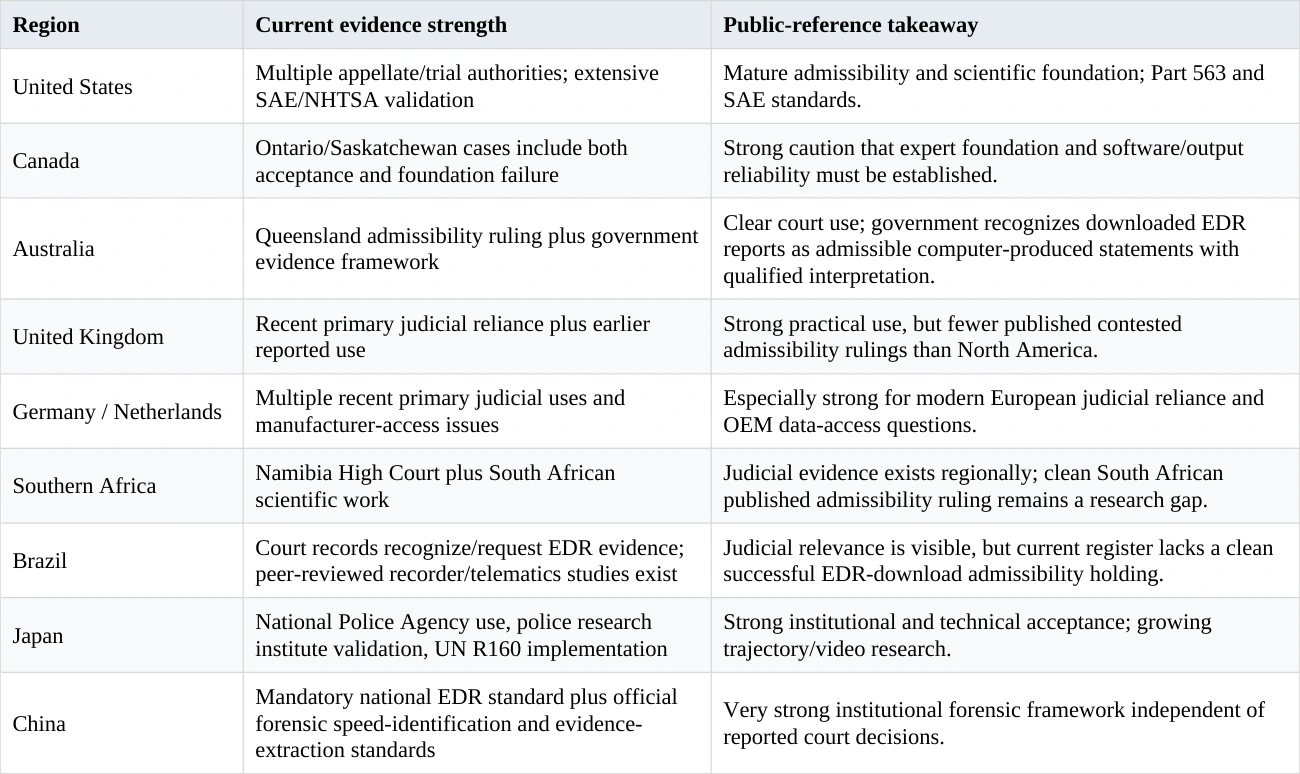
| United States | Multiple appellate/trial authorities; extensive SAE/NHTSA validation | Mature admissibility and scientific foundation; Part 563 and SAE standards. |
| Canada | Ontario/Saskatchewan cases include both acceptance and foundation failure | Strong caution that expert foundation and software/output reliability must be established. |
| Australia | Queensland admissibility ruling plus government evidence framework | Clear court use; government recognizes downloaded EDR reports as admissible computer-produced statements with qualified interpretation. |
| United Kingdom | Recent primary judicial reliance plus earlier reported use | Strong practical use, but fewer published contested admissibility rulings than North America. |
| Germany / Netherlands | Multiple recent primary judicial uses and manufacturer-access issues | Especially strong for modern European judicial reliance and OEM data-access questions. |
| Southern Africa | Namibia High Court plus South African scientific work | Judicial evidence exists regionally; clean South African published admissibility ruling remains a research gap. |
| Brazil | Court records recognize/request EDR evidence; peer-reviewed recorder/telematics studies exist | Judicial relevance is visible, but current register lacks a clean successful EDR-download admissibility holding. |
| Japan | National Police Agency use, police research institute validation, UN R160 implementation | Strong institutional and technical acceptance; growing trajectory/video research. |
| China | Mandatory national EDR standard plus official forensic speed-identification and evidence- extraction standards | Very strong institutional forensic framework independent of reported court decisions. |

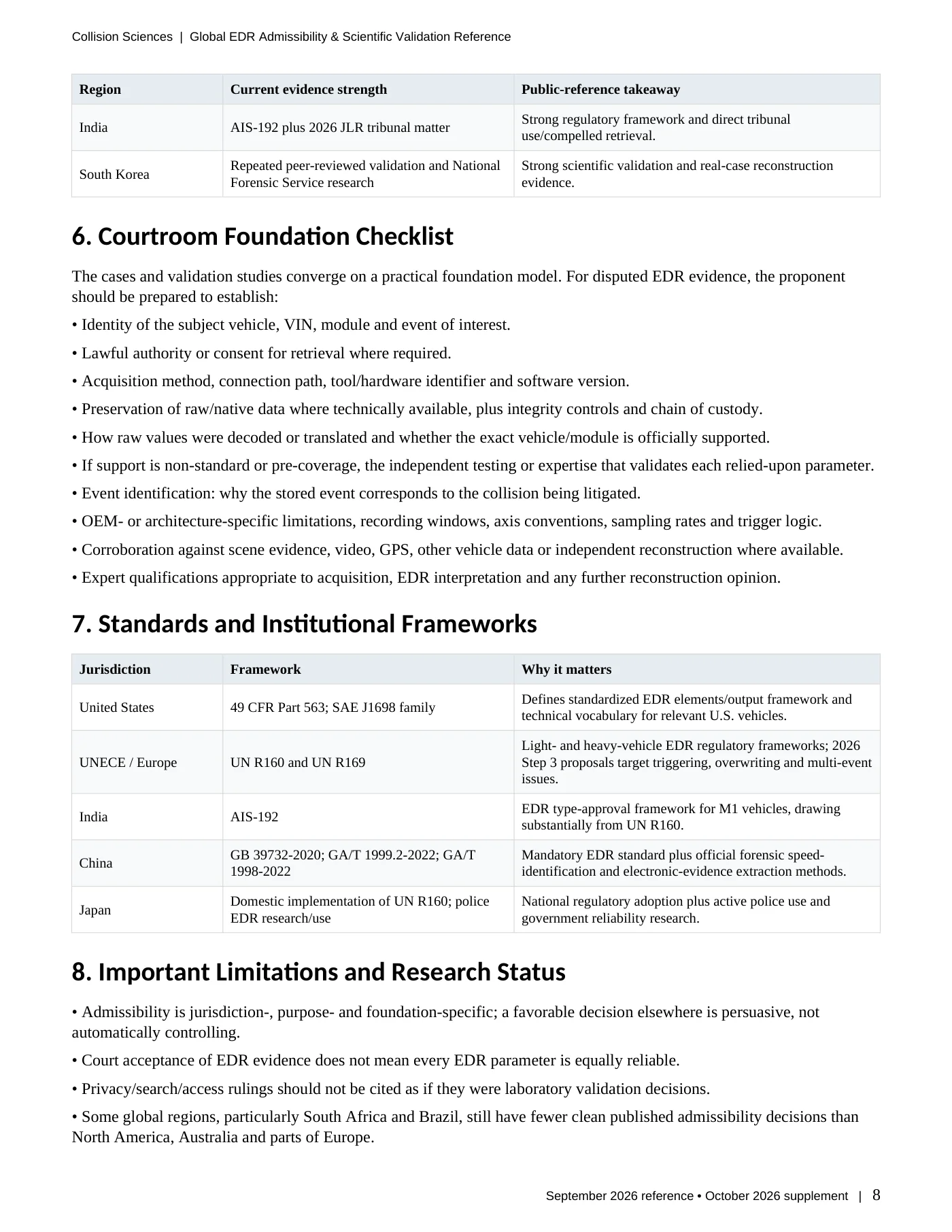
Read table as text
| Region | Current evidence strength | Public-reference takeaway |
| India | AIS-192 plus 2026 JLR tribunal matter | Strong regulatory framework and direct tribunal use/compelled retrieval. |
| South Korea | Repeated peer-reviewed validation and National Forensic Service research | Strong scientific validation and real-case reconstruction evidence. |
09 / In this resource
6. Courtroom foundation checklist
The cases and validation studies converge on a practical foundation model. For disputed EDR evidence, the proponent should be prepared to establish:
- Identity of the subject vehicle, VIN, module and event of interest.
- Lawful authority or consent for retrieval where required.
- Acquisition method, connection path, tool/hardware identifier and software version.
- Preservation of raw/native data where technically available, plus integrity controls and chain of custody.
- How raw values were decoded or translated and whether the exact vehicle/module is officially supported.
- If support is non-standard or pre-coverage, the independent testing or expertise that validates each relied-upon parameter.
- Event identification: why the stored event corresponds to the collision being litigated.
- OEM- or architecture-specific limitations, recording windows, axis conventions, sampling rates and trigger logic.
- Corroboration against scene evidence, video, GPS, other vehicle data or independent reconstruction where available.
- Expert qualifications appropriate to acquisition, EDR interpretation and any further reconstruction opinion.
10 / In this resource
7. Standards and institutional frameworks
Read table as text
| Jurisdiction | Framework | Why it matters |
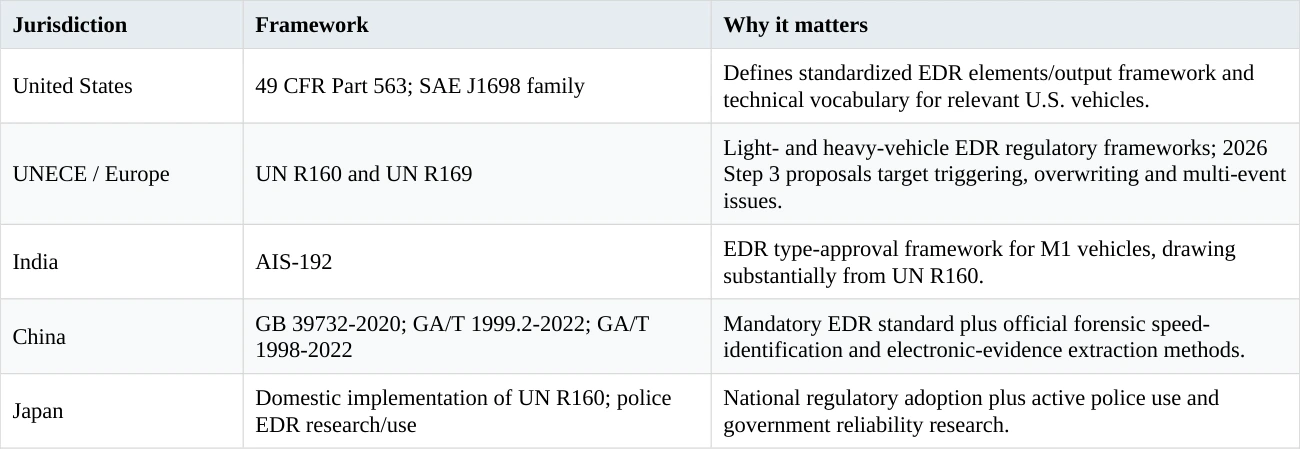
| United States | 49 CFR Part 563; SAE J1698 family | Defines standardized EDR elements/output framework and technical vocabulary for relevant U.S. vehicles. |
| UNECE / Europe | UN R160 and UN R169 | Light- and heavy-vehicle EDR regulatory frameworks; 2026 Step 3 proposals target triggering, overwriting and multi-event issues. |
| India | AIS-192 | EDR type-approval framework for M1 vehicles, drawing substantially from UN R160. |
| China | GB 39732-2020; GA/T 1999.2-2022; GA/T 1998-2022 | Mandatory EDR standard plus official forensic speed- identification and electronic-evidence extraction methods. |
| Japan | Domestic implementation of UN R160; police EDR research/use | National regulatory adoption plus active police use and government reliability research. |
11 / In this resource
8. Important limitations and research status
- Admissibility is jurisdiction-, purpose- and foundation-specific; a favorable decision elsewhere is persuasive, not automatically controlling.
- Court acceptance of EDR evidence does not mean every EDR parameter is equally reliable.
- Privacy/search/access rulings should not be cited as if they were laboratory validation decisions.
- Some global regions, particularly South Africa and Brazil, still have fewer clean published admissibility decisions than North America, Australia and parts of Europe.
- Author-posted technical studies are valuable evidence leads but should be distinguished from peer-reviewed journal publications.
- This reference is updated regularly as new court authorities, validation studies and regulatory developments become available.
12 / In this resource
9. Related Collision Sciences resources
Expert testimony and technical support (request by email):
support@collisionsciences.ca
Digital vehicle forensic guideline - for experts & investigators:
https://drive.google.com/file/d/1qSc5nMH03ufis1XxT0eEBPiecPFZ4WU4/view
13 / In this resource
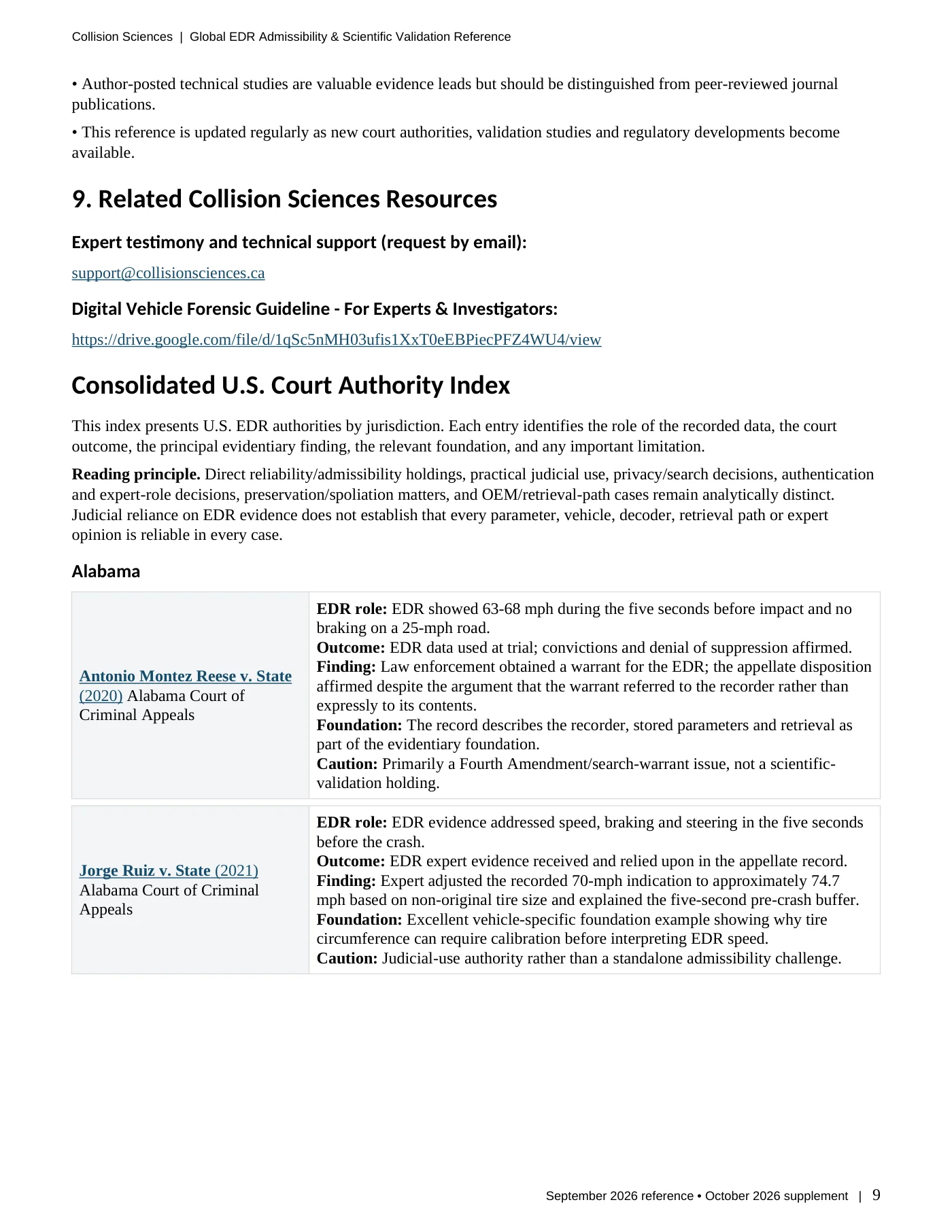
Consolidated U.S. court authority index
This index presents U.S. EDR authorities by jurisdiction. Each entry identifies the role of the recorded data, the court outcome, the principal evidentiary finding, the relevant foundation, and any important limitation. Reading principle. Direct reliability/admissibility holdings, practical judicial use, privacy/search decisions, authentication and expert-role decisions, preservation/spoliation matters, and OEM/retrieval-path cases remain analytically distinct. Judicial reliance on EDR evidence does not establish that every parameter, vehicle, decoder, retrieval path or expert opinion is reliable in every case.
Alabama
Antonio Montez Reese v. State (2020) Alabama Court of Criminal Appeals EDR role: EDR showed 63-68 mph during the five seconds before impact and no braking on a 25-mph road. Outcome: EDR data used at trial; convictions and denial of suppression affirmed. Finding: Law enforcement obtained a warrant for the EDR; the appellate disposition affirmed despite the argument that the warrant referred to the recorder rather than expressly to its contents. Foundation: The record describes the recorder, stored parameters and retrieval as part of the evidentiary foundation. Caution: Primarily a Fourth Amendment/search-warrant issue, not a scientific-validation holding.
Jorge Ruiz v. State (2021) Alabama Court of Criminal Appeals EDR role: EDR evidence addressed speed, braking and steering in the five seconds before the crash. Outcome: EDR expert evidence received and relied upon in the appellate record. Finding: Expert adjusted the recorded 70-mph indication to approximately 74.7 mph based on non-original tire size and explained the five-second pre-crash buffer. Foundation: Excellent vehicle-specific foundation example showing why tire circumference can require calibration before interpreting EDR speed. Caution: Judicial-use authority rather than a standalone admissibility challenge.
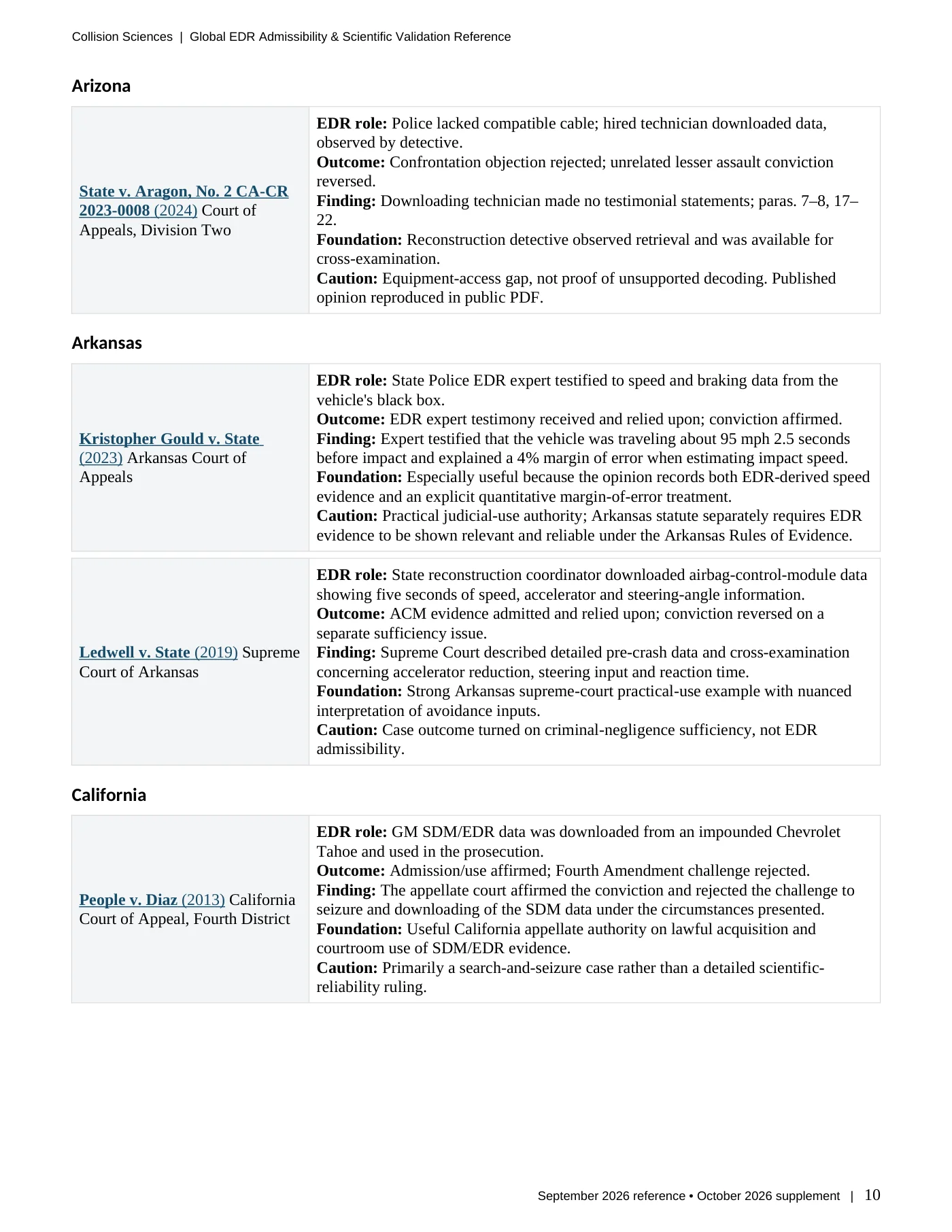
Arizona
State v. Aragon, No. 2 CA-CR 2023-0008 (2024) Court of Appeals, Division Two EDR role: Police lacked compatible cable; hired technician downloaded data, observed by detective. Outcome: Confrontation objection rejected; unrelated lesser assault conviction reversed. Finding: Downloading technician made no testimonial statements; paras. 7–8, 17– 22. Foundation: Reconstruction detective observed retrieval and was available for cross-examination. Caution: Equipment-access gap, not proof of unsupported decoding. Published opinion reproduced in public PDF.
Arkansas
Kristopher Gould v. State (2023) Arkansas Court of Appeals EDR role: State Police EDR expert testified to speed and braking data from the vehicle's black box. Outcome: EDR expert testimony received and relied upon; conviction affirmed. Finding: Expert testified that the vehicle was traveling about 95 mph 2.5 seconds before impact and explained a 4% margin of error when estimating impact speed. Foundation: Especially useful because the opinion records both EDR-derived speed evidence and an explicit quantitative margin-of-error treatment. Caution: Practical judicial-use authority; Arkansas statute separately requires EDR evidence to be shown relevant and reliable under the Arkansas Rules of Evidence.
Ledwell v. State (2019) Supreme Court of Arkansas EDR role: State reconstruction coordinator downloaded airbag-control-module data showing five seconds of speed, accelerator and steering-angle information. Outcome: ACM evidence admitted and relied upon; conviction reversed on a separate sufficiency issue. Finding: Supreme Court described detailed pre-crash data and cross-examination concerning accelerator reduction, steering input and reaction time. Foundation: Strong Arkansas supreme-court practical-use example with nuanced interpretation of avoidance inputs. Caution: Case outcome turned on criminal-negligence sufficiency, not EDR admissibility.
California
People v. Diaz (2013) California Court of Appeal, Fourth District EDR role: GM SDM/EDR data was downloaded from an impounded Chevrolet Tahoe and used in the prosecution. Outcome: Admission/use affirmed; Fourth Amendment challenge rejected. Finding: The appellate court affirmed the conviction and rejected the challenge to seizure and downloading of the SDM data under the circumstances presented. Foundation: Useful California appellate authority on lawful acquisition and courtroom use of SDM/EDR evidence. Caution: Primarily a search-and-seizure case rather than a detailed scientific-reliability ruling.
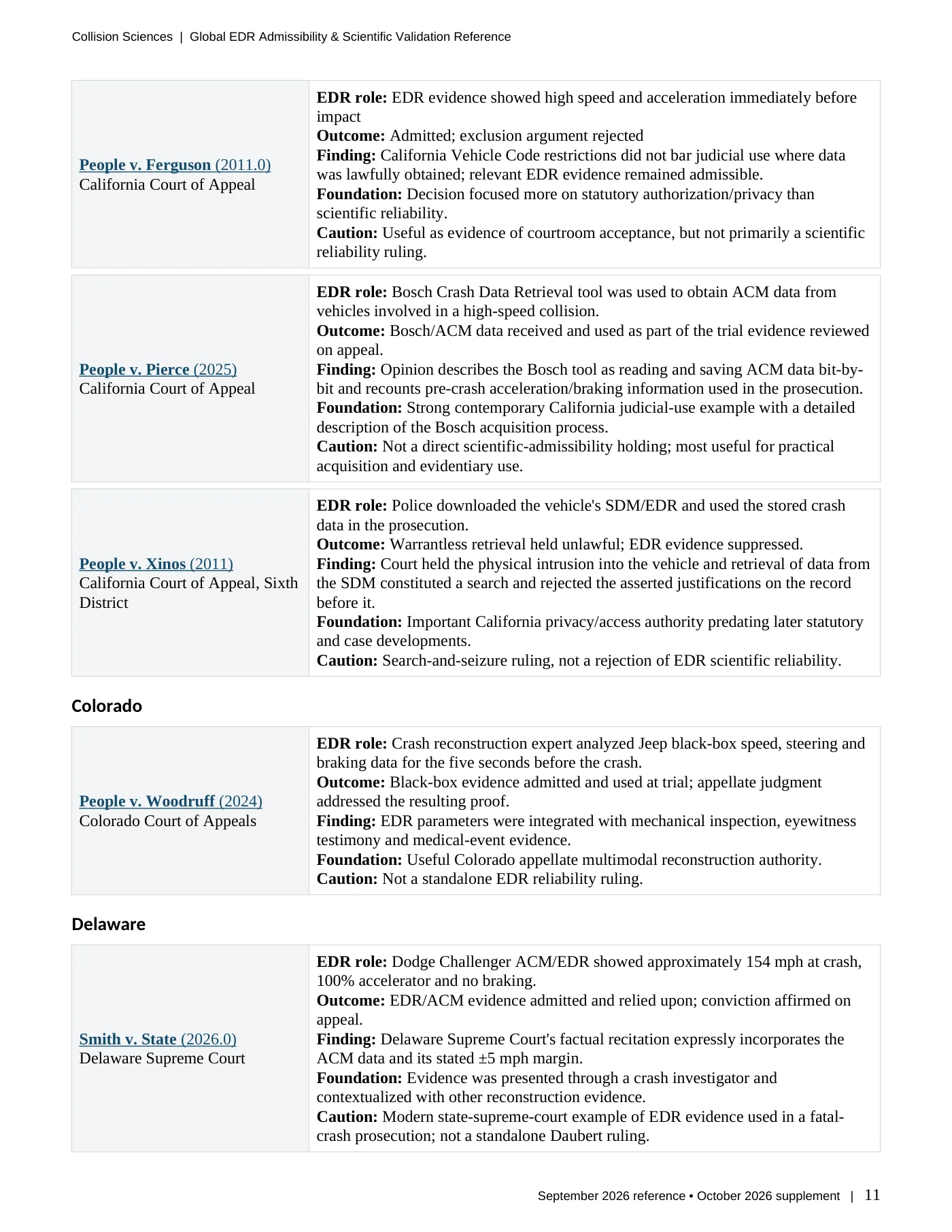
People v. Ferguson (2011.0) California Court of Appeal EDR role: EDR evidence showed high speed and acceleration immediately before impact Outcome: Admitted; exclusion argument rejected Finding: California Vehicle Code restrictions did not bar judicial use where data was lawfully obtained; relevant EDR evidence remained admissible. Foundation: Decision focused more on statutory authorization/privacy than scientific reliability. Caution: Useful as evidence of courtroom acceptance, but not primarily a scientific reliability ruling.
People v. Pierce (2025) California Court of Appeal EDR role: Bosch Crash Data Retrieval tool was used to obtain ACM data from vehicles involved in a high-speed collision. Outcome: Bosch/ACM data received and used as part of the trial evidence reviewed on appeal. Finding: Opinion describes the Bosch tool as reading and saving ACM data bit-by-bit and recounts pre-crash acceleration/braking information used in the prosecution. Foundation: Strong contemporary California judicial-use example with a detailed description of the Bosch acquisition process. Caution: Not a direct scientific-admissibility holding; most useful for practical acquisition and evidentiary use.
People v. Xinos (2011) California Court of Appeal, Sixth District EDR role: Police downloaded the vehicle's SDM/EDR and used the stored crash data in the prosecution. Outcome: Warrantless retrieval held unlawful; EDR evidence suppressed. Finding: Court held the physical intrusion into the vehicle and retrieval of data from the SDM constituted a search and rejected the asserted justifications on the record before it. Foundation: Important California privacy/access authority predating later statutory and case developments. Caution: Search-and-seizure ruling, not a rejection of EDR scientific reliability.
Colorado
People v. Woodruff (2024) Colorado Court of Appeals EDR role: Crash reconstruction expert analyzed Jeep black-box speed, steering and braking data for the five seconds before the crash. Outcome: Black-box evidence admitted and used at trial; appellate judgment addressed the resulting proof. Finding: EDR parameters were integrated with mechanical inspection, eyewitness testimony and medical-event evidence. Foundation: Useful Colorado appellate multimodal reconstruction authority. Caution: Not a standalone EDR reliability ruling.
Delaware
Smith v. State (2026.0) Delaware Supreme Court EDR role: Dodge Challenger ACM/EDR showed approximately 154 mph at crash, 100% accelerator and no braking. Outcome: EDR/ACM evidence admitted and relied upon; conviction affirmed on appeal. Finding: Delaware Supreme Court's factual recitation expressly incorporates the ACM data and its stated ±5 mph margin. Foundation: Evidence was presented through a crash investigator and contextualized with other reconstruction evidence. Caution: Modern state-supreme-court example of EDR evidence used in a fatal-crash prosecution; not a standalone Daubert ruling.
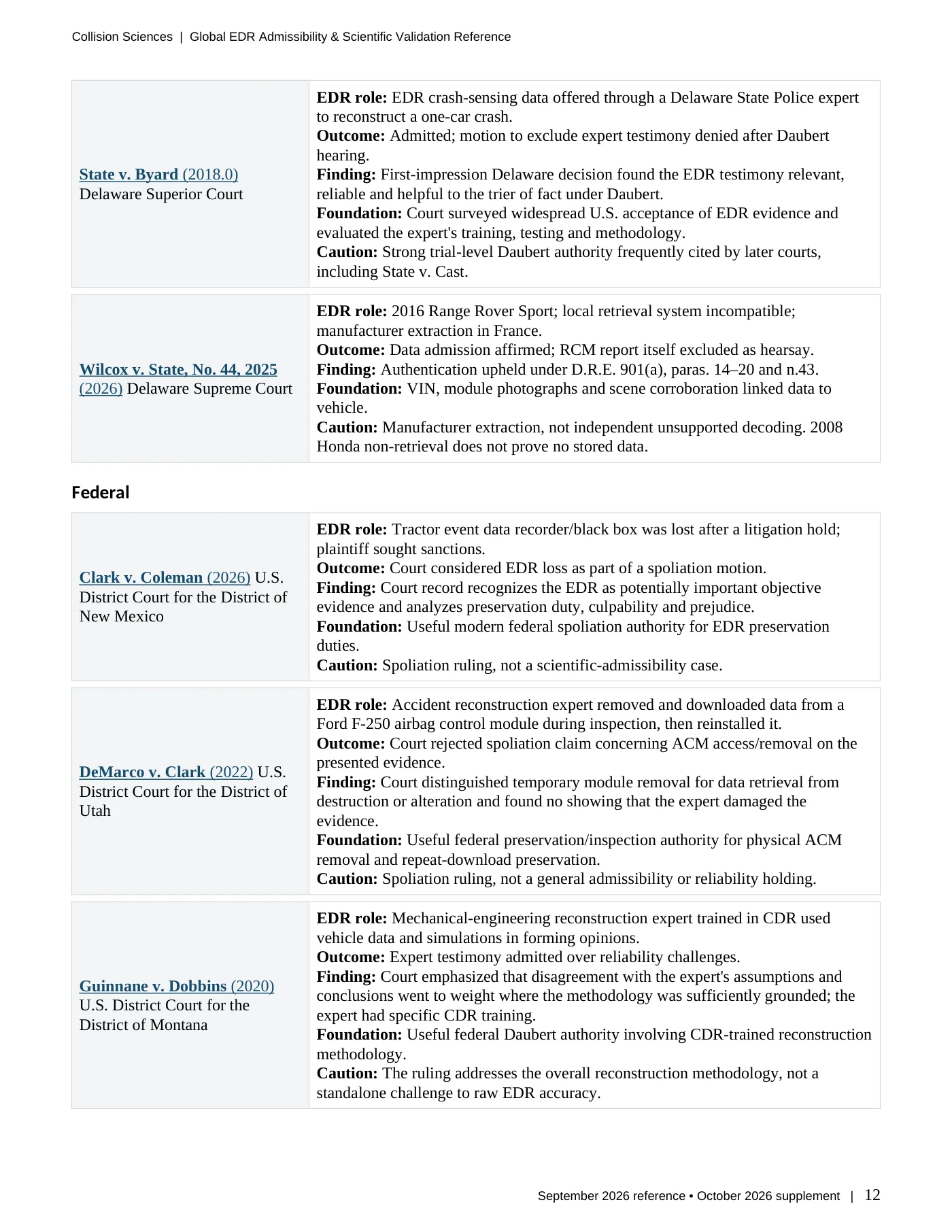
State v. Byard (2018.0) Delaware Superior Court EDR role: EDR crash-sensing data offered through a Delaware State Police expert to reconstruct a one-car crash. Outcome: Admitted; motion to exclude expert testimony denied after Daubert hearing. Finding: First-impression Delaware decision found the EDR testimony relevant, reliable and helpful to the trier of fact under Daubert. Foundation: Court surveyed widespread U.S. acceptance of EDR evidence and evaluated the expert's training, testing and methodology. Caution: Strong trial-level Daubert authority frequently cited by later courts, including State v. Cast.
Wilcox v. State, No. 44, 2025 (2026) Delaware Supreme Court EDR role: 2016 Range Rover Sport; local retrieval system incompatible; manufacturer extraction in France. Outcome: Data admission affirmed; RCM report itself excluded as hearsay. Finding: Authentication upheld under D.R.E. 901(a), paras. 14–20 and n.43. Foundation: VIN, module photographs and scene corroboration linked data to vehicle. Caution: Manufacturer extraction, not independent unsupported decoding. 2008 Honda non-retrieval does not prove no stored data.
Federal
Clark v. Coleman (2026) U.S.
District Court for the District of New Mexico EDR role: Tractor event data recorder/black box was lost after a litigation hold; plaintiff sought sanctions. Outcome: Court considered EDR loss as part of a spoliation motion. Finding: Court record recognizes the EDR as potentially important objective evidence and analyzes preservation duty, culpability and prejudice. Foundation: Useful modern federal spoliation authority for EDR preservation duties. Caution: Spoliation ruling, not a scientific-admissibility case.
DeMarco v. Clark (2022) U.S.
District Court for the District of Utah EDR role: Accident reconstruction expert removed and downloaded data from a Ford F-250 airbag control module during inspection, then reinstalled it. Outcome: Court rejected spoliation claim concerning ACM access/removal on the presented evidence. Finding: Court distinguished temporary module removal for data retrieval from destruction or alteration and found no showing that the expert damaged the evidence. Foundation: Useful federal preservation/inspection authority for physical ACM removal and repeat-download preservation. Caution: Spoliation ruling, not a general admissibility or reliability holding.
Guinnane v. Dobbins (2020) U.S. District Court for the District of Montana EDR role: Mechanical-engineering reconstruction expert trained in CDR used vehicle data and simulations in forming opinions. Outcome: Expert testimony admitted over reliability challenges. Finding: Court emphasized that disagreement with the expert's assumptions and conclusions went to weight where the methodology was sufficiently grounded; the expert had specific CDR training. Foundation: Useful federal Daubert authority involving CDR-trained reconstruction methodology. Caution: The ruling addresses the overall reconstruction methodology, not a standalone challenge to raw EDR accuracy.
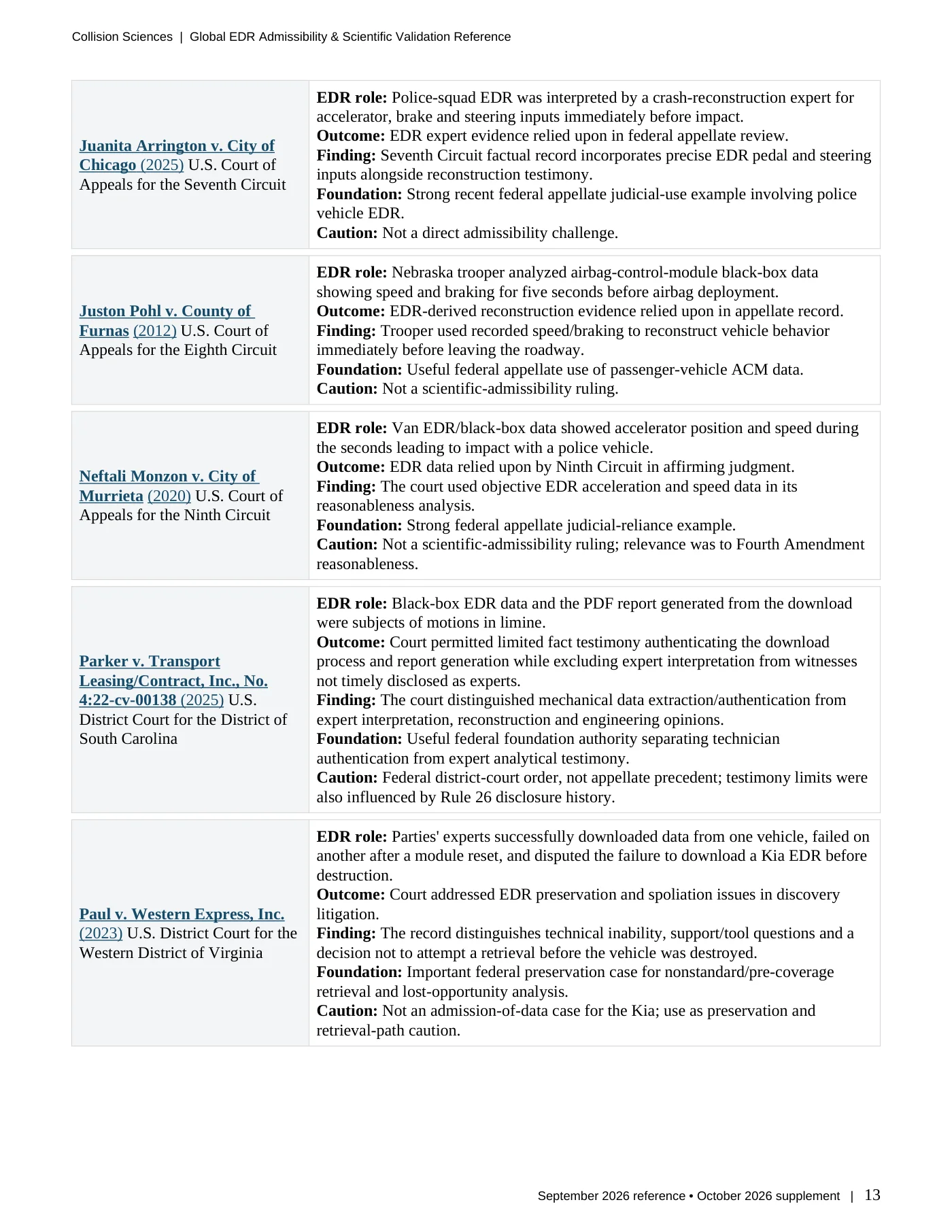
Juanita Arrington v. City of Chicago (2025) U.S. Court of Appeals for the Seventh Circuit EDR role: Police-squad EDR was interpreted by a crash-reconstruction expert for accelerator, brake and steering inputs immediately before impact. Outcome: EDR expert evidence relied upon in federal appellate review. Finding: Seventh Circuit factual record incorporates precise EDR pedal and steering inputs alongside reconstruction testimony. Foundation: Strong recent federal appellate judicial-use example involving police vehicle EDR. Caution: Not a direct admissibility challenge.
Juston Pohl v. County of Furnas(2012) U.S. Court of Appeals for the Eighth Circuit EDR role: Nebraska trooper analyzed airbag-control-module black-box data showing speed and braking for five seconds before airbag deployment. Outcome: EDR-derived reconstruction evidence relied upon in appellate record. Finding: Trooper used recorded speed/braking to reconstruct vehicle behavior immediately before leaving the roadway. Foundation: Useful federal appellate use of passenger-vehicle ACM data. Caution: Not a scientific-admissibility ruling.
Neftali Monzon v. City of Murrieta(2020) U.S. Court of Appeals for the Ninth Circuit EDR role: Van EDR/black-box data showed accelerator position and speed during the seconds leading to impact with a police vehicle. Outcome: EDR data relied upon by Ninth Circuit in affirming judgment. Finding: The court used objective EDR acceleration and speed data in its reasonableness analysis. Foundation: Strong federal appellate judicial-reliance example. Caution: Not a scientific-admissibility ruling; relevance was to Fourth Amendment reasonableness.
Parker v. Transport Leasing/Contract, inc., no.
4:22-cv-00138 (2025) U.S.
District Court for the District of South Carolina EDR role: Black-box EDR data and the PDF report generated from the download were subjects of motions in limine. Outcome: Court permitted limited fact testimony authenticating the download process and report generation while excluding expert interpretation from witnesses not timely disclosed as experts. Finding: The court distinguished mechanical data extraction/authentication from expert interpretation, reconstruction and engineering opinions. Foundation: Useful federal foundation authority separating technician authentication from expert analytical testimony. Caution: Federal district-court order, not appellate precedent; testimony limits were also influenced by Rule 26 disclosure history.
Paul v. Western Express, Inc. (2023) U.S. District Court for the Western District of Virginia EDR role: Parties' experts successfully downloaded data from one vehicle, failed on another after a module reset, and disputed the failure to download a Kia EDR before destruction. Outcome: Court addressed EDR preservation and spoliation issues in discovery litigation. Finding: The record distinguishes technical inability, support/tool questions and a decision not to attempt a retrieval before the vehicle was destroyed. Foundation: Important federal preservation case for nonstandard/pre-coverage retrieval and lost-opportunity analysis. Caution: Not an admission-of-data case for the Kia; use as preservation and retrieval-path caution.
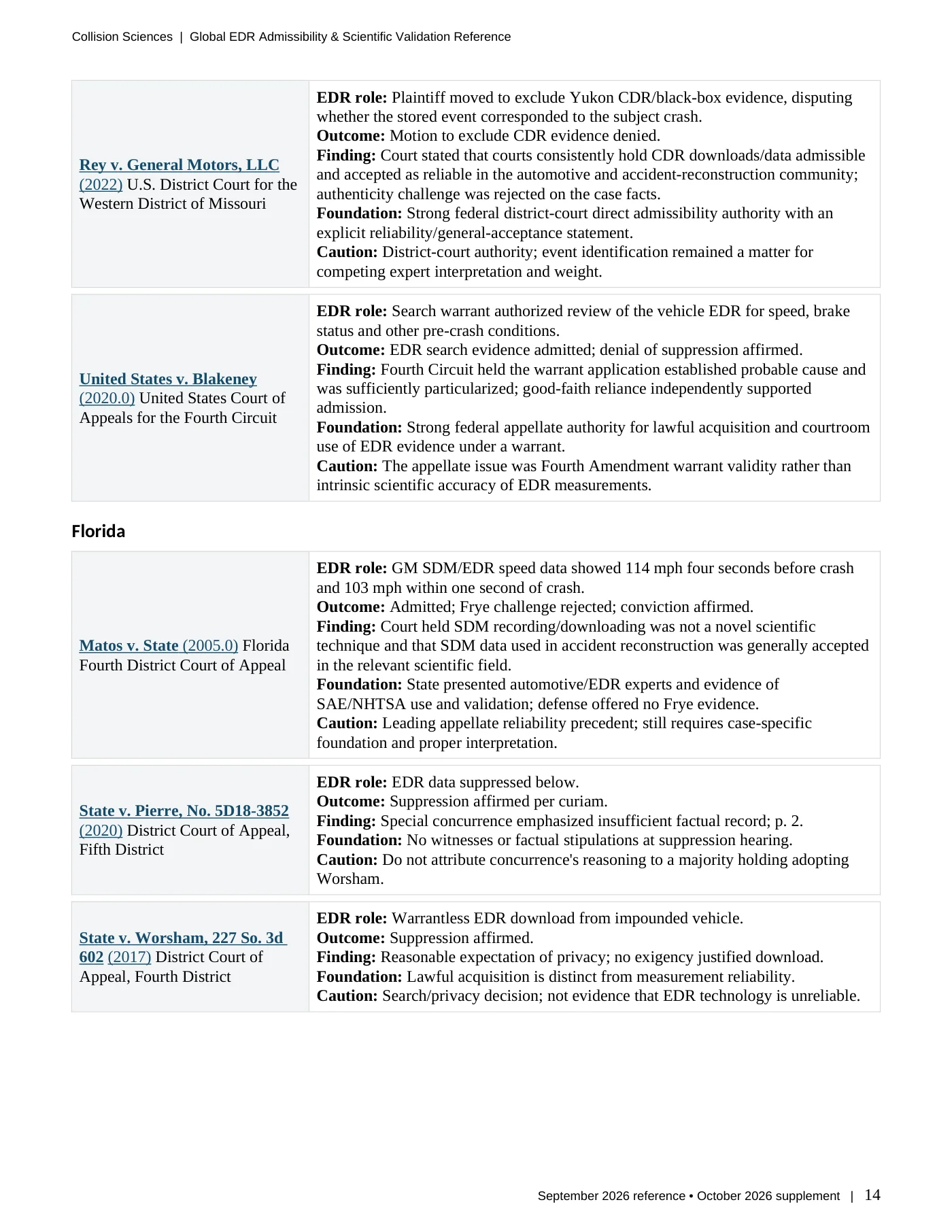
Rey v. General Motors, LLC (2022) U.S. District Court for the Western District of Missouri EDR role: Plaintiff moved to exclude Yukon CDR/black-box evidence, disputing whether the stored event corresponded to the subject crash. Outcome: Motion to exclude CDR evidence denied. Finding: Court stated that courts consistently hold CDR downloads/data admissible and accepted as reliable in the automotive and accident-reconstruction community; authenticity challenge was rejected on the case facts. Foundation: Strong federal district-court direct admissibility authority with an explicit reliability/general-acceptance statement. Caution: District-court authority; event identification remained a matter for competing expert interpretation and weight.
United States v. Blakeney (2020.0) United States Court of Appeals for the Fourth Circuit EDR role: Search warrant authorized review of the vehicle EDR for speed, brake status and other pre-crash conditions. Outcome: EDR search evidence admitted; denial of suppression affirmed. Finding: Fourth Circuit held the warrant application established probable cause and was sufficiently particularized; good-faith reliance independently supported admission. Foundation: Strong federal appellate authority for lawful acquisition and courtroom use of EDR evidence under a warrant. Caution: The appellate issue was Fourth Amendment warrant validity rather than intrinsic scientific accuracy of EDR measurements.
Florida
Matos v. State (2005.0) Florida Fourth District Court of Appeal EDR role: GM SDM/EDR speed data showed 114 mph four seconds before crash and 103 mph within one second of crash. Outcome: Admitted; Frye challenge rejected; conviction affirmed. Finding: Court held SDM recording/downloading was not a novel scientific technique and that SDM data used in accident reconstruction was generally accepted in the relevant scientific field. Foundation: State presented automotive/EDR experts and evidence of SAE/NHTSA use and validation; defense offered no Frye evidence. Caution: Leading appellate reliability precedent; still requires case-specific foundation and proper interpretation.
State v. Pierre, No. 5D18-3852 (2020) District Court of Appeal, Fifth District EDR role: EDR data suppressed below. Outcome: Suppression affirmed per curiam. Finding: Special concurrence emphasized insufficient factual record; p. 2. Foundation: No witnesses or factual stipulations at suppression hearing. Caution: Do not attribute concurrence's reasoning to a majority holding adopting Worsham.
State v. Worsham, 227 So. 3d 602(2017) District Court of Appeal, Fourth District EDR role: Warrantless EDR download from impounded vehicle. Outcome: Suppression affirmed. Finding: Reasonable expectation of privacy; no exigency justified download. Foundation: Lawful acquisition is distinct from measurement reliability. Caution: Search/privacy decision; not evidence that EDR technology is unreliable.
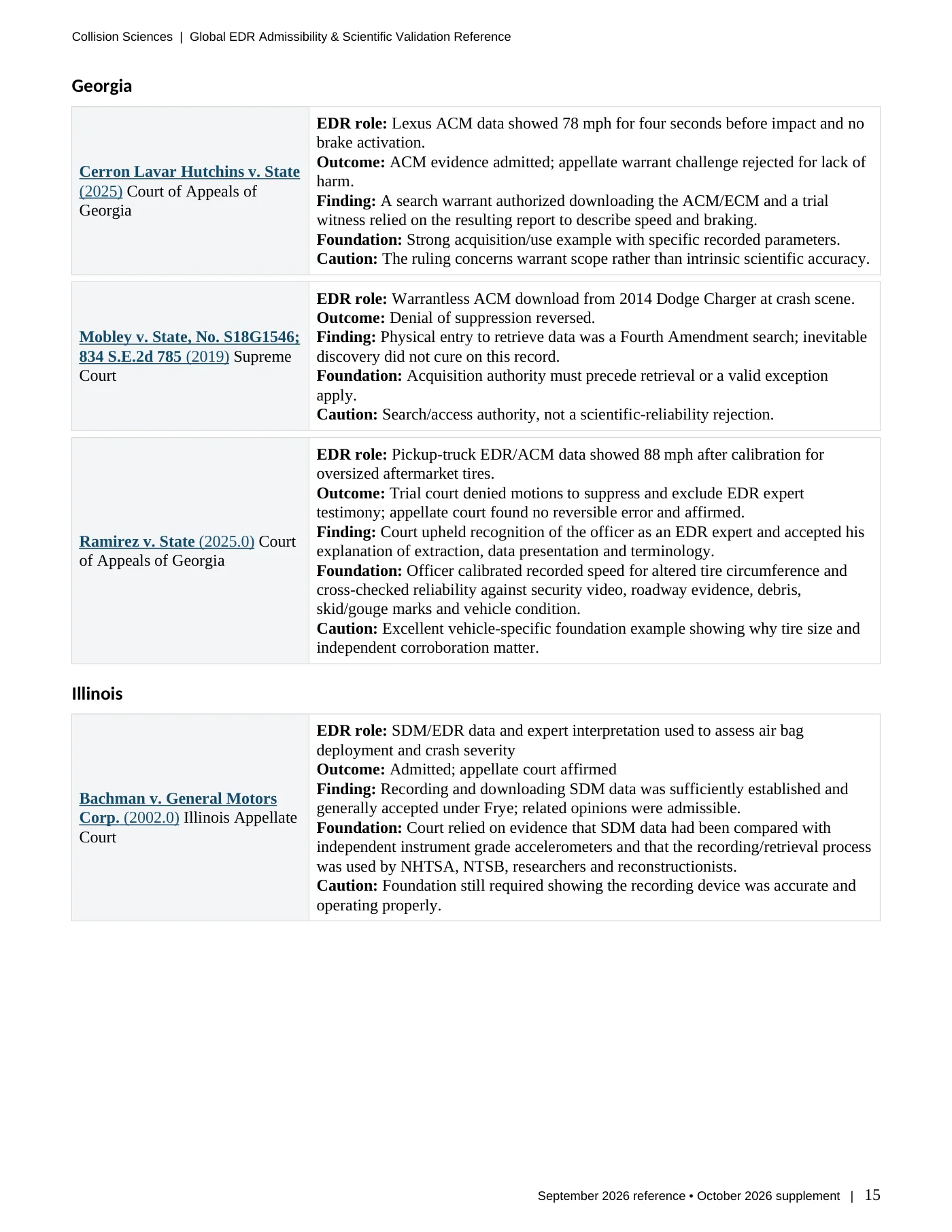
Georgia
Cerron Lavar Hutchins v. State (2025) Court of Appeals of Georgia EDR role: Lexus ACM data showed 78 mph for four seconds before impact and no brake activation. Outcome: ACM evidence admitted; appellate warrant challenge rejected for lack of harm. Finding: A search warrant authorized downloading the ACM/ECM and a trial witness relied on the resulting report to describe speed and braking. Foundation: Strong acquisition/use example with specific recorded parameters. Caution: The ruling concerns warrant scope rather than intrinsic scientific accuracy.
Mobley v. State, No. S18G1546; 834. S.e.2d 785 (2019) Supreme Court EDR role: Warrantless ACM download from 2014 Dodge Charger at crash scene. Outcome: Denial of suppression reversed. Finding: Physical entry to retrieve data was a Fourth Amendment search; inevitable discovery did not cure on this record. Foundation: Acquisition authority must precede retrieval or a valid exception apply. Caution: Search/access authority, not a scientific-reliability rejection.
Ramirez v. State (2025.0) Court of Appeals of Georgia EDR role: Pickup-truck EDR/ACM data showed 88 mph after calibration for oversized aftermarket tires. Outcome: Trial court denied motions to suppress and exclude EDR expert testimony; appellate court found no reversible error and affirmed. Finding: Court upheld recognition of the officer as an EDR expert and accepted his explanation of extraction, data presentation and terminology. Foundation: Officer calibrated recorded speed for altered tire circumference and cross-checked reliability against security video, roadway evidence, debris, skid/gouge marks and vehicle condition. Caution: Excellent vehicle-specific foundation example showing why tire size and independent corroboration matter.
Illinois
Bachman v. General Motors Corp.
(2002.0) Illinois Appellate Court EDR role: SDM/EDR data and expert interpretation used to assess air bag deployment and crash severity Outcome: Admitted; appellate court affirmed Finding: Recording and downloading SDM data was sufficiently established and generally accepted under Frye; related opinions were admissible. Foundation: Court relied on evidence that SDM data had been compared with independent instrument grade accelerometers and that the recording/retrieval process was used by NHTSA, NTSB, researchers and reconstructionists. Caution: Foundation still required showing the recording device was accurate and operating properly.
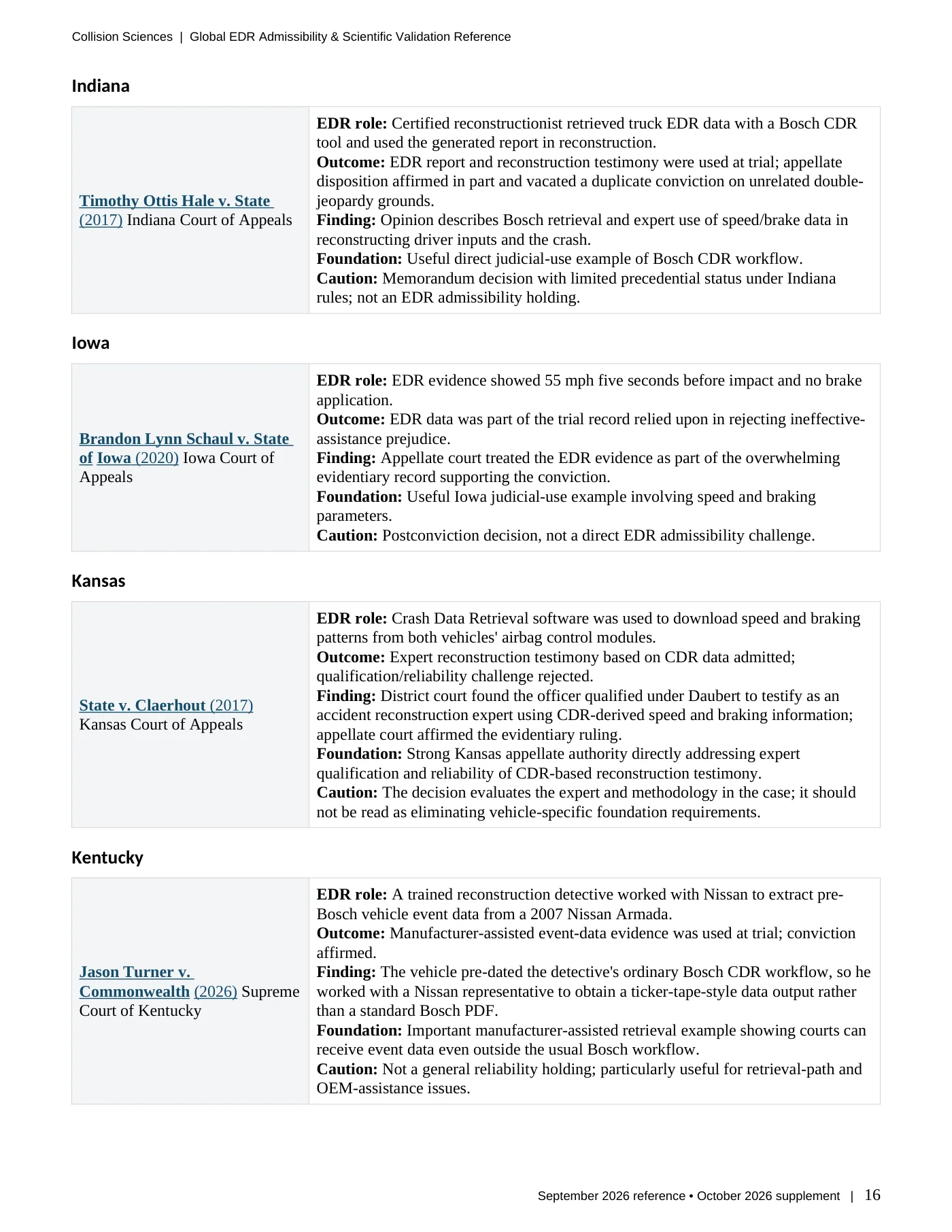
Indiana
Timothy Ottis Hale v. State (2017) Indiana Court of Appeals EDR role: Certified reconstructionist retrieved truck EDR data with a Bosch CDR tool and used the generated report in reconstruction. Outcome: EDR report and reconstruction testimony were used at trial; appellate disposition affirmed in part and vacated a duplicate conviction on unrelated double-jeopardy grounds. Finding: Opinion describes Bosch retrieval and expert use of speed/brake data in reconstructing driver inputs and the crash. Foundation: Useful direct judicial-use example of Bosch CDR workflow. Caution: Memorandum decision with limited precedential status under Indiana rules; not an EDR admissibility holding.
Iowa
Brandon Lynn Schaul v. State Ofiowa (2020) Iowa Court of Appeals EDR role: EDR evidence showed 55 mph five seconds before impact and no brake application. Outcome: EDR data was part of the trial record relied upon in rejecting ineffective-assistance prejudice. Finding: Appellate court treated the EDR evidence as part of the overwhelming evidentiary record supporting the conviction. Foundation: Useful Iowa judicial-use example involving speed and braking parameters. Caution: Postconviction decision, not a direct EDR admissibility challenge.
Kansas
State v. Claerhout (2017) Kansas Court of Appeals EDR role: Crash Data Retrieval software was used to download speed and braking patterns from both vehicles' airbag control modules. Outcome: Expert reconstruction testimony based on CDR data admitted; qualification/reliability challenge rejected. Finding: District court found the officer qualified under Daubert to testify as an accident reconstruction expert using CDR-derived speed and braking information; appellate court affirmed the evidentiary ruling. Foundation: Strong Kansas appellate authority directly addressing expert qualification and reliability of CDR-based reconstruction testimony. Caution: The decision evaluates the expert and methodology in the case; it should not be read as eliminating vehicle-specific foundation requirements.
Kentucky
Jason turner v.
Commonwealth(2026) Supreme Court of Kentucky EDR role: A trained reconstruction detective worked with Nissan to extract pre-Bosch vehicle event data from a 2007 Nissan Armada. Outcome: Manufacturer-assisted event-data evidence was used at trial; conviction affirmed. Finding: The vehicle pre-dated the detective's ordinary Bosch CDR workflow, so he worked with a Nissan representative to obtain a ticker-tape-style data output rather than a standard Bosch PDF. Foundation: Important manufacturer-assisted retrieval example showing courts can receive event data even outside the usual Bosch workflow. Caution: Not a general reliability holding; particularly useful for retrieval-path and OEM-assistance issues.
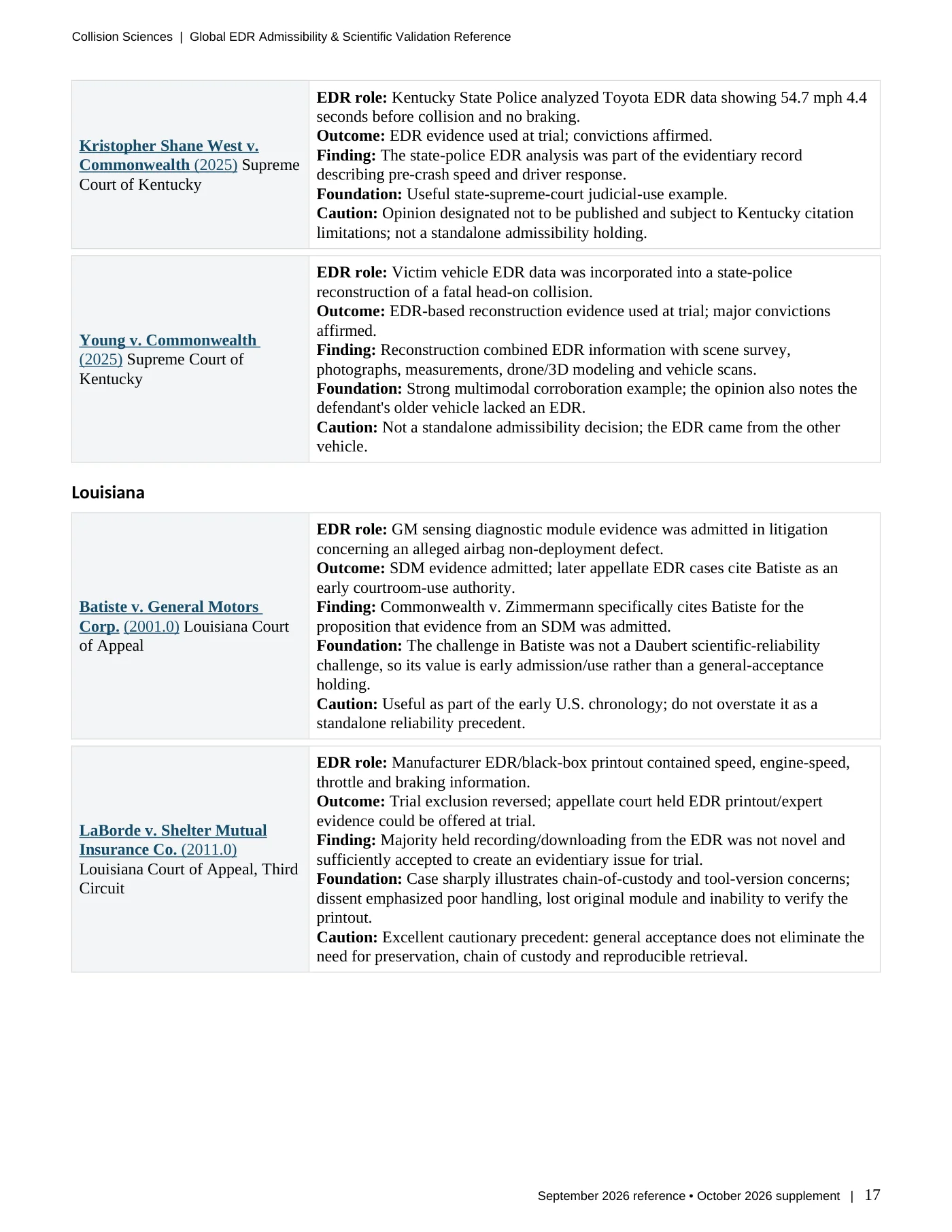
Kristopher shane west v. Commonwealth (2025) Supreme Court of Kentucky EDR role: Kentucky State Police analyzed Toyota EDR data showing 54.7 mph 4.4 seconds before collision and no braking. Outcome: EDR evidence used at trial; convictions affirmed. Finding: The state-police EDR analysis was part of the evidentiary record describing pre-crash speed and driver response. Foundation: Useful state-supreme-court judicial-use example. Caution: Opinion designated not to be published and subject to Kentucky citation limitations; not a standalone admissibility holding.
Young v. Commonwealth (2025) Supreme Court of Kentucky EDR role: Victim vehicle EDR data was incorporated into a state-police reconstruction of a fatal head-on collision. Outcome: EDR-based reconstruction evidence used at trial; major convictions affirmed. Finding: Reconstruction combined EDR information with scene survey, photographs, measurements, drone/3D modeling and vehicle scans. Foundation: Strong multimodal corroboration example; the opinion also notes the defendant's older vehicle lacked an EDR. Caution: Not a standalone admissibility decision; the EDR came from the other vehicle.
Louisiana
Batiste v. General Motors Corp.(2001.0) Louisiana Court of Appeal EDR role: GM sensing diagnostic module evidence was admitted in litigation concerning an alleged airbag non-deployment defect. Outcome: SDM evidence admitted; later appellate EDR cases cite Batiste as an early courtroom-use authority. Finding: Commonwealth v. Zimmermann specifically cites Batiste for the proposition that evidence from an SDM was admitted. Foundation: The challenge in Batiste was not a Daubert scientific-reliability challenge, so its value is early admission/use rather than a general-acceptance holding. Caution: Useful as part of the early U.S. chronology; do not overstate it as a standalone reliability precedent.
LaBorde v. Shelter Mutual Insurance co.
(2011.0) Louisiana Court of Appeal, Third Circuit EDR role: Manufacturer EDR/black-box printout contained speed, engine-speed, throttle and braking information. Outcome: Trial exclusion reversed; appellate court held EDR printout/expert evidence could be offered at trial. Finding: Majority held recording/downloading from the EDR was not novel and sufficiently accepted to create an evidentiary issue for trial. Foundation: Case sharply illustrates chain-of-custody and tool-version concerns; dissent emphasized poor handling, lost original module and inability to verify the printout. Caution: Excellent cautionary precedent: general acceptance does not eliminate the need for preservation, chain of custody and reproducible retrieval.
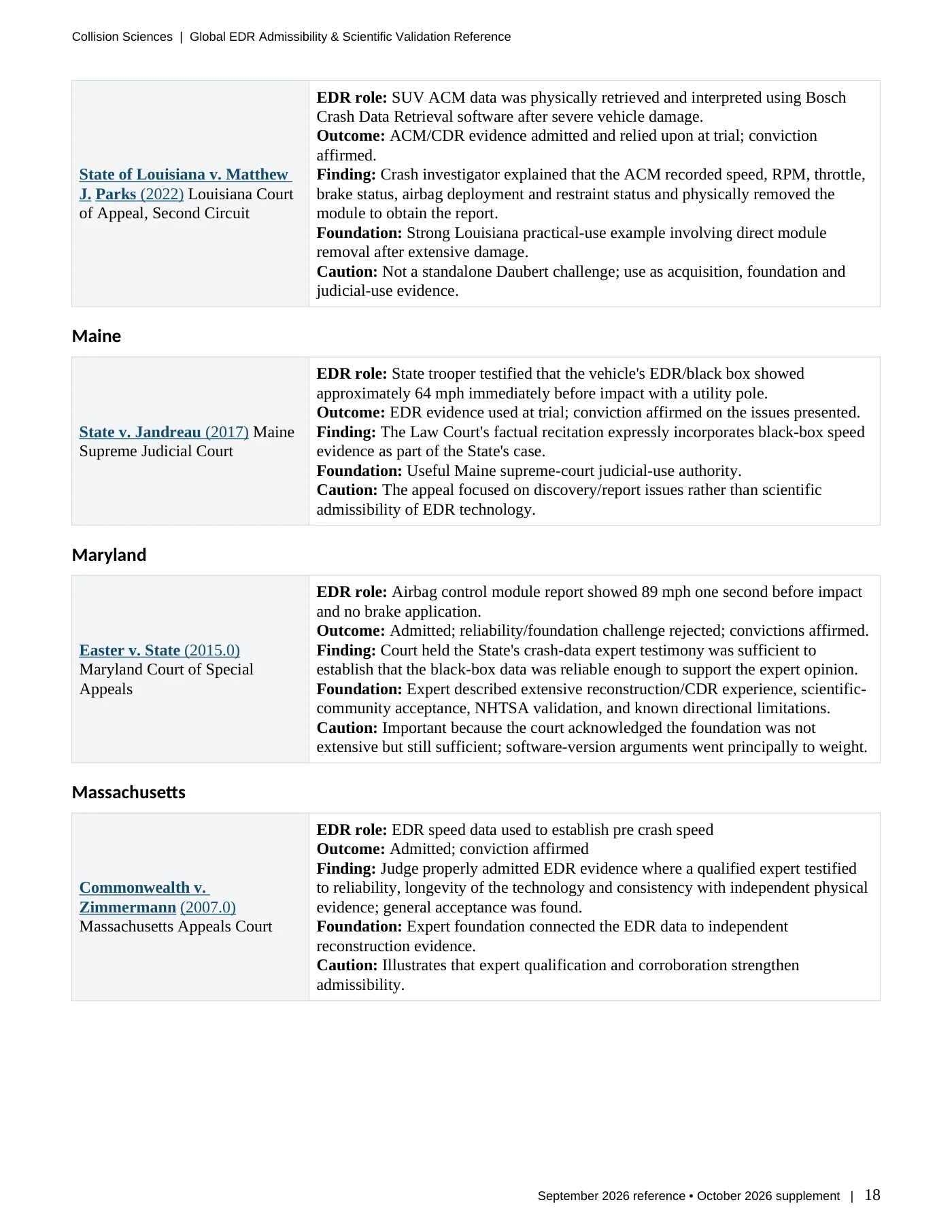
State of Louisiana v. Matthew J.parks (2022) Louisiana Court of Appeal, Second Circuit EDR role: SUV ACM data was physically retrieved and interpreted using Bosch Crash Data Retrieval software after severe vehicle damage. Outcome: ACM/CDR evidence admitted and relied upon at trial; conviction affirmed. Finding: Crash investigator explained that the ACM recorded speed, RPM, throttle, brake status, airbag deployment and restraint status and physically removed the module to obtain the report. Foundation: Strong Louisiana practical-use example involving direct module removal after extensive damage. Caution: Not a standalone Daubert challenge; use as acquisition, foundation and judicial-use evidence.
Maine
State v. Jandreau (2017) Maine Supreme Judicial Court EDR role: State trooper testified that the vehicle's EDR/black box showed approximately 64 mph immediately before impact with a utility pole. Outcome: EDR evidence used at trial; conviction affirmed on the issues presented. Finding: The Law Court's factual recitation expressly incorporates black-box speed evidence as part of the State's case. Foundation: Useful Maine supreme-court judicial-use authority. Caution: The appeal focused on discovery/report issues rather than scientific admissibility of EDR technology.
Maryland
Easter v. State (2015.0) Maryland Court of Special Appeals EDR role: Airbag control module report showed 89 mph one second before impact and no brake application. Outcome: Admitted; reliability/foundation challenge rejected; convictions affirmed. Finding: Court held the State's crash-data expert testimony was sufficient to establish that the black-box data was reliable enough to support the expert opinion. Foundation: Expert described extensive reconstruction/CDR experience, scientific-community acceptance, NHTSA validation, and known directional limitations. Caution: Important because the court acknowledged the foundation was not extensive but still sufficient; software-version arguments went principally to weight.
Massachusetts
Commonwealth v.
Zimmermann(2007.0) Massachusetts Appeals Court EDR role: EDR speed data used to establish pre crash speed Outcome: Admitted; conviction affirmed Finding: Judge properly admitted EDR evidence where a qualified expert testified to reliability, longevity of the technology and consistency with independent physical evidence; general acceptance was found. Foundation: Expert foundation connected the EDR data to independent reconstruction evidence. Caution: Illustrates that expert qualification and corroboration strengthen admissibility.
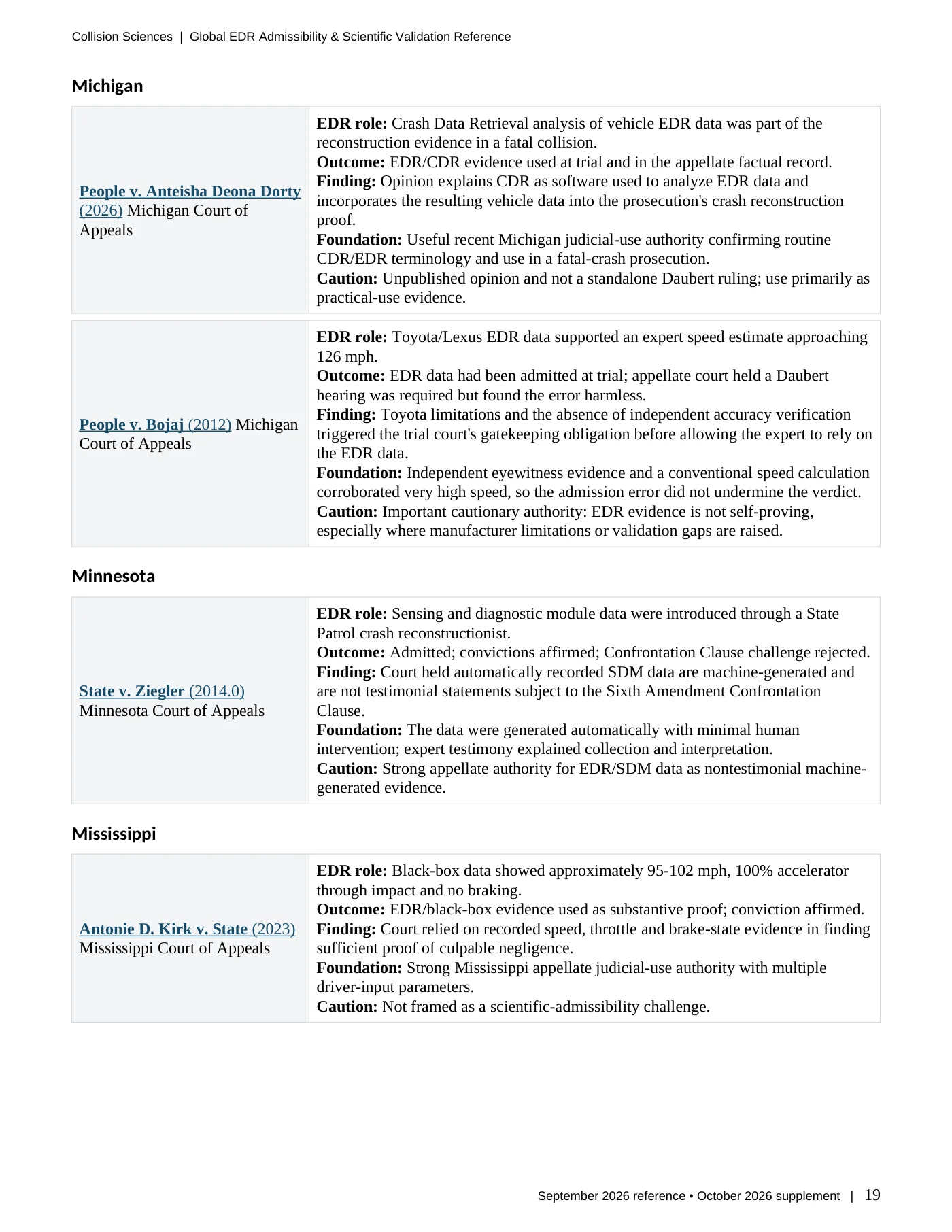
Michigan
People v. Anteisha Deona Dorty (2026) Michigan Court of Appeals EDR role: Crash Data Retrieval analysis of vehicle EDR data was part of the reconstruction evidence in a fatal collision. Outcome: EDR/CDR evidence used at trial and in the appellate factual record. Finding: Opinion explains CDR as software used to analyze EDR data and incorporates the resulting vehicle data into the prosecution's crash reconstruction proof. Foundation: Useful recent Michigan judicial-use authority confirming routine CDR/EDR terminology and use in a fatal-crash prosecution. Caution: Unpublished opinion and not a standalone Daubert ruling; use primarily as practical-use evidence.
People v. Bojaj (2012) Michigan Court of Appeals EDR role: Toyota/Lexus EDR data supported an expert speed estimate approaching 126 mph. Outcome: EDR data had been admitted at trial; appellate court held a Daubert hearing was required but found the error harmless. Finding: Toyota limitations and the absence of independent accuracy verification triggered the trial court's gatekeeping obligation before allowing the expert to rely on the EDR data. Foundation: Independent eyewitness evidence and a conventional speed calculation corroborated very high speed, so the admission error did not undermine the verdict. Caution: Important cautionary authority: EDR evidence is not self-proving, especially where manufacturer limitations or validation gaps are raised.
Minnesota
State v. Ziegler (2014.0) Minnesota Court of Appeals EDR role: Sensing and diagnostic module data were introduced through a State Patrol crash reconstructionist. Outcome: Admitted; convictions affirmed; Confrontation Clause challenge rejected. Finding: Court held automatically recorded SDM data are machine-generated and are not testimonial statements subject to the Sixth Amendment Confrontation Clause. Foundation: The data were generated automatically with minimal human intervention; expert testimony explained collection and interpretation. Caution: Strong appellate authority for EDR/SDM data as nontestimonial machine-generated evidence.
Mississippi
Antonie D. Kirk v. State (2023) Mississippi Court of Appeals EDR role: Black-box data showed approximately 95-102 mph, 100% accelerator through impact and no braking. Outcome: EDR/black-box evidence used as substantive proof; conviction affirmed. Finding: Court relied on recorded speed, throttle and brake-state evidence in finding sufficient proof of culpable negligence. Foundation: Strong Mississippi appellate judicial-use authority with multiple driver-input parameters. Caution: Not framed as a scientific-admissibility challenge.
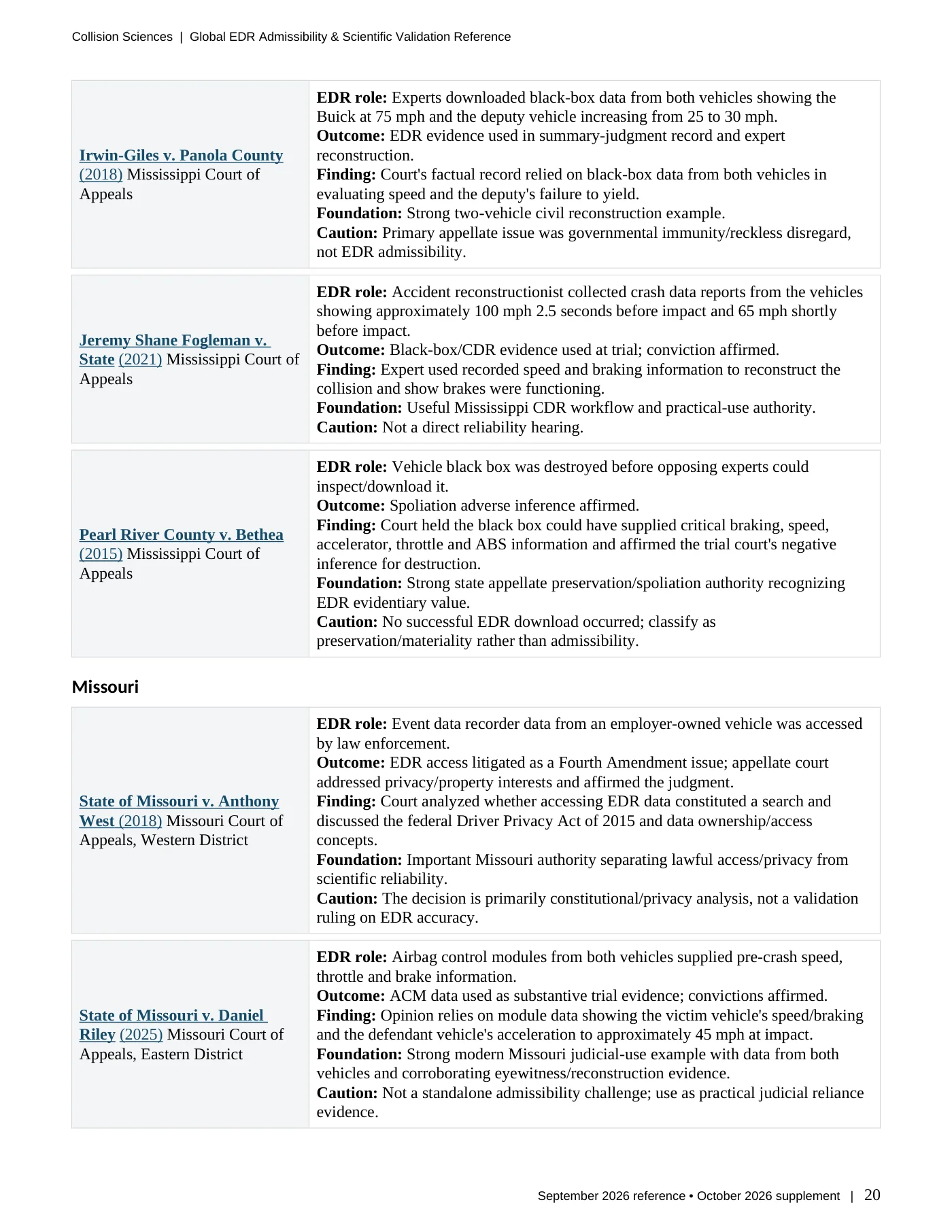
Irwin-Giles v. Panola County (2018) Mississippi Court of Appeals EDR role: Experts downloaded black-box data from both vehicles showing the Buick at 75 mph and the deputy vehicle increasing from 25 to 30 mph. Outcome: EDR evidence used in summary-judgment record and expert reconstruction. Finding: Court's factual record relied on black-box data from both vehicles in evaluating speed and the deputy's failure to yield. Foundation: Strong two-vehicle civil reconstruction example. Caution: Primary appellate issue was governmental immunity/reckless disregard, not EDR admissibility.
Jeremy shane fogleman v.
State(2021) Mississippi Court of Appeals EDR role: Accident reconstructionist collected crash data reports from the vehicles showing approximately 100 mph 2.5 seconds before impact and 65 mph shortly before impact. Outcome: Black-box/CDR evidence used at trial; conviction affirmed. Finding: Expert used recorded speed and braking information to reconstruct the collision and show brakes were functioning. Foundation: Useful Mississippi CDR workflow and practical-use authority. Caution: Not a direct reliability hearing.
Pearl River County v. Bethea (2015) Mississippi Court of Appeals EDR role: Vehicle black box was destroyed before opposing experts could inspect/download it. Outcome: Spoliation adverse inference affirmed. Finding: Court held the black box could have supplied critical braking, speed, accelerator, throttle and ABS information and affirmed the trial court's negative inference for destruction. Foundation: Strong state appellate preservation/spoliation authority recognizing EDR evidentiary value. Caution: No successful EDR download occurred; classify as preservation/materiality rather than admissibility.
Missouri
State of Missouri v. Anthony West (2018) Missouri Court of Appeals, Western District EDR role: Event data recorder data from an employer-owned vehicle was accessed by law enforcement. Outcome: EDR access litigated as a Fourth Amendment issue; appellate court addressed privacy/property interests and affirmed the judgment. Finding: Court analyzed whether accessing EDR data constituted a search and discussed the federal Driver Privacy Act of 2015 and data ownership/access concepts. Foundation: Important Missouri authority separating lawful access/privacy from scientific reliability. Caution: The decision is primarily constitutional/privacy analysis, not a validation ruling on EDR accuracy.
State of Missouri v. Daniel Riley(2025) Missouri Court of Appeals, Eastern District EDR role: Airbag control modules from both vehicles supplied pre-crash speed, throttle and brake information. Outcome: ACM data used as substantive trial evidence; convictions affirmed. Finding: Opinion relies on module data showing the victim vehicle's speed/braking and the defendant vehicle's acceleration to approximately 45 mph at impact. Foundation: Strong modern Missouri judicial-use example with data from both vehicles and corroborating eyewitness/reconstruction evidence. Caution: Not a standalone admissibility challenge; use as practical judicial reliance evidence.
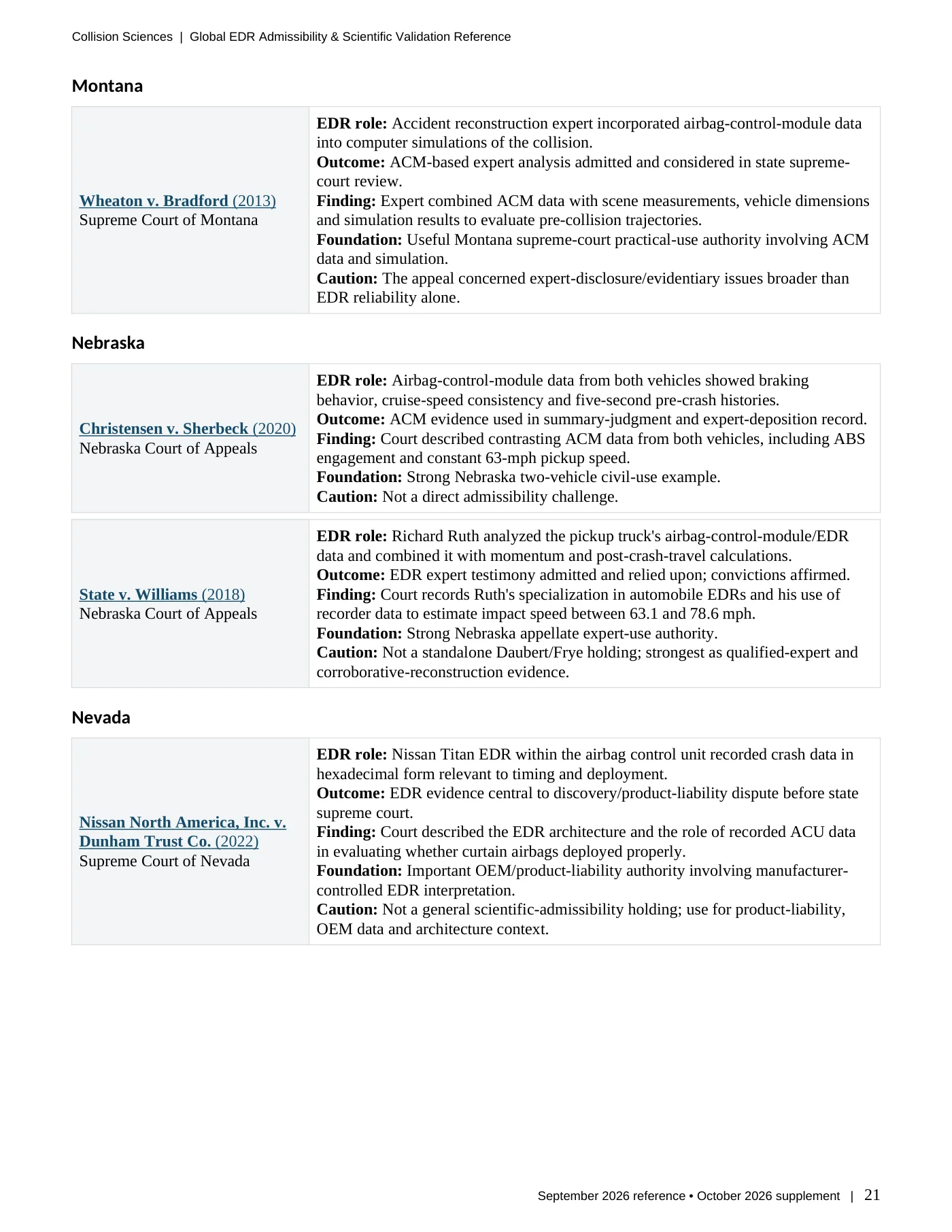
Montana
Wheaton v. Bradford (2013) Supreme Court of Montana EDR role: Accident reconstruction expert incorporated airbag-control-module data into computer simulations of the collision. Outcome: ACM-based expert analysis admitted and considered in state supreme-court review. Finding: Expert combined ACM data with scene measurements, vehicle dimensions and simulation results to evaluate pre-collision trajectories. Foundation: Useful Montana supreme-court practical-use authority involving ACM data and simulation. Caution: The appeal concerned expert-disclosure/evidentiary issues broader than EDR reliability alone.
Nebraska
Christensen v. Sherbeck (2020) Nebraska Court of Appeals EDR role: Airbag-control-module data from both vehicles showed braking behavior, cruise-speed consistency and five-second pre-crash histories. Outcome: ACM evidence used in summary-judgment and expert-deposition record. Finding: Court described contrasting ACM data from both vehicles, including ABS engagement and constant 63-mph pickup speed. Foundation: Strong Nebraska two-vehicle civil-use example. Caution: Not a direct admissibility challenge.
State v. Williams (2018) Nebraska Court of Appeals EDR role: Richard Ruth analyzed the pickup truck's airbag-control-module/EDR data and combined it with momentum and post-crash-travel calculations. Outcome: EDR expert testimony admitted and relied upon; convictions affirmed. Finding: Court records Ruth's specialization in automobile EDRs and his use of recorder data to estimate impact speed between 63.1 and 78.6 mph. Foundation: Strong Nebraska appellate expert-use authority. Caution: Not a standalone Daubert/Frye holding; strongest as qualified-expert and corroborative-reconstruction evidence.
Nevada
Nissan North America, inc. V. Dunham trust co.
(2022) Supreme Court of Nevada EDR role: Nissan Titan EDR within the airbag control unit recorded crash data in hexadecimal form relevant to timing and deployment. Outcome: EDR evidence central to discovery/product-liability dispute before state supreme court. Finding: Court described the EDR architecture and the role of recorded ACU data in evaluating whether curtain airbags deployed properly. Foundation: Important OEM/product-liability authority involving manufacturer-controlled EDR interpretation. Caution: Not a general scientific-admissibility holding; use for product-liability, OEM data and architecture context.
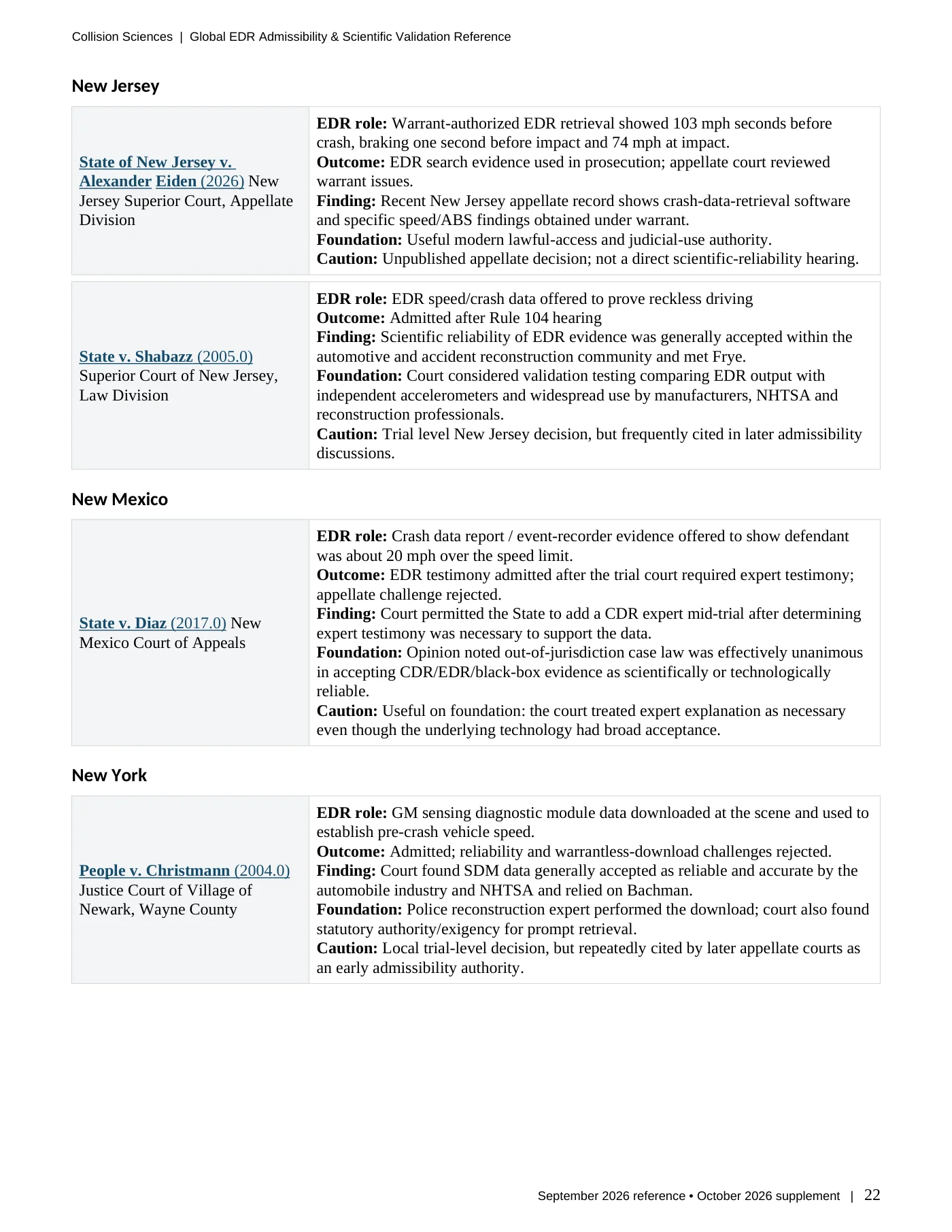
New Jersey
State of new jersey v. Alexandereiden (2026) New Jersey Superior Court, Appellate Division EDR role: Warrant-authorized EDR retrieval showed 103 mph seconds before crash, braking one second before impact and 74 mph at impact. Outcome: EDR search evidence used in prosecution; appellate court reviewed warrant issues. Finding: Recent New Jersey appellate record shows crash-data-retrieval software and specific speed/ABS findings obtained under warrant. Foundation: Useful modern lawful-access and judicial-use authority. Caution: Unpublished appellate decision; not a direct scientific-reliability hearing.
State v. Shabazz (2005.0) Superior Court of New Jersey, Law Division EDR role: EDR speed/crash data offered to prove reckless driving Outcome: Admitted after Rule 104 hearing Finding: Scientific reliability of EDR evidence was generally accepted within the automotive and accident reconstruction community and met Frye. Foundation: Court considered validation testing comparing EDR output with independent accelerometers and widespread use by manufacturers, NHTSA and reconstruction professionals. Caution: Trial level New Jersey decision, but frequently cited in later admissibility discussions.
New Mexico
State v. Diaz (2017.0) New Mexico Court of Appeals EDR role: Crash data report / event-recorder evidence offered to show defendant was about 20 mph over the speed limit. Outcome: EDR testimony admitted after the trial court required expert testimony; appellate challenge rejected. Finding: Court permitted the State to add a CDR expert mid-trial after determining expert testimony was necessary to support the data. Foundation: Opinion noted out-of-jurisdiction case law was effectively unanimous in accepting CDR/EDR/black-box evidence as scientifically or technologically reliable. Caution: Useful on foundation: the court treated expert explanation as necessary even though the underlying technology had broad acceptance.
New York
People v. Christmann (2004.0) Justice Court of Village of Newark, Wayne County EDR role: GM sensing diagnostic module data downloaded at the scene and used to establish pre-crash vehicle speed. Outcome: Admitted; reliability and warrantless-download challenges rejected. Finding: Court found SDM data generally accepted as reliable and accurate by the automobile industry and NHTSA and relied on Bachman. Foundation: Police reconstruction expert performed the download; court also found statutory authority/exigency for prompt retrieval. Caution: Local trial-level decision, but repeatedly cited by later appellate courts as an early admissibility authority.
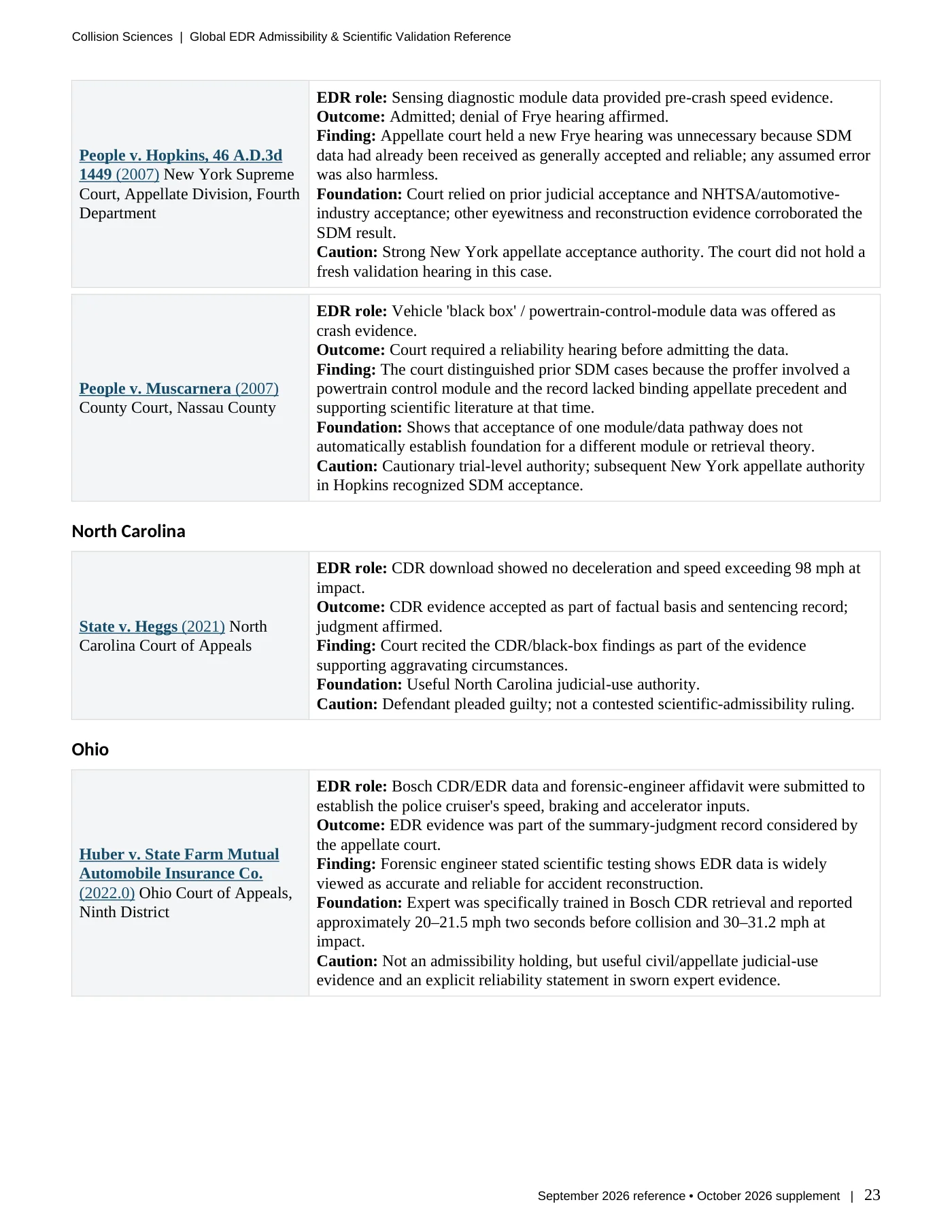
People v. Hopkins, 46 A.D.3d 1449 (2007) New York Supreme Court, Appellate Division, Fourth Department EDR role: Sensing diagnostic module data provided pre-crash speed evidence. Outcome: Admitted; denial of Frye hearing affirmed. Finding: Appellate court held a new Frye hearing was unnecessary because SDM data had already been received as generally accepted and reliable; any assumed error was also harmless. Foundation: Court relied on prior judicial acceptance and NHTSA/automotive-industry acceptance; other eyewitness and reconstruction evidence corroborated the SDM result. Caution: Strong New York appellate acceptance authority. The court did not hold a fresh validation hearing in this case.
People v. Muscarnera (2007) County Court, Nassau County EDR role: Vehicle 'black box' / powertrain-control-module data was offered as crash evidence. Outcome: Court required a reliability hearing before admitting the data. Finding: The court distinguished prior SDM cases because the proffer involved a powertrain control module and the record lacked binding appellate precedent and supporting scientific literature at that time. Foundation: Shows that acceptance of one module/data pathway does not automatically establish foundation for a different module or retrieval theory. Caution: Cautionary trial-level authority; subsequent New York appellate authority in Hopkins recognized SDM acceptance.
North Carolina
State v. Heggs (2021) North Carolina Court of Appeals EDR role: CDR download showed no deceleration and speed exceeding 98 mph at impact. Outcome: CDR evidence accepted as part of factual basis and sentencing record; judgment affirmed. Finding: Court recited the CDR/black-box findings as part of the evidence supporting aggravating circumstances. Foundation: Useful North Carolina judicial-use authority. Caution: Defendant pleaded guilty; not a contested scientific-admissibility ruling.
Ohio
Huber v. State Farm Mutual Automobile insurance co.
(2022.0) Ohio Court of Appeals, Ninth District EDR role: Bosch CDR/EDR data and forensic-engineer affidavit were submitted to establish the police cruiser's speed, braking and accelerator inputs. Outcome: EDR evidence was part of the summary-judgment record considered by the appellate court. Finding: Forensic engineer stated scientific testing shows EDR data is widely viewed as accurate and reliable for accident reconstruction. Foundation: Expert was specifically trained in Bosch CDR retrieval and reported approximately 20–21.5 mph two seconds before collision and 30–31.2 mph at impact. Caution: Not an admissibility holding, but useful civil/appellate judicial-use evidence and an explicit reliability statement in sworn expert evidence.
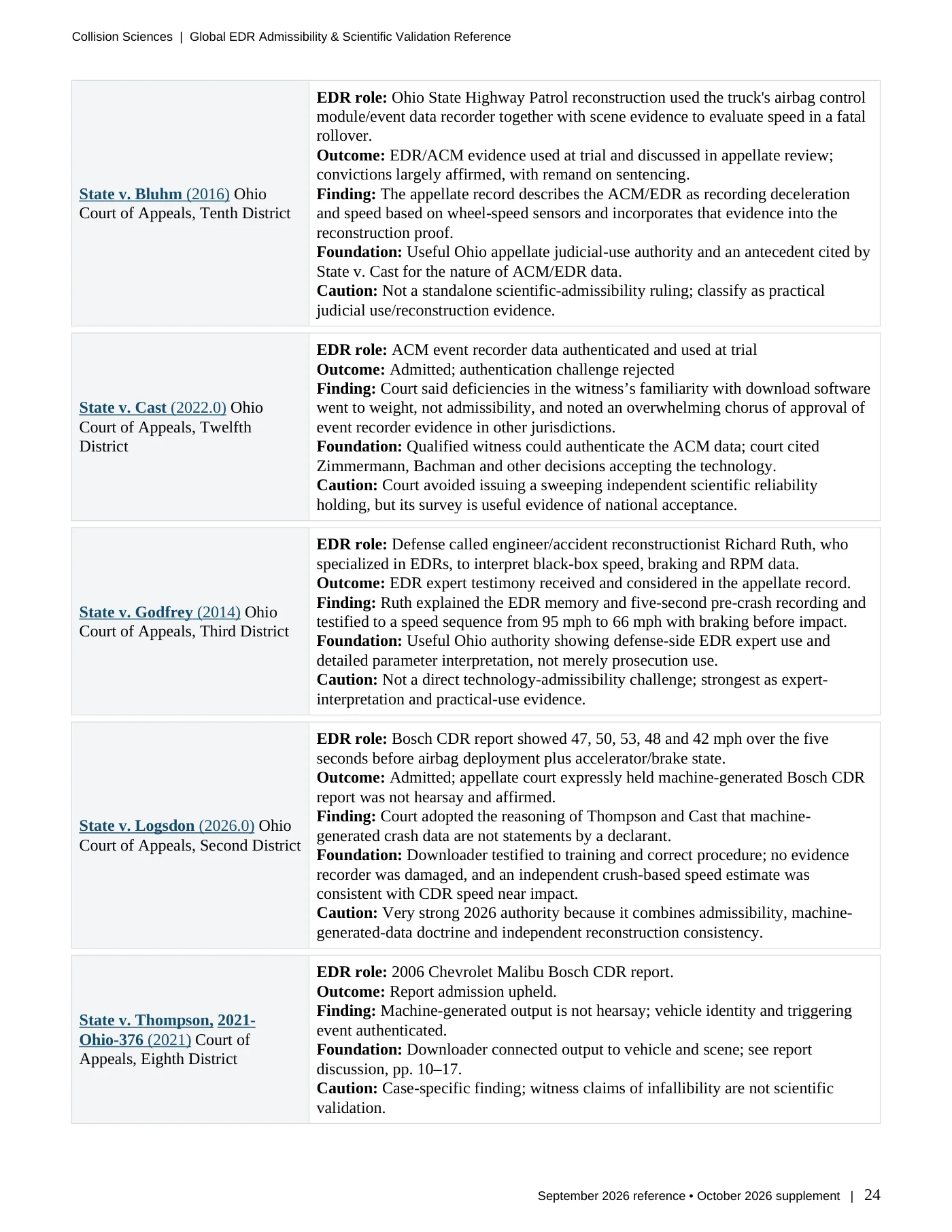
State v. Bluhm (2016) Ohio Court of Appeals, Tenth District EDR role: Ohio State Highway Patrol reconstruction used the truck's airbag control module/event data recorder together with scene evidence to evaluate speed in a fatal rollover. Outcome: EDR/ACM evidence used at trial and discussed in appellate review; convictions largely affirmed, with remand on sentencing. Finding: The appellate record describes the ACM/EDR as recording deceleration and speed based on wheel-speed sensors and incorporates that evidence into the reconstruction proof. Foundation: Useful Ohio appellate judicial-use authority and an antecedent cited by State v. Cast for the nature of ACM/EDR data. Caution: Not a standalone scientific-admissibility ruling; classify as practical judicial use/reconstruction evidence.
State v. Cast (2022.0) Ohio Court of Appeals, Twelfth District EDR role: ACM event recorder data authenticated and used at trial Outcome: Admitted; authentication challenge rejected Finding: Court said deficiencies in the witness’s familiarity with download software went to weight, not admissibility, and noted an overwhelming chorus of approval of event recorder evidence in other jurisdictions. Foundation: Qualified witness could authenticate the ACM data; court cited Zimmermann, Bachman and other decisions accepting the technology. Caution: Court avoided issuing a sweeping independent scientific reliability holding, but its survey is useful evidence of national acceptance.
State v. Godfrey (2014) Ohio Court of Appeals, Third District EDR role: Defense called engineer/accident reconstructionist Richard Ruth, who specialized in EDRs, to interpret black-box speed, braking and RPM data. Outcome: EDR expert testimony received and considered in the appellate record. Finding: Ruth explained the EDR memory and five-second pre-crash recording and testified to a speed sequence from 95 mph to 66 mph with braking before impact. Foundation: Useful Ohio authority showing defense-side EDR expert use and detailed parameter interpretation, not merely prosecution use. Caution: Not a direct technology-admissibility challenge; strongest as expert-interpretation and practical-use evidence.
State v. Logsdon (2026.0) Ohio Court of Appeals, Second District EDR role: Bosch CDR report showed 47, 50, 53, 48 and 42 mph over the five seconds before airbag deployment plus accelerator/brake state. Outcome: Admitted; appellate court expressly held machine-generated Bosch CDR report was not hearsay and affirmed. Finding: Court adopted the reasoning of Thompson and Cast that machine-generated crash data are not statements by a declarant. Foundation: Downloader testified to training and correct procedure; no evidence recorder was damaged, and an independent crush-based speed estimate was consistent with CDR speed near impact. Caution: Very strong 2026 authority because it combines admissibility, machine-generated-data doctrine and independent reconstruction consistency.
State v. Thompson,2021- Ohio-376
(2021) Court of Appeals, Eighth District EDR role: 2006 Chevrolet Malibu Bosch CDR report. Outcome: Report admission upheld. Finding: Machine-generated output is not hearsay; vehicle identity and triggering event authenticated. Foundation: Downloader connected output to vehicle and scene; see report discussion, pp. 10–17. Caution: Case-specific finding; witness claims of infallibility are not scientific validation.
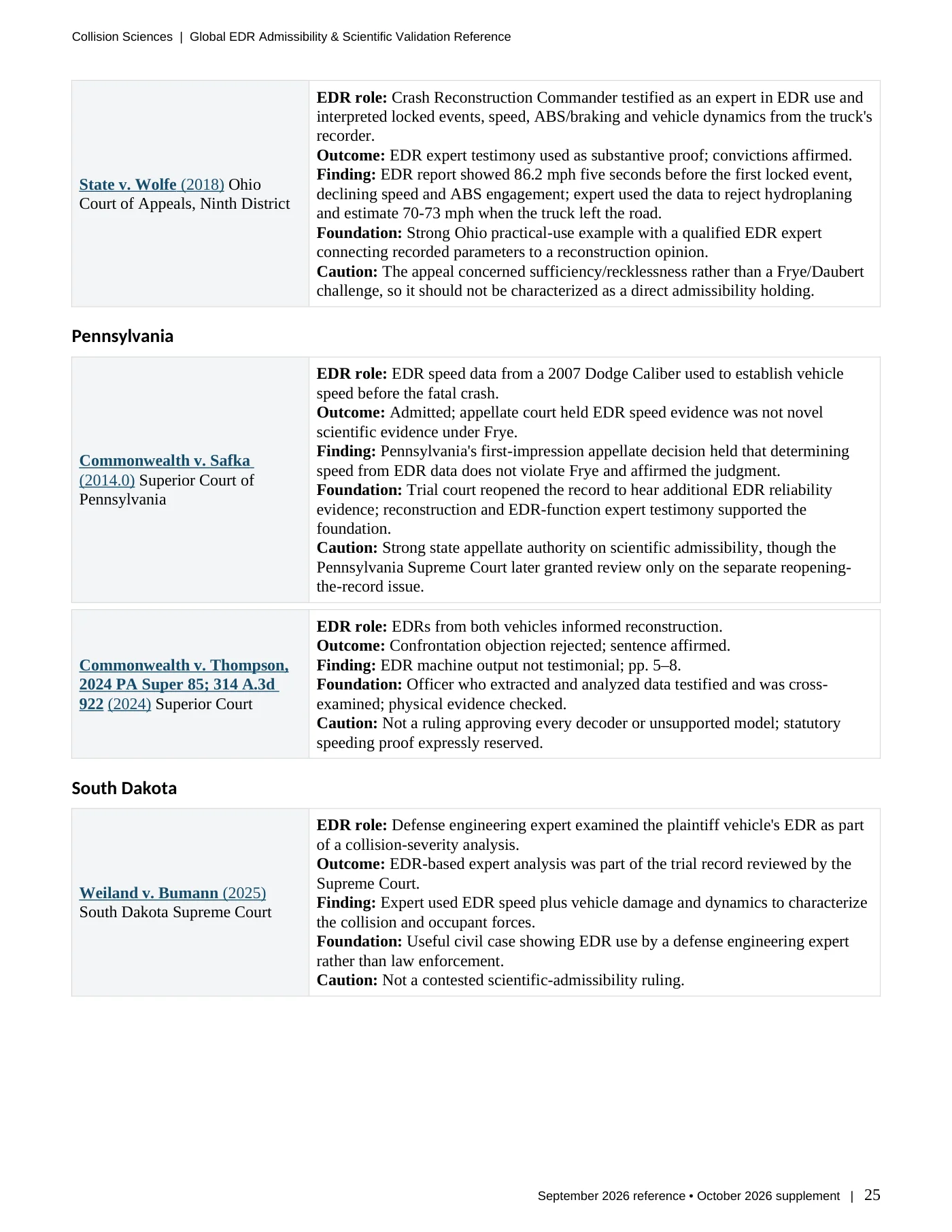
State v. Wolfe (2018) Ohio Court of Appeals, Ninth District EDR role: Crash Reconstruction Commander testified as an expert in EDR use and interpreted locked events, speed, ABS/braking and vehicle dynamics from the truck's recorder. Outcome: EDR expert testimony used as substantive proof; convictions affirmed. Finding: EDR report showed 86.2 mph five seconds before the first locked event, declining speed and ABS engagement; expert used the data to reject hydroplaning and estimate 70-73 mph when the truck left the road. Foundation: Strong Ohio practical-use example with a qualified EDR expert connecting recorded parameters to a reconstruction opinion. Caution: The appeal concerned sufficiency/recklessness rather than a Frye/Daubert challenge, so it should not be characterized as a direct admissibility holding.
Pennsylvania
Commonwealth v. Safka (2014.0) Superior Court of Pennsylvania EDR role: EDR speed data from a 2007 Dodge Caliber used to establish vehicle speed before the fatal crash. Outcome: Admitted; appellate court held EDR speed evidence was not novel scientific evidence under Frye. Finding: Pennsylvania's first-impression appellate decision held that determining speed from EDR data does not violate Frye and affirmed the judgment. Foundation: Trial court reopened the record to hear additional EDR reliability evidence; reconstruction and EDR-function expert testimony supported the foundation. Caution: Strong state appellate authority on scientific admissibility, though the Pennsylvania Supreme Court later granted review only on the separate reopening-the-record issue.
Commonwealth v. Thompson, 2024. Pa super 85; 314 a.3d 922(2024) Superior Court EDR role: EDRs from both vehicles informed reconstruction. Outcome: Confrontation objection rejected; sentence affirmed. Finding: EDR machine output not testimonial; pp. 5–8. Foundation: Officer who extracted and analyzed data testified and was cross-examined; physical evidence checked. Caution: Not a ruling approving every decoder or unsupported model; statutory speeding proof expressly reserved.
South Dakota
Weiland v. Bumann (2025) South Dakota Supreme Court EDR role: Defense engineering expert examined the plaintiff vehicle's EDR as part of a collision-severity analysis. Outcome: EDR-based expert analysis was part of the trial record reviewed by the Supreme Court. Finding: Expert used EDR speed plus vehicle damage and dynamics to characterize the collision and occupant forces. Foundation: Useful civil case showing EDR use by a defense engineering expert rather than law enforcement. Caution: Not a contested scientific-admissibility ruling.
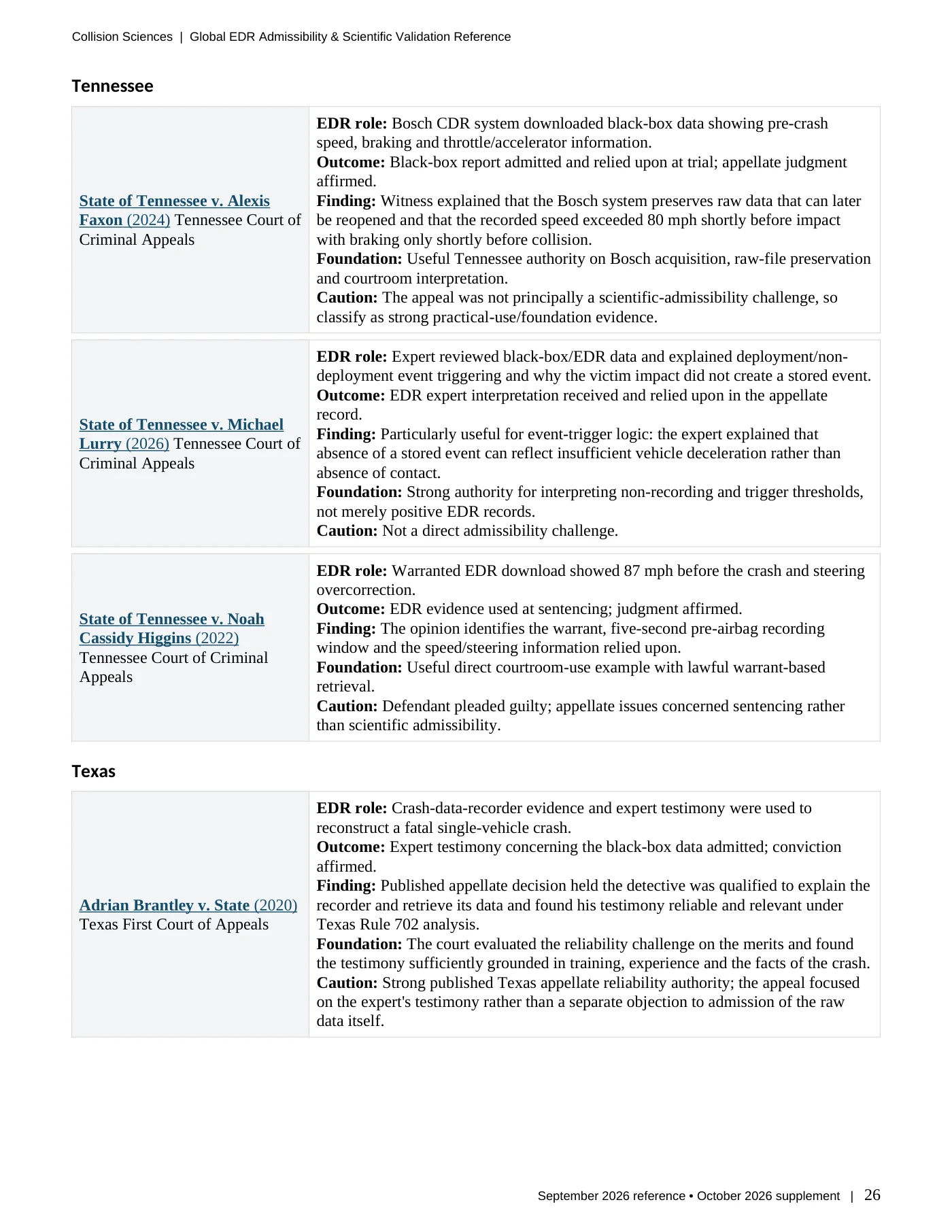
Tennessee
State of Tennessee v. Alexis Faxon (2024) Tennessee Court of Criminal Appeals EDR role: Bosch CDR system downloaded black-box data showing pre-crash speed, braking and throttle/accelerator information. Outcome: Black-box report admitted and relied upon at trial; appellate judgment affirmed. Finding: Witness explained that the Bosch system preserves raw data that can later be reopened and that the recorded speed exceeded 80 mph shortly before impact with braking only shortly before collision. Foundation: Useful Tennessee authority on Bosch acquisition, raw-file preservation and courtroom interpretation. Caution: The appeal was not principally a scientific-admissibility challenge, so classify as strong practical-use/foundation evidence.
State of Tennessee v. Michael Lurry (2026) Tennessee Court of Criminal Appeals EDR role: Expert reviewed black-box/EDR data and explained deployment/non-deployment event triggering and why the victim impact did not create a stored event. Outcome: EDR expert interpretation received and relied upon in the appellate record. Finding: Particularly useful for event-trigger logic: the expert explained that absence of a stored event can reflect insufficient vehicle deceleration rather than absence of contact. Foundation: Strong authority for interpreting non-recording and trigger thresholds, not merely positive EDR records. Caution: Not a direct admissibility challenge.
State of Tennessee v. Noah Cassidy higgins (2022) Tennessee Court of Criminal Appeals EDR role: Warranted EDR download showed 87 mph before the crash and steering overcorrection. Outcome: EDR evidence used at sentencing; judgment affirmed. Finding: The opinion identifies the warrant, five-second pre-airbag recording window and the speed/steering information relied upon. Foundation: Useful direct courtroom-use example with lawful warrant-based retrieval. Caution: Defendant pleaded guilty; appellate issues concerned sentencing rather than scientific admissibility.
Texas
Adrian Brantley v. State (2020) Texas First Court of Appeals EDR role: Crash-data-recorder evidence and expert testimony were used to reconstruct a fatal single-vehicle crash. Outcome: Expert testimony concerning the black-box data admitted; conviction affirmed. Finding: Published appellate decision held the detective was qualified to explain the recorder and retrieve its data and found his testimony reliable and relevant under Texas Rule 702 analysis. Foundation: The court evaluated the reliability challenge on the merits and found the testimony sufficiently grounded in training, experience and the facts of the crash. Caution: Strong published Texas appellate reliability authority; the appeal focused on the expert's testimony rather than a separate objection to admission of the raw data itself.
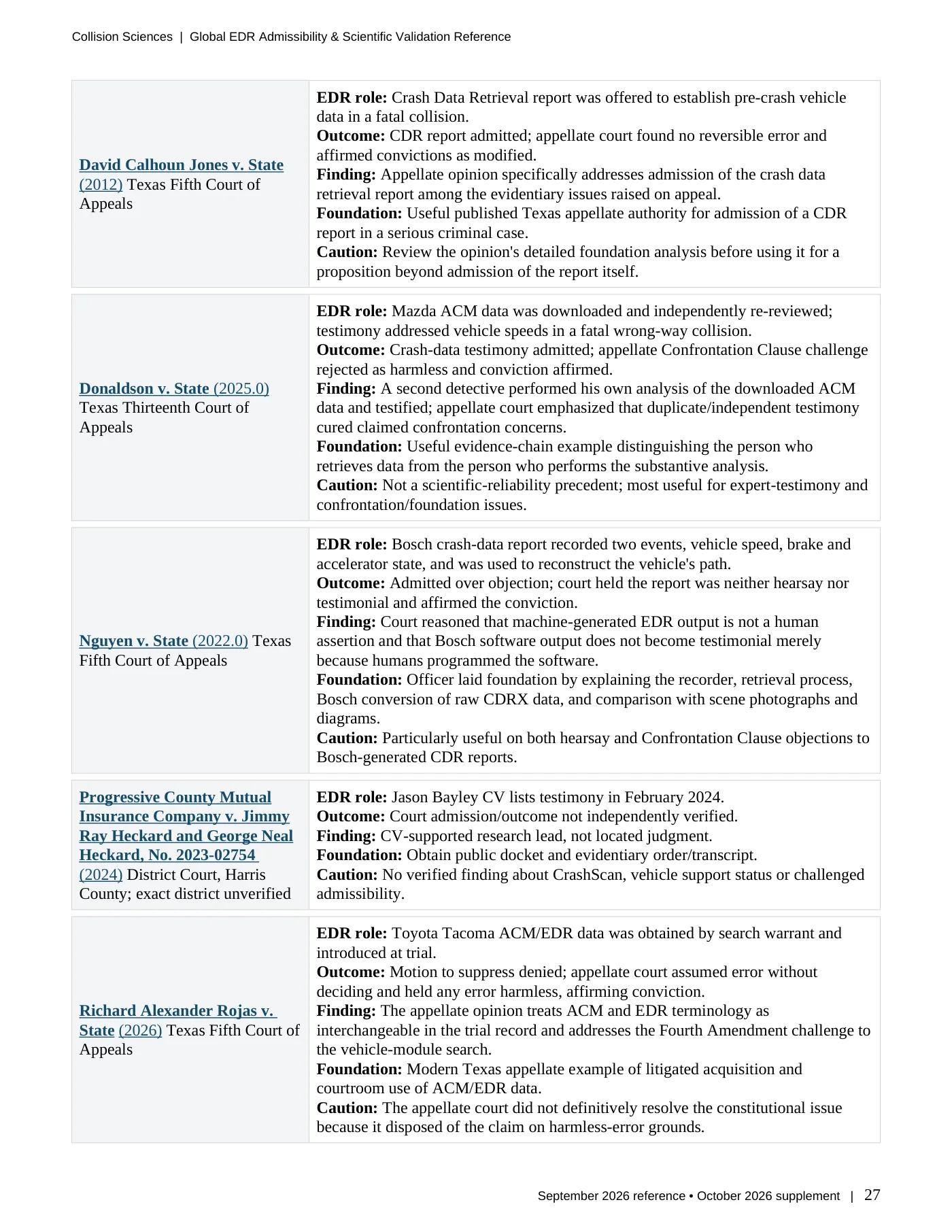
David Calhoun Jones v. State (2012) Texas Fifth Court of Appeals EDR role: Crash Data Retrieval report was offered to establish pre-crash vehicle data in a fatal collision. Outcome: CDR report admitted; appellate court found no reversible error and affirmed convictions as modified. Finding: Appellate opinion specifically addresses admission of the crash data retrieval report among the evidentiary issues raised on appeal. Foundation: Useful published Texas appellate authority for admission of a CDR report in a serious criminal case. Caution: Review the opinion's detailed foundation analysis before using it for a proposition beyond admission of the report itself.
Donaldson v. State (2025.0) Texas Thirteenth Court of Appeals EDR role: Mazda ACM data was downloaded and independently re-reviewed; testimony addressed vehicle speeds in a fatal wrong-way collision. Outcome: Crash-data testimony admitted; appellate Confrontation Clause challenge rejected as harmless and conviction affirmed. Finding: A second detective performed his own analysis of the downloaded ACM data and testified; appellate court emphasized that duplicate/independent testimony cured claimed confrontation concerns. Foundation: Useful evidence-chain example distinguishing the person who retrieves data from the person who performs the substantive analysis. Caution: Not a scientific-reliability precedent; most useful for expert-testimony and confrontation/foundation issues.
Nguyen v. State (2022.0) Texas Fifth Court of Appeals EDR role: Bosch crash-data report recorded two events, vehicle speed, brake and accelerator state, and was used to reconstruct the vehicle's path. Outcome: Admitted over objection; court held the report was neither hearsay nor testimonial and affirmed the conviction. Finding: Court reasoned that machine-generated EDR output is not a human assertion and that Bosch software output does not become testimonial merely because humans programmed the software. Foundation: Officer laid foundation by explaining the recorder, retrieval process, Bosch conversion of raw CDRX data, and comparison with scene photographs and diagrams. Caution: Particularly useful on both hearsay and Confrontation Clause objections to Bosch-generated CDR reports.
Progressive county mutual Insurance Company v. Jimmy Ray heckard and george neal heckard, no. 2023-02754 (2024) District Court, Harris County; exact district unverified EDR role: Jason Bayley CV lists testimony in February 2024. Outcome: Court admission/outcome not independently verified. Finding: CV-supported research lead, not located judgment. Foundation: Obtain public docket and evidentiary order/transcript. Caution: No verified finding about CrashScan, vehicle support status or challenged admissibility.
Richard alexander rojas v.
State(2026) Texas Fifth Court of Appeals EDR role: Toyota Tacoma ACM/EDR data was obtained by search warrant and introduced at trial. Outcome: Motion to suppress denied; appellate court assumed error without deciding and held any error harmless, affirming conviction. Finding: The appellate opinion treats ACM and EDR terminology as interchangeable in the trial record and addresses the Fourth Amendment challenge to the vehicle-module search. Foundation: Modern Texas appellate example of litigated acquisition and courtroom use of ACM/EDR data. Caution: The appellate court did not definitively resolve the constitutional issue because it disposed of the claim on harmless-error grounds.
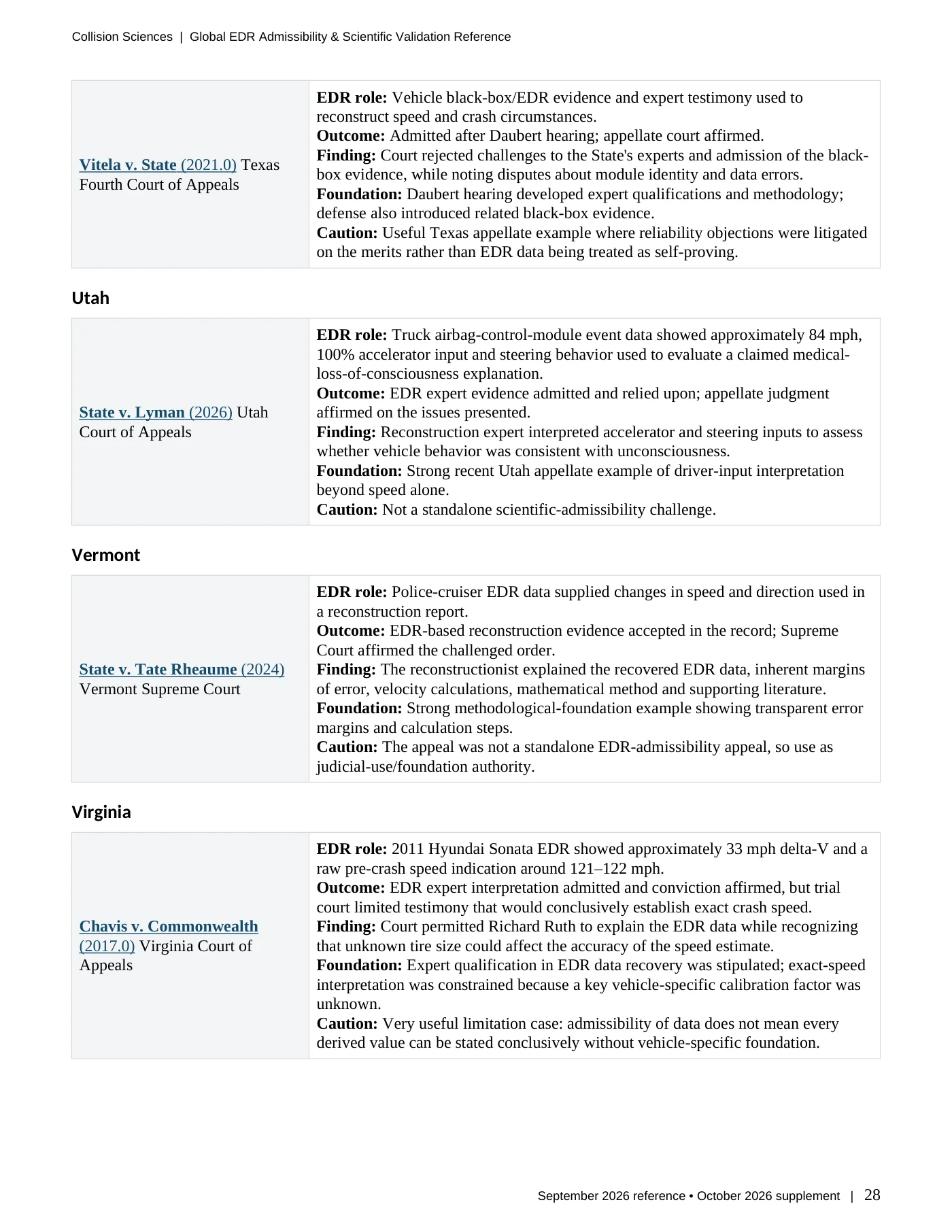
Vitela v. State (2021.0) Texas Fourth Court of Appeals EDR role: Vehicle black-box/EDR evidence and expert testimony used to reconstruct speed and crash circumstances. Outcome: Admitted after Daubert hearing; appellate court affirmed. Finding: Court rejected challenges to the State's experts and admission of the black-box evidence, while noting disputes about module identity and data errors. Foundation: Daubert hearing developed expert qualifications and methodology; defense also introduced related black-box evidence. Caution: Useful Texas appellate example where reliability objections were litigated on the merits rather than EDR data being treated as self-proving.
Utah
State v. Lyman (2026) Utah Court of Appeals EDR role: Truck airbag-control-module event data showed approximately 84 mph, 100% accelerator input and steering behavior used to evaluate a claimed medical-loss-of-consciousness explanation. Outcome: EDR expert evidence admitted and relied upon; appellate judgment affirmed on the issues presented. Finding: Reconstruction expert interpreted accelerator and steering inputs to assess whether vehicle behavior was consistent with unconsciousness. Foundation: Strong recent Utah appellate example of driver-input interpretation beyond speed alone. Caution: Not a standalone scientific-admissibility challenge.
Vermont
State v. Tate Rheaume (2024) Vermont Supreme Court EDR role: Police-cruiser EDR data supplied changes in speed and direction used in a reconstruction report. Outcome: EDR-based reconstruction evidence accepted in the record; Supreme Court affirmed the challenged order. Finding: The reconstructionist explained the recovered EDR data, inherent margins of error, velocity calculations, mathematical method and supporting literature. Foundation: Strong methodological-foundation example showing transparent error margins and calculation steps. Caution: The appeal was not a standalone EDR-admissibility appeal, so use as judicial-use/foundation authority.
Virginia
Chavis v. Commonwealth (2017.0) Virginia Court of Appeals EDR role: 2011 Hyundai Sonata EDR showed approximately 33 mph delta-V and a raw pre-crash speed indication around 121–122 mph. Outcome: EDR expert interpretation admitted and conviction affirmed, but trial court limited testimony that would conclusively establish exact crash speed. Finding: Court permitted Richard Ruth to explain the EDR data while recognizing that unknown tire size could affect the accuracy of the speed estimate. Foundation: Expert qualification in EDR data recovery was stipulated; exact-speed interpretation was constrained because a key vehicle-specific calibration factor was unknown. Caution: Very useful limitation case: admissibility of data does not mean every derived value can be stated conclusively without vehicle-specific foundation.
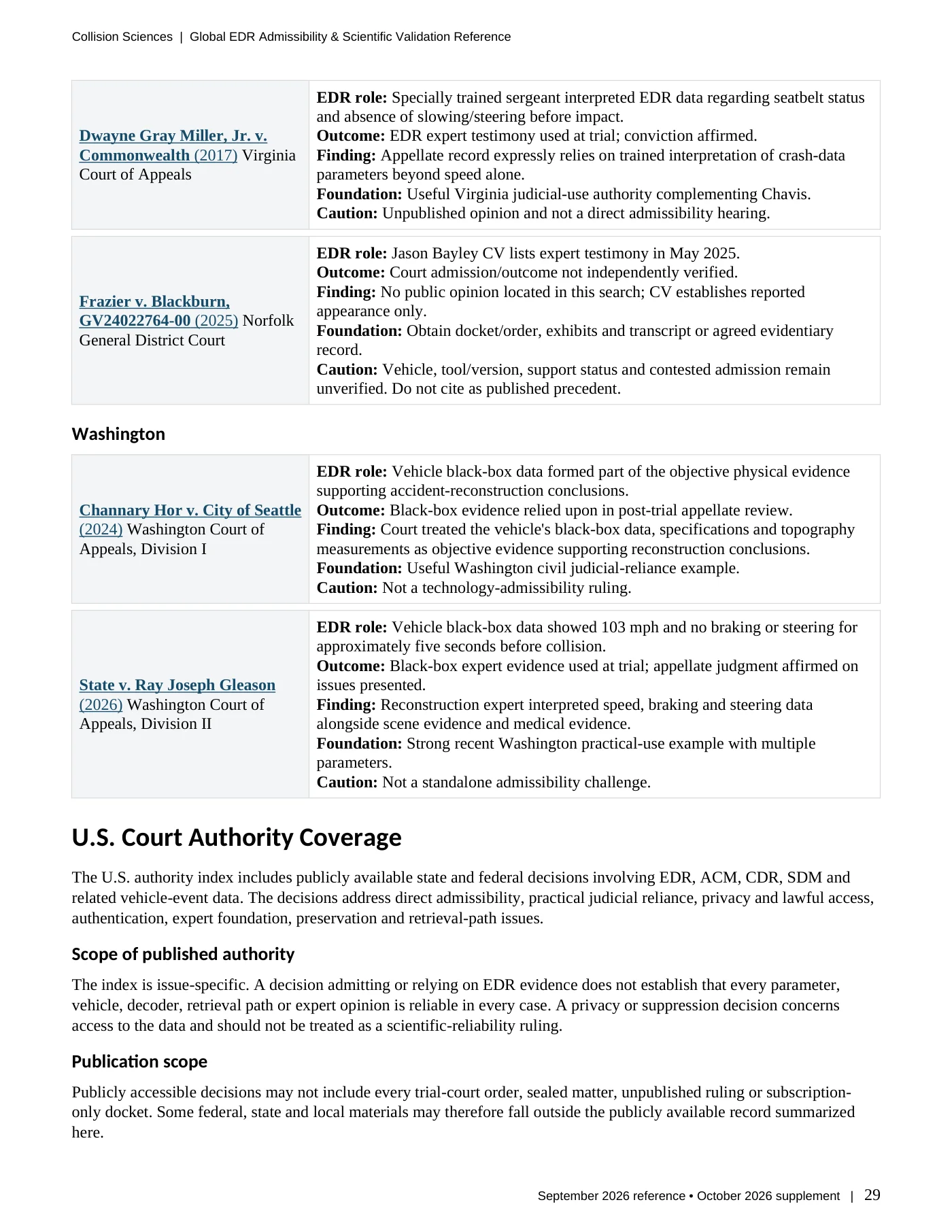
Dwayne gray miller, jr. V. Commonwealth (2017) Virginia Court of Appeals EDR role: Specially trained sergeant interpreted EDR data regarding seatbelt status and absence of slowing/steering before impact. Outcome: EDR expert testimony used at trial; conviction affirmed. Finding: Appellate record expressly relies on trained interpretation of crash-data parameters beyond speed alone. Foundation: Useful Virginia judicial-use authority complementing Chavis. Caution: Unpublished opinion and not a direct admissibility hearing.
Frazier v. Blackburn, Gv24022764-00 (2025) Norfolk General District Court EDR role: Jason Bayley CV lists expert testimony in May 2025. Outcome: Court admission/outcome not independently verified. Finding: No public opinion located in this search; CV establishes reported appearance only. Foundation: Obtain docket/order, exhibits and transcript or agreed evidentiary record. Caution: Vehicle, tool/version, support status and contested admission remain unverified. Do not cite as published precedent.
Washington
Channary Hor v. City of Seattle (2024) Washington Court of Appeals, Division I EDR role: Vehicle black-box data formed part of the objective physical evidence supporting accident-reconstruction conclusions. Outcome: Black-box evidence relied upon in post-trial appellate review. Finding: Court treated the vehicle's black-box data, specifications and topography measurements as objective evidence supporting reconstruction conclusions. Foundation: Useful Washington civil judicial-reliance example. Caution: Not a technology-admissibility ruling.
State v. Ray Joseph Gleason (2026) Washington Court of Appeals, Division II EDR role: Vehicle black-box data showed 103 mph and no braking or steering for approximately five seconds before collision. Outcome: Black-box expert evidence used at trial; appellate judgment affirmed on issues presented. Finding: Reconstruction expert interpreted speed, braking and steering data alongside scene evidence and medical evidence. Foundation: Strong recent Washington practical-use example with multiple parameters. Caution: Not a standalone admissibility challenge.
14 / In this resource
U.S. court authority coverage
The U.S. authority index includes publicly available state and federal decisions involving EDR, ACM, CDR, SDM and related vehicle-event data. The decisions address direct admissibility, practical judicial reliance, privacy and lawful access, authentication, expert foundation, preservation and retrieval-path issues.
Scope of published authority
The index is issue-specific. A decision admitting or relying on EDR evidence does not establish that every parameter, vehicle, decoder, retrieval path or expert opinion is reliable in every case. A privacy or suppression decision concerns access to the data and should not be treated as a scientific-reliability ruling.
Publication scope
Publicly accessible decisions may not include every trial-court order, sealed matter, unpublished ruling or subscription-only docket. Some federal, state and local materials may therefore fall outside the publicly available record summarized here.
Use note
The cited authorities should be read in full and considered with the governing jurisdiction's current evidence law, procedural posture and later treatment. This reference is updated regularly to reflect newly published U.S. authorities and technical developments.
15 / In this resource
Global jurisdictional evidence overview
Published EDR-related court and tribunal authorities have been identified across multiple legal systems. The table below summarizes the principal public sources and the type of documented authority currently available.
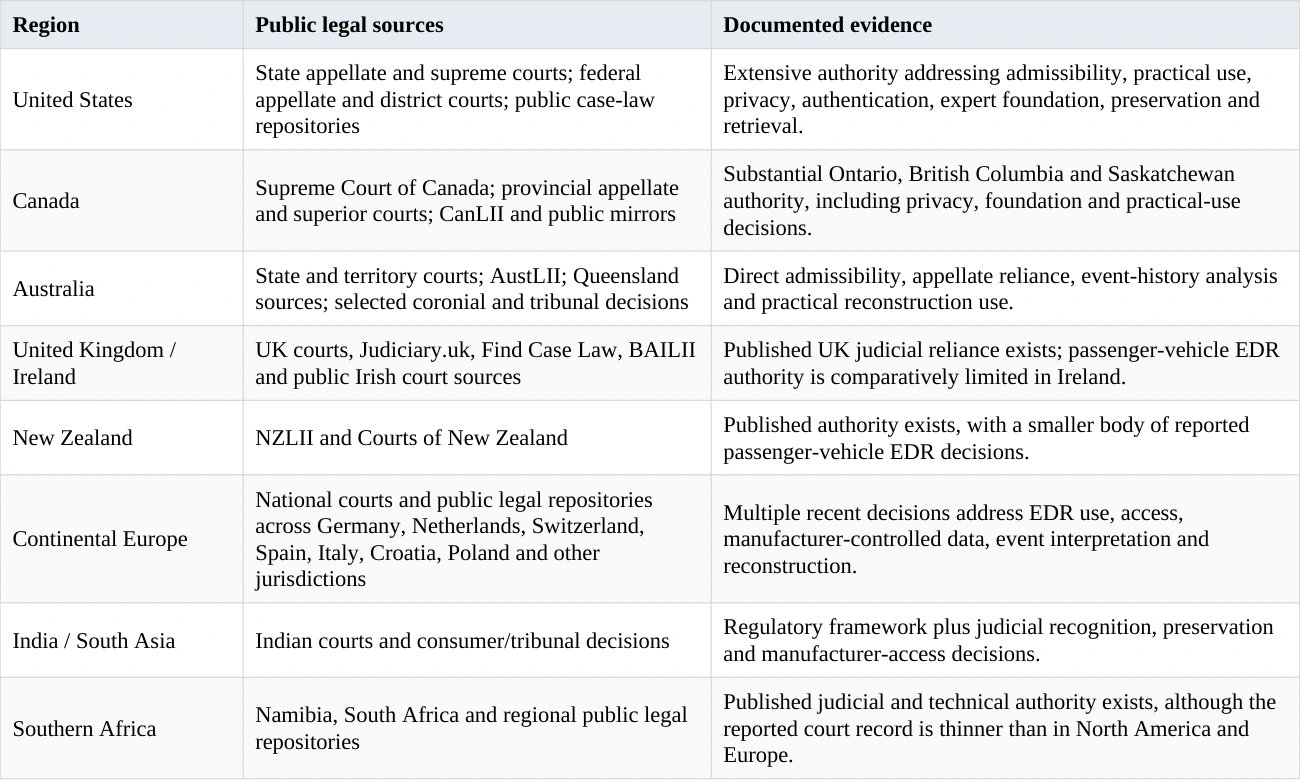
Read table as text
| Region | Public legal sources | Documented evidence |
| United States | State appellate and supreme courts; federal appellate and district courts; public case-law repositories | Extensive authority addressing admissibility, practical use, privacy, authentication, expert foundation, preservation and retrieval. |
| Canada | Supreme Court of Canada; provincial appellate and superior courts; CanLII and public mirrors | Substantial Ontario, British Columbia and Saskatchewan authority, including privacy, foundation and practical-use decisions. |
| Australia | State and territory courts; AustLII; Queensland sources; selected coronial and tribunal decisions | Direct admissibility, appellate reliance, event-history analysis and practical reconstruction use. |
| United Kingdom / Ireland | UK courts, Judiciary.uk, Find Case Law, BAILII and public Irish court sources | Published UK judicial reliance exists; passenger-vehicle EDR authority is comparatively limited in Ireland. |
| New Zealand | NZLII and Courts of New Zealand | Published authority exists, with a smaller body of reported passenger-vehicle EDR decisions. |
| Continental Europe | National courts and public legal repositories across Germany, Netherlands, Switzerland, Spain, Italy, Croatia, Poland and other jurisdictions | Multiple recent decisions address EDR use, access, manufacturer-controlled data, event interpretation and reconstruction. |
| India / South Asia | Indian courts and consumer/tribunal decisions | Regulatory framework plus judicial recognition, preservation and manufacturer-access decisions. |
| Southern Africa | Namibia, South Africa and regional public legal repositories | Published judicial and technical authority exists, although the reported court record is thinner than in North America and Europe. |
Scope note. Publicly available decisions do not necessarily include sealed matters, unpublished trial orders, subscription-only dockets or decisions that are not digitally indexed. Absence of a listed authority should not be interpreted as proof that no relevant decision exists. This reference is updated regularly to reflect newly published authorities and technical developments.
Global jurisdictional evidence overview
Published EDR-related court and tribunal authorities have been identified across multiple legal systems. The table below summarizes additional regional public sources and the type of documented authority available.
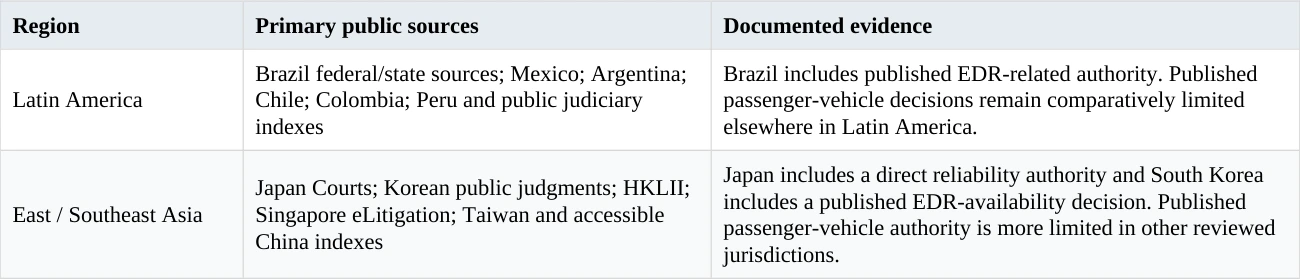
Read table as text
| Region | Primary public sources | Documented evidence |
| Latin America | Brazil federal/state sources; Mexico; Argentina; Chile; Colombia; Peru and public judiciary indexes | Brazil includes published EDR-related authority. Published passenger-vehicle decisions remain comparatively limited elsewhere in Latin America. |
| East / Southeast Asia | Japan Courts; Korean public judgments; HKLII; Singapore eLitigation; Taiwan and accessible China indexes | Japan includes a direct reliability authority and South Korea includes a published EDR-availability decision. Published passenger-vehicle authority is more limited in other reviewed jurisdictions. |

Read table as text
| Region | Primary public sources | Documented evidence |
| Other regions | Middle East, Caribbean, Central Asia and Pacific public legal sources | Published passenger-vehicle EDR court authority remains limited in the reviewed public sources. |
Scope note. Public legal sources do not necessarily include sealed matters, unpublished trial orders, subscription-only dockets or decisions that are not digitally indexed. Absence of a listed authority should not be interpreted as proof that no relevant decision exists.
16 / In this resource
Selected global court and tribunal authorities
Canada
R. v. Fedan (BCCA, 2016) No reasonable expectation of privacy in impersonal SDM data after lawful vehicle seizure; major appellate access authority. Source
Canada
R. v. Monteath (ONCJ, 2026) Modern GM CDR use: eight seconds of pre-crash speed/driver inputs; court relied on approximately 156 km/h evidence. Source
Canada
R. v. Anstie (ONSC, 2019) Rental Nissan CDR data; no reasonable expectation of privacy in limited mechanical crash data. Source
Australia
R v Lock [2025] SADC 110 Subaru EDR with speed, accelerator, brake, RPM, ABS and steering; overlapping event records interpreted by qualified expert. Source
Australia
De Pledge [2021] WASCA 1 Appellate reliance on LandCruiser EDR plus dashcam to establish slowing and impact speed. Source
Australia
Issa [2016] NSWSC 1320 Corolla EDR removed and analyzed; court discussed trigger logic and retention of multiple impacts. Source
Japan
Tokyo High Court, 14 Dec. 2022 Direct reliability discussion: multiple triggers, accelerator/ABS, readout procedure, tamper resistance and corroboration; accuracy challenge rejected. Source
South Korea
Seoul Administrative Court 2017Gudam59478 Vehicle lacked EDR in ACU; court treated absence as preventing precise event-data analysis and as an investigative limitation. Source
Spain
AP Lleida, Penal 61/2024 Toyota Hilux EDR speed/brake/steering evidence relied upon; police analysis treated as objective and corroborated. Source
Spain
AP Granada, Civil 250/2023 EDR + Vehicle Control History used for detailed automated-data reconstruction; source types kept distinct. Source
Switzerland
Bundesgericht 7B_711/2024 Swiss Federal Supreme Court upheld search/release of EDR and vehicle-system data; limited privacy content weighed against prosecution interest. Source
Switzerland
HG210212-O (Zurich, 2023) Detailed distinction between EDR and diagnostic/fault-memory data; important negative-retrieval and taxonomy authority. Source
Croatia
Pp-5506/2023-15 Court-ordered EDR preservation/extraction and university expert analysis used in traffic proceeding. Source
Poland
SO Rzeszow I C 1480/19 SRS/EDR speed, brake, steering and ESP data considered; court rejected overextended fraud inference after full expert review. Source
Germany
LG Ellwangen 1 S 70/23 Tesla Model S event data used by court expert to localize collision and analyze speeds. Source
17 / In this resource
Evidence categories across jurisdictions
Direct reliability / admissibility
Authorities such as R v Dobrenov, Bachman, Shabazz, Zimmermann and the Tokyo High Court decision directly address reliability or admissibility. These are stronger for admissibility propositions than decisions that merely recite EDR evidence.
Practical judicial reliance
Courts in the United States, Canada, Australia, Europe and the United Kingdom routinely integrate EDR with physical reconstruction, video, scene evidence and expert testimony.
Privacy / lawful access
Canadian, U.S. and Swiss decisions address whether vehicle data may lawfully be obtained or used. Access doctrine should be kept separate from scientific validation.
Event logic / multiple records
Cases including Issa and R v Lock illustrate the importance of trigger logic, locked and unlocked events, overlapping records, overwrite behavior and event-to-collision mapping.
Negative / absence evidence
South Korean and Swiss decisions illustrate that absence of an EDR, an unsupported architecture or the absence of a retrievable record may itself affect the evidentiary analysis.
Preservation / failure to retrieve
Published cases address lost modules, missed retrieval opportunities, unavailable keys, physical module removal and spoliation. Preservation can be as important as later interpretation.
Adjacent module evidence
SRS, ACM and other control-module evidence may be relevant even where the record does not establish a standardized EDR output. These sources should be identified precisely rather than treated as interchangeable.
18 / In this resource
Jurisdictions with limited published authority
Published passenger-vehicle EDR decisions remain comparatively limited in several jurisdictions, including parts of Southern Africa, Latin America, East and Southeast Asia, the Middle East, the Caribbean, Central Asia and the Pacific. France, Portugal and several Scandinavian jurisdictions have substantial regulatory or technical material, while published court authority remains less extensive.
Publication scope
Commercial legal databases, sealed matters, non-indexed trial orders, scanned non-OCR decisions and inaccessible local dockets may contain additional authority. This reference should therefore be read as a curated public reference rather than an exhaustive index of every judicial decision.
19 / In this resource
Evidence by vehicle OEM
This section combines scientific and judicial evidence by manufacturer. Exact vehicle, module generation, retrieval path and parameter should still be confirmed for case-specific use.
| OEM | Scientific evidence | Judicial evidence | Best-supported parameters | Key caution |
|---|---|---|---|---|
| General Motors | GM speed validation; Malibu underride delta-V; modern SDM50/VIP architecture studies. | Bachman v. General Motors Corp.; Batiste; People v. Diaz. | Speed, longitudinal delta-V, brake/accelerator, restraint/system states. | Long crash pulses can truncate delta-V; confirm architecture. |
| Ford / Lincoln | Ford Flex / Autoliv RC6 controlled validation; multi-OEM frontal and side studies. | ECLI:NL:RBDHA:2025:17204; Wheaton v. Bradford. | Speed, brake timing, steering/yaw, delta-V. | Confirm RC6 or equivalent architecture; sign conventions matter. |
| Toyota / Lexus | Generation-specific Corolla/Camry/Prius/Yaris work; Highlander high-severity validation. | Landgericht Mannheim 9 O 164/24; Jorge Ruiz v. State; other Toyota authorities. | Speed, delta-V, trigger sensitivity, restraints, braking. | Generation-specific trigger behavior and sensor bias can matter. |
| Hyundai / Kia / Genesis | 54-module NCAP translation study; Genesis Coupe instrumented test; modern Mobis/Autoliv studies. | Chavis v. Commonwealth; ECLI:NL:RBOVE:2025:6960; AFCA determination; Paul v. Western Express. | Speed, delta-V, brake, accelerator, steering, RPM, translation. | One translated throttle field was shown unreliable; tool/support path must be established. |
| Stellantis / Chrysler | Chrysler ACM reliability testing; multi-OEM validation includes Chrysler. | Same-OEM reported court authority is comparatively limited. | Pre-crash speed, brake, throttle, delta-V, restraints. | Do not imply same-OEM court validation where none is identified. |
| Volkswagen Group | Audi A6 event/timing research; Golf R source-signal / speed-sampling validation. | ECLI:NL:RBOVE:2025:3404; ECLI:NL:RBOVE:2025:6960. | Speed, event timing, braking, steering, ABS, delta-V. | Recorded speed can reflect wheel-derived/instrument-panel signal and offset rather than ground speed. |
| Mercedes-Benz | Technical CrashScan/XENTRY cross-verification plus broader science. | ECLI:NL:RBGEL:2025:11623. | Speed, accelerator, brake, event/system data. | Distinguish peer-reviewed literature from author-posted technical work. |
| BMW / MINI | General parameter literature; direct BMW-specific controlled science remains limited. | Rex v Justin Clarke-Samuel; Swiss vehicle-data search cases. | Speed; vehicle-system/event data. | Do not claim BMW-specific numerical error bounds without direct validation. |
| Nissan / Infiniti | General parameter science; OEM-specific science is comparatively thinner. | Jason Turner v. Commonwealth; Nissan North America v. Dunham Trust. | Event data, speed, restraint/ACU architecture. | Manufacturer-assisted retrieval is not the same as independent decoder validation. |
| Honda / Acura | Honda vehicles appear in major multi-OEM frontal and side validation. | Ben-Margi v. Paiva and related support/preservation material. | Speed, delta-V, restraint/deployment. | Non-retrieval does not prove no stored data. |
| Mazda | Mazda appears in strong multi-OEM validation. | Donaldson v. State. | Speed, delta-V, restraint/deployment. | Donaldson is useful for foundation/confrontation, not scientific validation. |
| Subaru | General parameter science; direct Subaru-specific controlled validation remains a gap. | R v Lock [2025] SADC 110. | Speed, accelerator, brake, RPM, ABS, steering, event ordering. | Lock is strong practical use, but largely uncontested technical evidence. |
| Tesla | General parameter science; independent Tesla-specific validation is not yet strong in the indexed vehicle table. | R v Dobrenov; LG Ellwangen 1 S 70/23. | Speed, acceleration, event data. | Do not infer standard EDR architecture or regulatory applicability solely from brand/model. |
| Volvo / Polestar | Volvo included in major multi-manufacturer frontal validation. | Current same-OEM court authority is limited. | Speed, longitudinal delta-V, belt/deployment. | Identify exact tested model/architecture before elevating beyond general support. |
20 / In this resource
Evidence by parameter
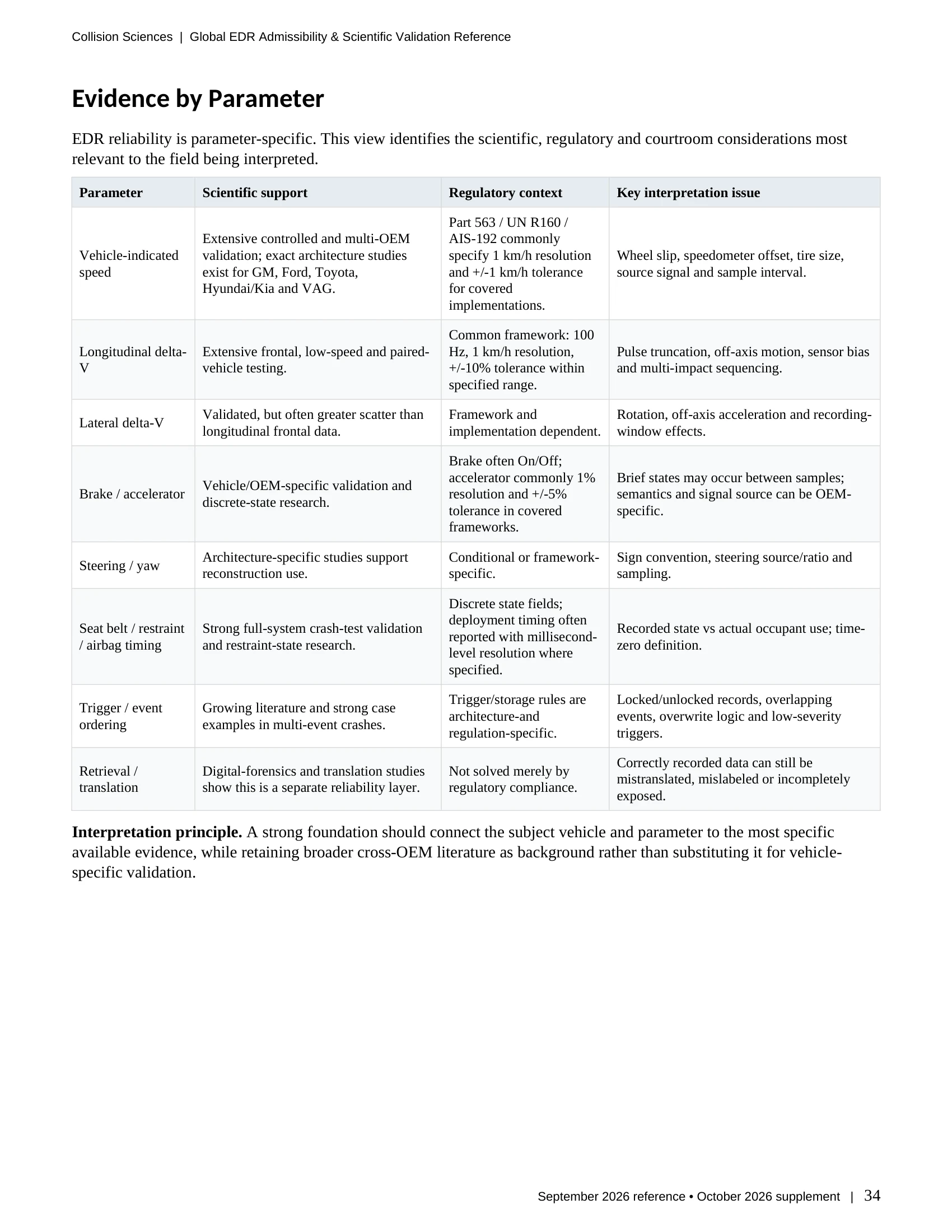
Read source text
Collision Sciences  | Global EDR Admissibility & Scientific Validation Reference


Evidence by Parameter

EDR reliability is parameter-specific. This view identifies the scientific, regulatory and courtroom considerations most
relevant to the field being interpreted.

 Parameter           Scientific support                     Regulatory context       Key interpretation issue

                                                                   Part 563 / UN R160 /
                     Extensive controlled and multi-OEM      AIS-192 commonly
 Vehicle-indicated    validation; exact architecture studies       specify 1 km/h resolution   Wheel slip, speedometer offset, tire size,
 speed                 exist for GM, Ford, Toyota,             and +/-1 km/h tolerance      source signal and sample interval.
                    Hyundai/Kia and VAG.                     for covered
                                                              implementations.

                                           Common framework: 100
 Longitudinal delta-   Extensive frontal, low-speed and paired-   Hz, 1 km/h resolution,       Pulse truncation, off-axis motion, sensor bias
 V                    vehicle testing.                       +/-10% tolerance within     and multi-impact sequencing.
                                                                   specified range.

                       Validated, but often greater scatter than    Framework and              Rotation, off-axis acceleration and recording-
 Lateral delta-V
                       longitudinal frontal data.                 implementation dependent.  window effects.

                                                         Brake often On/Off;
                                                                    accelerator commonly 1%    Brief states may occur between samples;
                     Vehicle/OEM-specific validation and
 Brake / accelerator                                               resolution and +/-5%        semantics and signal source can be OEM-
                         discrete-state research.
                                                                  tolerance in covered          specific.
                                                           frameworks.

                       Architecture-specific studies support       Conditional or framework-   Sign convention, steering source/ratio and
 Steering / yaw
                       reconstruction use.                           specific.                    sampling.

                                                                 Discrete state fields;
                                                         deployment timing often
 Seat belt / restraint   Strong full-system crash-test validation                             Recorded state vs actual occupant use; time-
                                                                 reported with millisecond-
  / airbag timing      and restraint-state research.                                           zero definition.
                                                                      level resolution where
                                                                      specified.

                                                                  Trigger/storage rules are     Locked/unlocked records, overlapping
 Trigger / event      Growing literature and strong case
                                                                  architecture-and              events, overwrite logic and low-severity
 ordering           examples in multi-event crashes.
                                                                      regulation-specific.            triggers.

                                                                                             Correctly recorded data can still be
 Retrieval /            Digital-forensics and translation studies   Not solved merely by
                                                                                                  mistranslated, mislabeled or incompletely
 translation         show this is a separate reliability layer.     regulatory compliance.
                                                                                        exposed.

Interpretation principle. A strong foundation should connect the subject vehicle and parameter to the most specific
available evidence, while retaining broader cross-OEM literature as background rather than substituting it for vehicle-
specific validation.


                                                                     September 2026 reference • October 2026 supplement   | 34
21 / In this resource
Regulatory performance mini-reference
Regulatory requirements establish standardized recording and output expectations. They do not establish the actual error in a particular crash and should be distinguished from empirical validation studies.
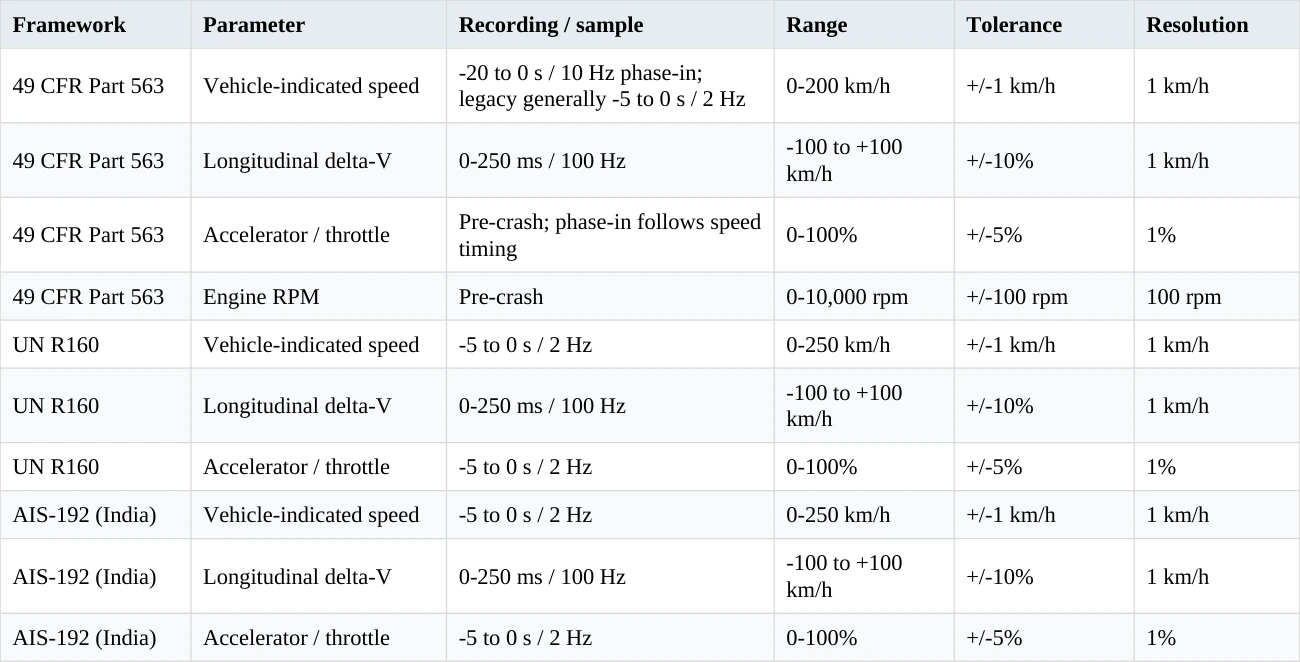
Read table as text
| Framework | Parameter | Recording / sample | Range | Tolerance | Resolution |
| 49 CFR Part 563 | Vehicle-indicated speed | -20 to 0 s / 10 Hz phase-in; legacy generally -5 to 0 s / 2 Hz | 0-200 km/h | +/-1 km/h | 1 km/h |
| 49 CFR Part 563 | Longitudinal delta-V | 0-250 ms / 100 Hz | -100 to +100 km/h | +/-10% | 1 km/h |
| 49 CFR Part 563 | Accelerator / throttle | Pre-crash; phase-in follows speed timing | 0-100% | +/-5% | 1% |
| 49 CFR Part 563 | Engine RPM | Pre-crash | 0-10,000 rpm | +/-100 rpm | 100 rpm |
| UN R160 | Vehicle-indicated speed | -5 to 0 s / 2 Hz | 0-250 km/h | +/-1 km/h | 1 km/h |
| UN R160 | Longitudinal delta-V | 0-250 ms / 100 Hz | -100 to +100 km/h | +/-10% | 1 km/h |
| UN R160 | Accelerator / throttle | -5 to 0 s / 2 Hz | 0-100% | +/-5% | 1% |
| AIS-192 (India) | Vehicle-indicated speed | -5 to 0 s / 2 Hz | 0-250 km/h | +/-1 km/h | 1 km/h |
| AIS-192 (India) | Longitudinal delta-V | 0-250 ms / 100 Hz | -100 to +100 km/h | +/-10% | 1 km/h |
| AIS-192 (India) | Accelerator / throttle | -5 to 0 s / 2 Hz | 0-100% | +/-5% | 1% |
Resolution is not accuracy. A 1 km/h resolution means the standardized reported value is quantized in 1 km/h increments. It does not mean every real-world event is accurate to +/-1 km/h. Regulatory tolerance and empirically measured error are separate concepts. Other frameworks. EU type-approval rules, China GB 39732-2020 and additional regulatory fields such as brake state, steering, RPM and airbag timing are also relevant. Numerical requirements should be verified against the authoritative text applicable to the subject vehicle.
22 / In this resource
Evidence type and best use
The same authority may be relevant for more than one reason, but its strongest proposition should be stated precisely. This table keeps judicial use, scientific validation and access/privacy decisions analytically distinct.
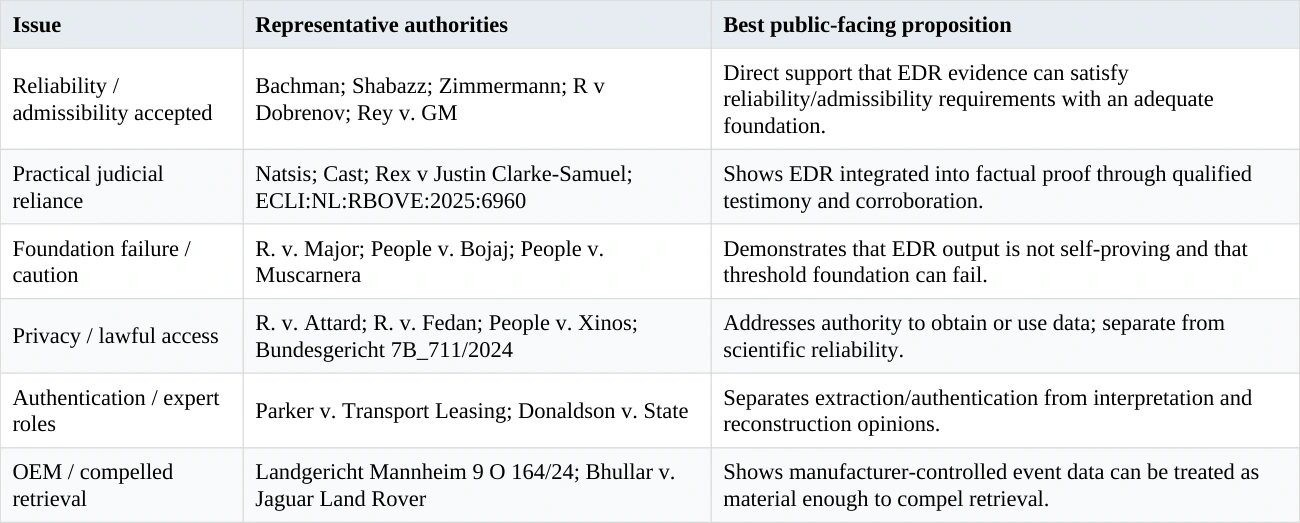
Read table as text
| Issue | Representative authorities | Best public-facing proposition |
| Reliability / admissibility accepted | Bachman; Shabazz; Zimmermann; R v Dobrenov; Rey v. GM | Direct support that EDR evidence can satisfy reliability/admissibility requirements with an adequate foundation. |
| Practical judicial reliance | Natsis; Cast; Rex v Justin Clarke-Samuel; ECLI:NL:RBOVE:2025:6960 | Shows EDR integrated into factual proof through qualified testimony and corroboration. |
| Foundation failure / caution | R. v. Major; People v. Bojaj; People v. Muscarnera | Demonstrates that EDR output is not self-proving and that threshold foundation can fail. |
| Privacy / lawful access | R. v. Attard; R. v. Fedan; People v. Xinos; Bundesgericht 7B_711/2024 | Addresses authority to obtain or use data; separate from scientific reliability. |
| Authentication / expert roles | Parker v. Transport Leasing; Donaldson v. State | Separates extraction/authentication from interpretation and reconstruction opinions. |
| OEM / compelled retrieval | Landgericht Mannheim 9 O 164/24; Bhullar v. Jaguar Land Rover | Shows manufacturer-controlled event data can be treated as material enough to compel retrieval. |

Read table as text
| Issue | Representative authorities | Best public-facing proposition |
| Preservation / spoliation | Pearl River County v. Bethea; Paul v. Western Express; Ben-Margi v. Paiva | Highlights lost modules, missed retrieval opportunities and destroyed evidence. |
| Vehicle-specific interpretation | Jorge Ruiz v. State; Chavis v. Commonwealth; State v. Lurry | Shows calibration, tire size, trigger logic and event identification can limit otherwise usable data. |
This reference is updated regularly to reflect newly published court authorities, scientific validation and regulatory developments.
23 / In this resource
Selected additional verified authorities
These public decisions and docket materials expand the jurisdictional examples in this reference. Each entry is classified narrowly: practical judicial use, foundation, limitations, or preservation. None is presented as universal validation of every vehicle, recorder architecture, parameter, or retrieval method.
Sandra Pepper v. Grant Harley Thelen
2026 | Court of Appeals of Georgia | Civil negligence appeal
Evidence: Ford F-150 EDR recorded 83.3-85 mph five seconds before impact, braking 1.1 seconds before impact, and a 15-degree right steering input 0.1 second before impact. Court use: The appellate court included the EDR chronology in its negligence analysis. Reversal concerned an erroneous sudden-emergency instruction, not the EDR evidence. Scope and limits: Practical judicial-use authority, not a scientific-admissibility ruling.
Decision or docket source
People of Michigan v. Robert Fitzgerald Coker
2026 | Michigan Court of Appeals | Criminal appeal
Evidence: A 2014 Buick LaCrosse CDR report recorded accelerator position and speed around impact; the Buick was about 1 mph before impact, 7 mph at impact, and accelerated after being struck. Court use: The court considered the Buick data with truck-engine data, video, scene evidence, and cell-phone evidence; convictions were affirmed. Scope and limits: Unpublished opinion. The passenger Buick, not the defendant's truck, supplied the EDR evidence.
Decision or docket source
Angel May Rider v. Jersey City Transfer, Inc., et al.
2026 | Superior Court of New Jersey, Appellate Division | Civil negligence appeal Evidence: The plaintiff vehicle's black-box data showed approximately 62.1 mph five seconds before impact, rising to 64.3 mph about two seconds before impact, then falling from 60.9 to 43 mph in the final second. Court use: The court recited the speed chronology in evaluating competing negligence theories; the judgment and jury verdict were affirmed. Scope and limits: Unpublished opinion under New Jersey Rule 1:36-3; vehicle make and model were not identified in the EDR discussion.
Decision or docket source
ECLI:NL:RBOBR:2025:5384
2025 | Rechtbank Oost-Brabant, Netherlands | Criminal traffic prosecution
Evidence: Volkswagen Polo EDR data recorded approximately 207-209 km/h five seconds before the crash on a road limited to 100 km/h; the airbag module was preserved as evidence. Court use: The court relied on the EDR speed data with eyewitness evidence in finding reckless driving and convicting the defendant. Scope and limits: Trial-level practical-use authority. Preserve the Polo, event, and module context before applying it to other VAG architectures.
Decision or docket source
ECLI:NL:RBNHO:2025:14068
2025 | Rechtbank Noord-Holland, Netherlands | Interim civil damages proceeding
Evidence: An EDR examination found no recorded impact event. The retained expert estimated longitudinal delta-v at no more than about 8 km/h, below the stated trigger threshold. Court use: The court considered the EDR and impact analysis in rejecting a severe-impact characterization and denied interim compensation on the record before it. Scope and limits: A non-recorded event is not proof that no collision occurred. The threshold conclusion was expert interpretation, not a controlled validation study.
Decision or docket source
Commonwealth v. Khalif T. Moore
2026 | Pennsylvania Superior Court | Criminal appeal
Evidence: CDR data recorded 59-64 mph over the final five seconds, 100% throttle at -4 seconds, braking beginning at -2 seconds, and about 46-57 mph at impact. Court use: The court's factual record integrated the data with video, skid marks, and physical evidence; convictions were affirmed. Scope and limits: Non-precedential and not a direct reliability ruling; no OEM, model, or retrieval tool should be inferred.
Decision or docket source
Michelle Ojeda v. City of Grand Prairie
2026 | Texas Fifth Court of Appeals | Civil immunity appeal
Evidence: An ambulance EDR showed slowing from 33.3 mph at -5 seconds to 16.8 mph at impact; expert testimony confirmed a brief accelerator touch did not measurably increase speed. Court use: The data informed the assessment of pre-impact conduct and alleged reckless disregard; judgment for the City was affirmed. Scope and limits: Emergency-vehicle practical-use authority; no scientific-validity issue was decided.
Decision or docket source
Landgericht Frankenthal (Pfalz), 4 O 221/23
2026 | Germany | Civil comparative-fault decision
Evidence: An expert used stored steering and speed data; the vehicle's black box recorded up to 131 km/h where the limit was 70 km/h and technically excluded the claimed unexplained swerving. Court use: The court attributed 80% of the priority-road driver's own loss to that driver because of the extreme speed; the decision was not yet final when published. Scope and limits: Official court release rather than the full judgment; vehicle and module details were not stated.
Decision or docket source
Corte di Cassazione Penale, Sez. IV, n. 29102/2026
2026 | Italy | Criminal cassation
Evidence: The defense challenged the extraction, interpretation, error margin, module integrity, completeness, and lack of speed-enforcement homologation for airbag-control-unit speed evidence. Court use: The cassation appeal was declared inadmissible; the lower courts' 100 km/h pre-crash finding remained supported by braking, loss of control, opposite-lane incursion, and impact violence. Scope and limits: Not an independent validation ruling. The public full-text reproduction is non-official; an official online copy was not located.
Decision or docket source
State of West Virginia v. Morgan C. Vandergrift
2020 | Supreme Court of Appeals of West Virginia | Criminal appeal
Evidence: ACM data recorded braking from 54 to 42 mph at -5 to -4 seconds, followed by slight acceleration and later brake-switch activity. Court use: State and defense reconstruction evidence integrated the electronic record with eyewitness and physical evidence; the second-degree murder conviction was affirmed. Scope and limits: No recorder-specific admissibility holding; vehicle, module, and retrieval-tool details were not established.
Decision or docket source
State v. Stephen A. Zadroga
2023 | Supreme Court of New Jersey | Criminal prosecution
Evidence: Mazda EDR history showed approximately 85-88 mph at -3 seconds, 68 mph at -1.5 seconds, and 43 mph at impact, considered with lane-position, eyewitness, and reconstruction evidence. Court use: The court held that aggravated-manslaughter and death-by-auto charges could proceed without intoxication evidence; the EDR remained part of the independent reckless-driving record. Scope and limits: The central holding concerns mistrial and double jeopardy, not EDR reliability. Exact Mazda architecture was not identified.
Decision or docket source
Commonwealth v. Kevin R. Peters
2026 | Supreme Court of Pennsylvania | Criminal appeal
Evidence: A Mazda SUV black box recorded 113 mph at -5 seconds, 83% throttle, 115 mph at -0.5 seconds, braking at most 0.4 seconds before impact, and an unbuckled seat belt. Court use: The recorder evidence was corroborated by video, witnesses, 911 calls, scene evidence, and toxicology; convictions were affirmed. Scope and limits: The expert's four-mph margin of error and half-second interval are case-specific testimony, not universal Mazda values.
Decision or docket source
People v. Stencel
2026 | New York appellate court | Criminal prosecution
Evidence: The crash physically destroyed the vehicle black box, preventing use of recorder data to establish precise pre-crash speed. Court use: Independent witness, scene, and expert evidence remained available; the appellate court reinstated the indictment on separate grand-jury issues. Scope and limits: Not spoliation and not an admissibility ruling. Absence of data after physical destruction is not substantive negative proof.
Decision or docket source
Cochlin v. State
2020 | Oklahoma Court of Criminal Appeals | Criminal appeal
Evidence: A Mercedes EDR showed 149 mph at -5 seconds, 96 mph at impact, no stop at a four-way stop, and braking beginning about three seconds before impact. Court use: The recorder evidence was considered with witness evidence and BAC; two second-degree depraved-mind murder convictions were affirmed. Scope and limits: No recorder-specific reliability holding. Model, year, module, and retrieval tool were not identified, so timing and values remain case-specific.
Decision or docket source
Cardenas v. Ori
2020 | U.S. District Court, Western District of Oklahoma | Civil collision litigation Evidence: The ACM of a 2002 Chevrolet Trailblazer recorded 69 mph at -2 seconds and 60 mph at -1 second before the vehicle underrode a stopped semi-trailer in dense fog. Court use: The verified RECAP order recited the speed history; partial summary judgment was granted to the truck defendants on punitive damages. Scope and limits: Not an admissibility ruling. The ACM evidence concerned the decedent vehicle and was not dispositive of punitive damages against the truck defendants.
Decision or docket source
Coverage note. This is an actively maintained public reference, not a representation that every sealed, unreported, subscription-only, non-indexed, or inaccessible proceeding has been discovered. Separate procedural stages within the same litigation are retained only when they supply a distinct citable decision.
24 / In this resource
Regulatory update
This supplement records a verified regulatory development added to the maintained worldwide EDR reference. It is a legal-framework update, not a new court authority or an empirical validation study.
India CMVR Rule 125H / AIS-220
2025 Final rule | India | N2/N3 haulage tractors
Requirement: The final Central Motor Vehicles (Fourth Amendment) Rules, 2025 require N2 and N3 haulage tractors, other than agricultural tractors, to be fitted with an event data recorder conforming to AIS-220, as amended. Effective date: The requirement applies to covered vehicles manufactured on or after April 1, 2027. The final notification is G.S.R. 819(E), dated November 3, 2025. Function stated in the rule: The EDR is to capture and store critical vehicle data for analysing operational events and enhancing safety monitoring. Scope and limits: This is a distinct Indian heavy-duty mandate. It should not be conflated with AIS-192 for M1 light vehicles or with UN R169. The official rule establishes scope and implementation date, but an authoritative public copy of the AIS-220 parameter tables was not located in this search pass. No numerical recording interval, sampling, range, resolution, or tolerance is inferred from AIS-192 or UN R169.
Official gazette notification (public mirror)
Coverage note. PACER, licensed databases, sealed or unreported matters, and non-indexed local-language sources remain coverage gaps. Worldwide completeness is not claimed.