
01 / In this resource
“I was going 5 mph” — what does the pre-crash table show?
02 / In this resource
Case question
How can objective pre-crash data test a reported low-speed account?
03 / In this resource
What the evidence showed
In a GMC Sierra matter, the pre-crash record showed vehicle speeds around 30–33 mph in the seconds before impact. That objective time series provided a direct comparison point for a much lower reported speed.
04 / In this resource
Practical takeaway
When speed is disputed, use the actual time-series table and preserve its sample timing, units and OEM limitations rather than relying on a single summary number.
05 / In this resource
Reading the exhibit
The excerpt contains five samples from -5 to -1 seconds. It does not provide a time-zero speed. Its derived columns are report calculations and should not be treated as independent recorded EDR parameters.
The source evidence exhibit is provided below.
06 / In this resource
Related resources
07 / In this resource
Related cases
08 / In this resource
Evidence exhibit
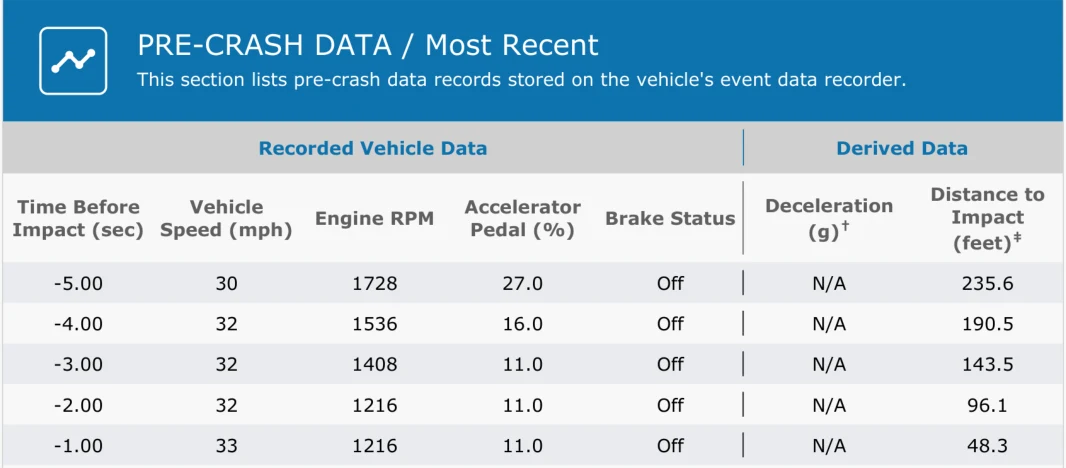
Complete Most Recent pre-crash table from the GMC Sierra report, with the recorded and derived data labels, units and five available sample rows preserved.